
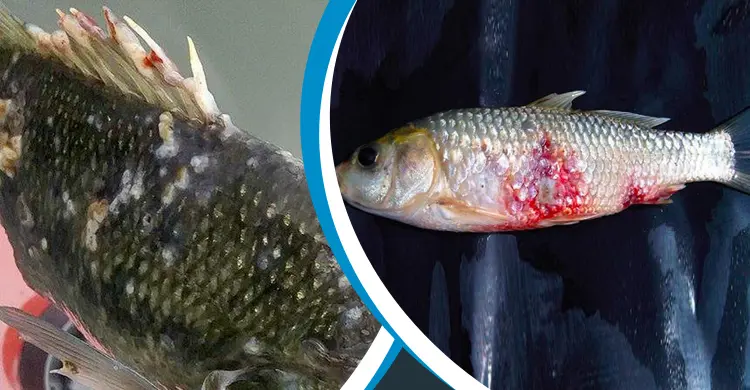
Fish, too, suffer from many kinds of disease, and these are a major problem in fish farming. Fish fall ill at many times of the year, and for various reasons disease is more common in fish farmed in closed waters than in open waters, so fish in ponds and tanks often suffer.
Ulcer disease
About 32 species of fish in Bangladesh are affected by ulcer disease, in which wounds spread widely over the body. Small red spots appear on the fish, and deep ulcers form where the spots are. The fish die quickly, the eyes may be damaged, the wounds smell foul and the fish stop feeding. Pressing a wound releases foul-smelling pus. The fish grow weak and swim unsteadily, and in severe cases the tail and fins rot and fall off.
In the country, shol, gajar, taki, puti, baim, koi, mrigal, carpio and other bottom-dwelling pond species are usually affected.
Most fish farmers know something about the disease. It can be recognised by red spots from wounds or sores on the body, which keep growing, mostly near the base of the tail, the back and the mouth. As soon as it is seen, the fish should be taken out of the pond quickly, dipped for five to 10 minutes in water with 100 grams of salt dissolved in 10 litres, and then released back into the pond.
Before the disease strikes, apply 1 kg of quicklime and 1 kg of salt per decimal of pond every year at the end of Ashwin or early Kartik. The fish will then usually stay free of ulcer disease in the coming winter.
Dropsy
Rohu-type carps, shing, magur and pangas are most affected by dropsy (swollen belly). The body turns pale, the belly swells as water collects in it and the fish swim unsteadily. Most of the time they float at the surface and gasp, and they can die very quickly. As a remedy, 1 kg of quicklime per decimal of water can be applied. Fishmeal must be used in the feed, enough natural food should be produced in the pond and the fish given a balanced diet regularly.
Fin and tail rot
Rohu-type carps, shing, magur and pangas are usually affected by fin and tail rot. At first the dorsal fin is affected, then gradually the other fins. Some fisheries scientists say the infection is caused by bacteria of the Aeromonas and Myxobacter groups. Low alkalinity and low pH in the water can also cause it. Affected fish should be taken out of the pond and dipped for 3 to 5 minutes in water containing 0.5 ppm potash. Fertilising the pond should be stopped for a time.
After the pathogens are destroyed, the number of stocked fish should be reduced. Applying 1 kg of quicklime per decimal at this stage is very important.
Fish lice
Lice affect almost all fish, especially rohu and sometimes catla, and outbreaks occur in summer. The lice spread over the whole body, suck the body fluids and leave the fish covered in wounds, so they may weaken and die. To treat it, dip the affected fish for a short time in a 2.5 percent salt solution. The lice will become sluggish and can then be removed from the body by hand or with tweezers.
Nutritional disorders
Fish sometimes suffer diseases caused by poor nutrition, and any fish farmed in ponds can be affected. A lack of vitamins A, D and K causes blindness and bent bones. A shortage of protein in the feed disrupts normal growth, and the fish soon fall prey to various diseases.
Feeding affected fish the specific vitamins and mineral salts they need, mixed with their food in the right amounts, can quickly improve their condition. Farming fish with modern technology can prevent disease in ponds to a large extent.
Source: Jagonews24. First published in Bengali on The Agro News.
Comments
(0)