
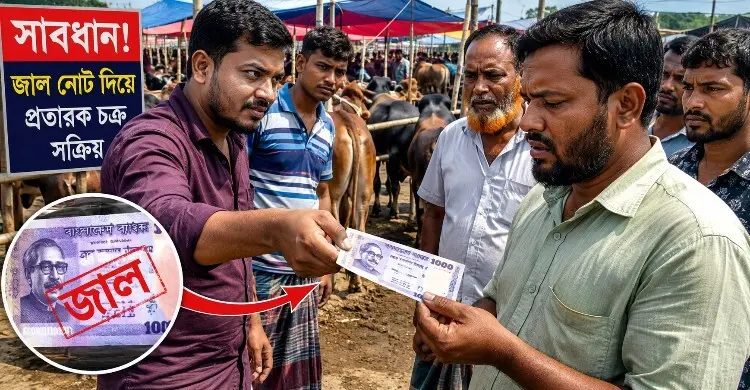
Fake note gangs become active whenever a big festival such as Eid comes round. About 70 per cent of the counterfeit notes made during the year are released onto the market around the two Eids. As cash transactions rise, both the demand for and the price of fake notes go up. Gangs even offer home delivery to win buyers and campaign widely on social media. This Eid too, they are targeting cattle markets, shopping malls, bus terminals and other places with heavy cash dealings.
The dealers are already active and are now so reckless that they advertise the sale of fake notes openly, offering home delivery for a fixed charge.
Dealers are often caught in continuing raids by law enforcers, yet the spread of fake notes has not stopped.
Cheaper to make, harder to spot
People involved say fraudsters exploit public carelessness as cash dealings rise around Eid. Crowds and fast transactions often make it impossible to tell real from fake, and high-quality fake notes can now be made very cheaply.
Where making 100 notes of Tk 500 or Tk 1,000 once cost Tk 4,000 to 7,000, it now costs about Tk 2,500. Fake notes worth Tk 1 lakh are currently selling for Tk 6,000 to Tk 10,000.
According to intelligence agencies, factories making fake notes are running secretly in the capital and elsewhere. Using ordinary printers, special paper, watermarks and gum, the notes are made so finely that ordinary people often find them hard to detect, and in some cases even ordinary detection machines miss them.
According to law enforcers, various gangs have again made cattle markets their main target, because large amounts of cash change hands there late into the night, and the crowds and rush mean many sellers get no chance to check the money.
Sources say fraudsters enter the markets posing as ordinary buyers, pass large sums in fake notes and leave quickly. Others break fake notes through small purchases to take real money. The gangs are most active late at night, when sellers are busy finishing their deals quickly.
Raids in Dhaka and Chattogram
RAB-3 arrested two people with equipment for making fake notes in a raid in the capital's Motijheel area. Acting on a tip-off, it raided a cyber net café on Kamalapur Bazar Road under Motijheel police station at about 11.20pm on 13 May and arrested Kamrul Islam and Nishad Hossain on charges of involvement in making fake notes.
Forty fake Tk 500 notes, worth Tk 20,000 in total, were recovered from them. A CPU, monitor, scanner, colour printer, keyboard, mouse, connecting cables and a ream of white paper used to make the notes were also seized.
Detective police recently raided Uttara and Gazipur on a tip-off and detained three members of a gang. At a briefing at the DMP Media Centre on 14 May, Additional Police Commissioner Shafiqul Islam of the Detective Branch said a member named Mujibur Rahman was first arrested in Uttara. Based on his information, a raid at a place in Tongi seized fake notes worth about Tk 34 lakh and a large quantity of equipment, and two more members, Dulal and Mamun, were detained.
He said the gang had made a large amount of fake notes ahead of Eid-ul-Azha and planned to spread them in various cattle markets in Dhaka.
On 16 May RAB arrested three people with fake notes worth Tk 1 lakh 13 thousand 600 in two separate raids in Chattogram city and district. RAB said they were making the notes to spread in cattle markets.
Secret printing presses
According to several intelligence and law enforcement sources, makeshift printing presses have been set up in houses, garages and residential buildings in the capital's Mirpur, Mohammadpur and Jatrabari, and in Savar, Ashulia, Gazipur, Narayanganj, Cumilla and Chattogram.
Sources say the methods have also modernised. The gangs no longer rely only on ordinary scanners or photocopiers but use high-quality printers, scanners, cutting devices and specialised printing equipment. Detectives have learned that some parts are brought into the country across the border from India, China and Dubai.
Special paper, materials resembling security thread, holograms, colour-changing ink and UV chemicals are also sourced from online markets and wholesale suppliers. Gang members use modern software to scan real notes and edit designs.
Detectives say the network runs in stages: one group handles design and printing, another transport and another marketing. Fake money is delivered across the country by inter-district courier services, buses and goods vehicles.
Detection booths at cattle markets
Bangladesh Bank recently sent a circular to the chief executives of all commercial banks. It says fake note detection booths must be set up at approved sacrificial animal markets across the country, staffed by an experienced bank cash officer and equipped with detection machines supplied by the bank. The central bank has ordered that the service be given free to traders and buyers without a break from the first day of the market until the night before Eid.
Banks have also been asked to send Bangladesh Bank the list of officers to be posted at the markets quickly. The central bank has ordered the service to reach cattle markets down to upazila level.
Bangladesh Bank said legal action must be taken against those involved if any fake note is detected. People involved believe the move will ensure safe and orderly transactions at the markets.
K N Roy Niyoti, additional superintendent of police (media) of RAB-4, told Jago News that RAB will take a tough stand on detecting fake notes at the Gabtoli cattle market. Anyone suspecting someone of spreading or dealing in fake notes is asked to report to RAB's mobile court at the market.
Shafiqul Islam, additional commissioner of the Dhaka Metropolitan Police's Detective Branch (DB), told Jago News that fake money dealers become active before any big festival. Although gang members are often arrested, many come out on bail and return to the same crime, so the gangs keep reappearing with new tactics.
He said the DB is carrying out intelligence operations ahead of the coming Eid to stop the gangs, and other law enforcers are also active. Various police units are already working to identify gang members, and the DB's cyber unit has stepped up monitoring of social media and online activity.
Source: Jagonews24. First published in Bengali on The Agro News.

Comments
(0)