
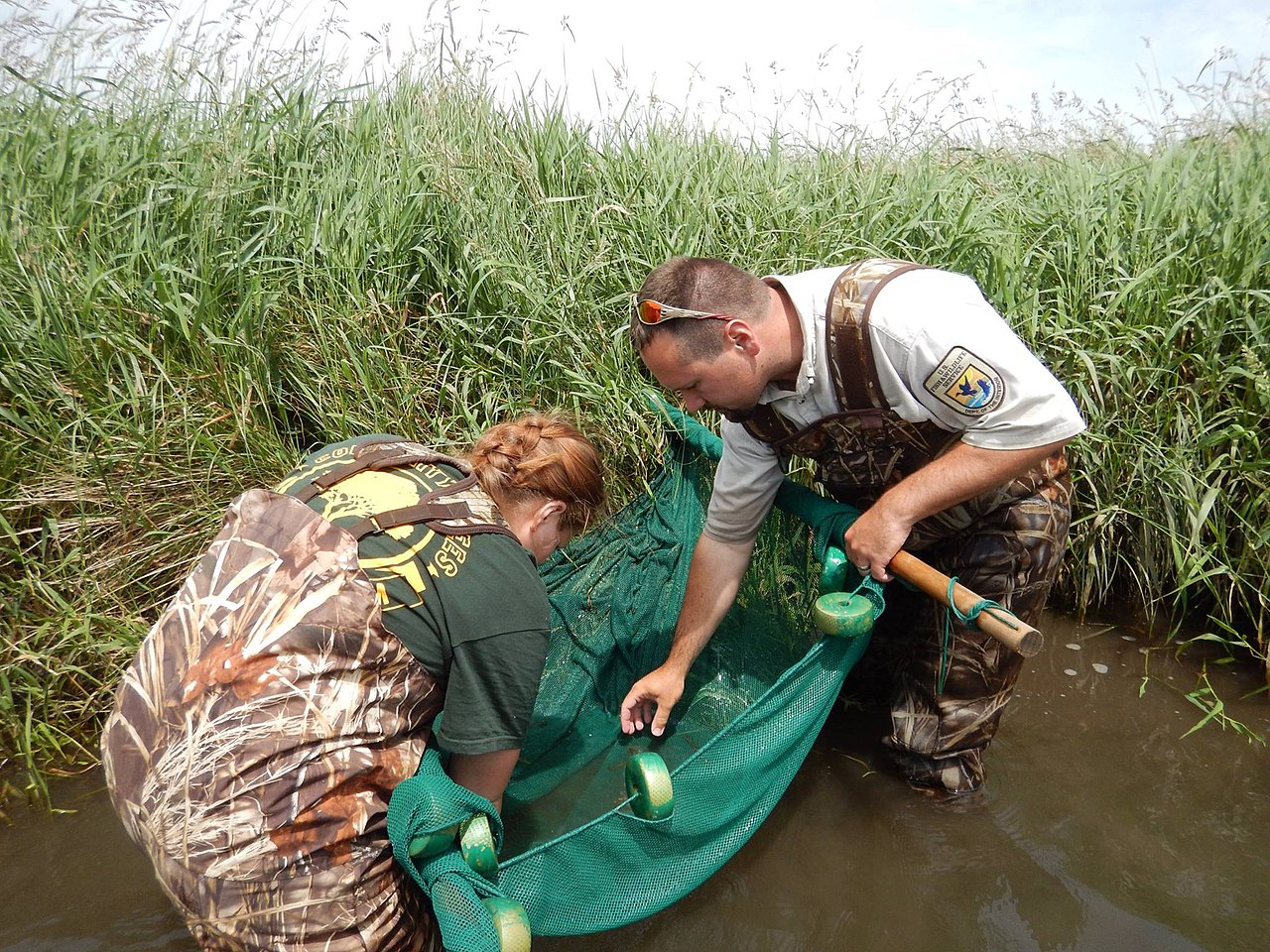
About 40 people took part in the third annual Endangered Species Act (ESA) Farm Tour, held from 14 to 16 September in Minnesota and South Dakota, to see on working farms how farming and the protection of threatened and endangered species can be reconciled as new pesticide requirements under the act take effect.
The tour is organised each year by the National Alliance of Independent Crop Consultants (NAICC), the Weed Science Society of America (WSSA) and the Foundation for Environmental Agriculture Education. This year it brought together the US Environmental Protection Agency, the US Fish and Wildlife Service, the US Department of Agriculture, South Dakota State University, the University of Minnesota and the Southern Minnesota Beet Sugar Cooperative, among others.
It began at Split Rock Creek State Park near Jasper, Minnesota, with a discussion of restoring habitat for the Topeka shiner, an endangered freshwater minnow, and a walk through a Pesticide Use Limitation Area to see what it means for neighbouring farmland. University of Minnesota researchers reported on soil health and erosion work, and the sugar beet cooperative described its weed and disease problems and how crop rotation can reduce erosion in low-residue crops.
On the second day the group visited the grain and livestock farm of David and Benji Hiebert near Iroquois, South Dakota, where rotational grazing and cover crops have improved soil health and water quality. An aerial application demonstration followed, and pilots at Brookings airport showed the cockpit controls and mapping programs they use to steer around sensitive areas. At South Dakota State University the discussion turned to precision tools, including machines that kill weeds with electricity and variable-rate nitrogen.
"The open discussions we had during the tour made it clear to me that crop consultants have a central role to play in helping farmers implement the new pesticide ESA requirements," said Steve Hoffman, managing agronomist at Indepth Agronomy in Wisconsin and a NAICC member. Dawn Refsell, president-elect of WSSA, said the tours help regulators, researchers and farmers find workable approaches together.
For growers, the practical stakes are the limits that ESA protections can put on when, where and how pesticides are applied near the habitats of listed species, and the tour's organisers see field-level dialogue as the way to make those limits workable.
Photo: U.S. Fish and Wildlife Service Midwest Region / Wikimedia Commons (Public domain)
Source: Global Agriculture


Comments
(0)