
By Kefayet Shakil
As a child I read in a book the story of the blind men and the elephant. Because we had seen elephants with our own eyes, the story seemed quite funny to us. I remember that as the teacher described it, we all giggled. Today a harsh reality has reminded me of that moment.
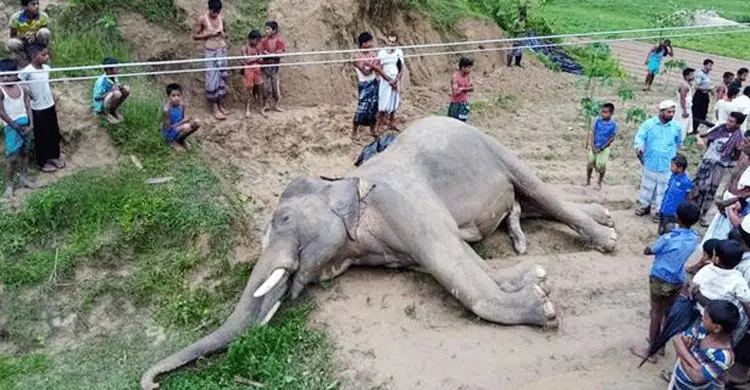
For the past three days, the first thing I have seen on waking has been news of an elephant's death: first on Friday in Teknaf, Cox's Bazar, the next day in Lama, Bandarban, and then in Banshkhali, Chattogram. News of elephant deaths like this has hurt those of us who care about wildlife. I was talking about it with a senior official concerned. He replied with regret: "We are probably going to be the last generation to see elephants."
The remark struck me deeply. Since then I have kept thinking about what the next generation will think when they hear the word elephant. Even with eyes, they may think like those blind men that an elephant is as tall as a hill, with ears like a winnowing tray and legs like pillars, and so on. It would not be strange, since they may never have the good fortune to see an elephant except on the pages of a book.
Falling numbers, rising deaths
According to the latest survey, published in 2017 by the Forest Department and the International Union for Conservation of Nature (IUCN) Bangladesh, 268 elephants range in the country: 67 males, 172 females and 29 calves. Apart from 96 captive and 93 migratory elephants (moving between more than one country), the remaining 79 live permanently in the country's forests. Earlier, IUCN data published in 2016 showed that 62 elephants were killed by people in the 13 years up to 2014, and said the number was rising.
Elephant deaths in the country's forests have recently risen abnormally. Data from the Forest Department's Wildlife Crime Control Unit show that 12 elephants died in the forests of Chattogram division alone in the past nine months: five in the Cox's Bazar North forest division, three in Cox's Bazar South, three in the Lama forest division and one in Banshkhali, Chattogram. Three of them were calves.
Most of these deaths happened in plain sight. Some were planned in advance, yet the forest department could not prevent them. Prevention, I understand, may not have been possible without intelligence. But when five elephants die one after another in one area, can that be called unforeseen?
Who is accountable?
Look at police stations and we see that if several murders happen one after another, the officer in charge can no longer eat in peace; even if he somehow survives, it costs him his sleep. That is how it should be for forest officials too. Without doubt they have far less responsibility than the police, yet they are failing to stop the unwanted deaths of so many animals. After the deaths there is hardly any investigation. And still these forest officials relax in air-conditioned comfort.
Take the Cox's Bazar North forest division, where five elephants have died in nine months. Apart from perfunctory post-mortems, burying the elephant and at most filing a case, no action has been seen. Yet the forest officials there remain in their posts, with no concern or remorse. And why would they have any, if there is no punitive action?
Can the forest department not take departmental action for failing to prevent the unwanted deaths of animals? It can, but it does not. As a result these government-paid officials develop no sense of responsibility for protecting these animals, nor a mindset of accountability.
Whenever wildlife is killed, we see the forest department talk about public awareness. But whose job is it to build awareness? The question must now be asked: what have the elephant conservation projects achieved? If so many elephants are to die unwanted deaths, why are such expensive projects running? If wildlife cannot be protected, why should the public pay for hundreds of officials in the Wildlife and Nature Conservation division?
With so many wildlife deaths every month, fingers are inevitably pointing at the conservator of forests of the Wildlife and Nature Conservation division too. It has to be said that either he is not sincere or he cannot manage his subordinates. But whoever's failure it is, life and nature are paying the price, and in the end the whole country will suffer. So the public must speak up in their own interest and force the forest department to be accountable to them.
My few days of experience working on wildlife tell me the media also bear responsibility for the state of the forests and wildlife. Every year the budget makes a huge allocation for protecting life and nature, but its accounts never appear in the media. Unlike ten other ministries or directorates, the forest ministry is never put in the dock of media accountability. As a result the institution always stays out of reach. So on one hand life and nature are constantly disappearing, and on the other the public's pockets are being picked in the name of protecting them.
Now is the time to raise our voices. To stay healthy, we must keep the environment healthy, and there is no alternative to conserving biodiversity to protect the environment. So let us raise our voices for biodiversity in our own interest. Let us earn the name not of "the last generation to see elephants" but of "the generation that conserved elephants". Remember: if you, I and all of us unite, the environment will be saved, and the country will be saved.
The writer is a life and nature reporter at Somoy Television.
Source: Jagonews24. First published in Bengali on The Agro News.


Comments
(0)