
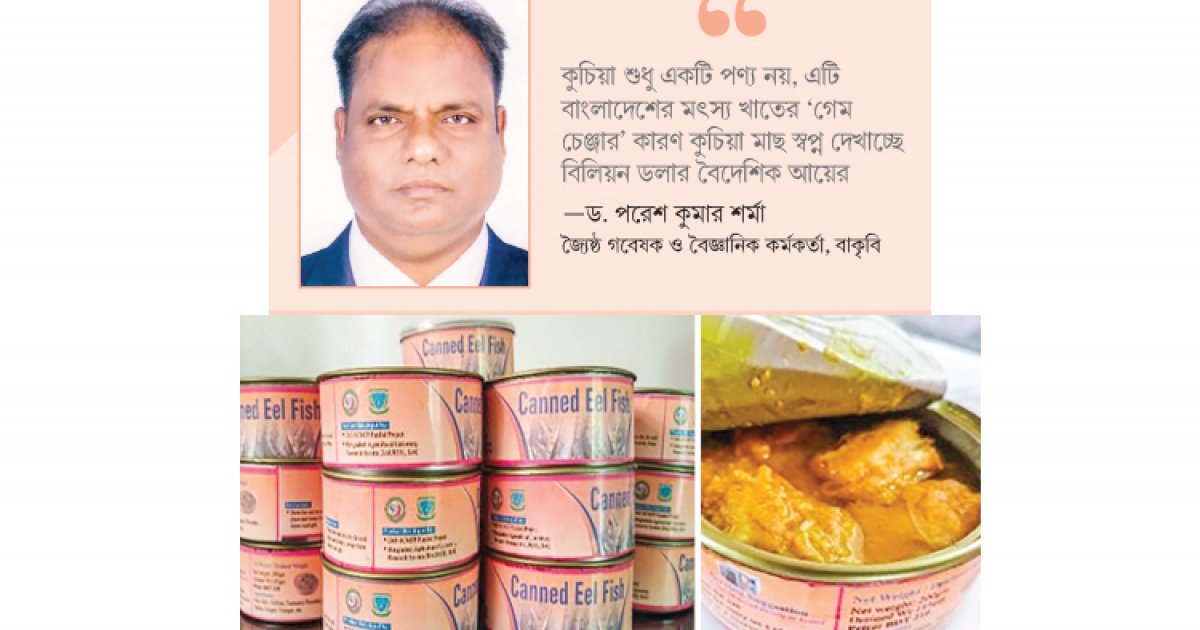
A canning technology developed at Bangladesh Agricultural University (BAU) is opening a way to earn more foreign exchange from kuchia, the freshwater mud eel long neglected in Bangladesh, Desh Rupantor's Musaddiqul Islam Tanvir reports. A team led by Dr Paresh Kumar Sarma has produced a safe, nutritious and shelf-stable canned kuchia product on a trial basis, using controlled temperatures, sterile processing and quality packaging.
Commercial kuchia farming and export have become a fast-growing sector, Dr Sarma said: the eel now goes to about 15 countries, notably Japan, China, Mongolia, Thailand, Malaysia and South Korea. Total production in fiscal 2023-24 was 15,790 tonnes, of which 9,947 tonnes were exported for about Tk 752 crore in foreign exchange.
Rich in protein, calcium, phosphorus, iron, B vitamins and omega-3 fatty acids, kuchia is regarded internationally as a high-value aquatic resource. Fish supplies more than 60 per cent of the country's animal protein and fish products reach more than 50 countries, with a growing share of exports moving to value-added products, the report notes.
Because the canned product meets international food-safety standards for shelf stability and consumer safety, it offers new export potential; but the researchers say more work is needed on production cost, market demand, export capacity, consumer acceptance and supply chains, and that entrepreneurs, farmers, research institutions, donors and investors must act together to commercialise it.
"Boundless possibility is hidden inside a small can," the BAU expert said, calling kuchia a potential game-changer for the fisheries sector; with modern canning and international certification, he said, a once-neglected fish could become a major source of foreign exchange.
Source: Desh Rupantor — Reporting: Musaddiqul Islam Tanvir

Comments
(0)