
The coral reef is colourful, and so are its fish. It looks as if someone has just dabbed spots of colour on both with a paintbrush. The bright fish swim around the reddish-pink reef, playing hide and seek. As they feed, they hide inside the reef the moment they see an enemy coming. Because their colours match, predators cannot find them. Colourful fish and coral reefs have lived this way in the sea for a long time.
A group of colourful cacti has climbed up the tallest tree in the forest, clinging to it. To survive, they always choose such big trees and cling to them for as long as they live. Just now a rabbit has come to eat grass. As soon as the hawk spots the foolish rabbit on the green grass, its eyes gleam. It glides down on the wind, and before the rabbit understands what is happening it is dangling between the hawk's feet. A little later, perched on the branch of a tall tree, the hawk tears the rabbit apart with its sharp claws.
What an ecosystem is
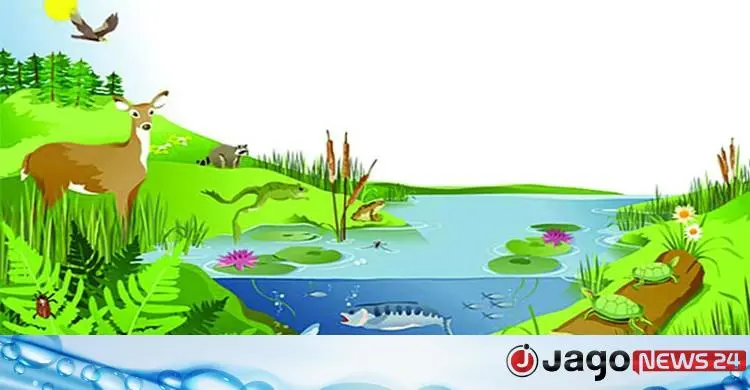
These three survival stories are really stories of an ecosystem. The colourful fish, coral reef, cacti, big tree, hawk, rabbit and grass are each elements of an ecosystem.
All the living and non-living things in a place together form an ecosystem. Plants, animals and even the micro-organisms living in the soil are its living elements; air, water and stone are its non-living elements. An ecosystem is a small part of all the living communities on Earth. All the living communities on Earth together are called the biosphere, and each part of it covers a vast area, which biologists call a biome.
Nothing can live alone, and that is why communities have formed on Earth. An ecosystem is one such community, where each depends on another to survive. It does not matter who depends on whom; what matters is that everyone keeps working equally. In any ecosystem, living elements can be producers, which make food, or consumers. Producers cannot take other living things as food; they only produce food.
Producers, consumers and decomposers
To make food, a plant uses the chlorophyll in its body, water from the soil, light from the sun and carbon dioxide from the air. Plants make food for themselves, and by eating it they grow and are adorned with flowers and fruit. Not all green plants live very long; they soon become food for animals. Animals that live only on leaves or grass are called herbivores, and they are the primary consumers. They include rabbits, rats and various insects. These plant-eating animals are in turn eaten by other animals. Because these eat the flesh of other animals they are called carnivores, and in the ecosystem they are secondary consumers. They include bears, tigers, lions, hyenas, hawks, vultures and eagles.
An ecosystem also has another kind of element, called decomposers. What they break down mixes with the soil and eventually becomes chemical nutrients, which plants take up from the soil through their roots when they make food. The work of rotting dead plants, animals and their waste and returning them to the soil is done by bacteria and fungi.
Ecosystems can be large or small. A tropical rainforest ecosystem may cover several hundred square miles, while a mangrove ecosystem may cover only a few miles. One place can also hold more than one ecosystem: the same island can have both a rainforest ecosystem and a mangrove ecosystem.
From food chain to food web
All the elements of an ecosystem are closely bound to one another through food and energy. When this food chain spreads further, it is called a food web. Consider a river. When the water flows, both banks stay damp, and plants that always need water grow along them. Insects are common in the water, and those that live on small plants and grass can easily eat the leaves of plants growing on the bank. These insects are often eaten by salmon, and the salmon in turn are eaten by bears living in the forests near the river. A bear cannot always eat a whole salmon, so the bones and some flesh are often left behind. Fungi and bacteria then get to work, and within a few days the remains rot into the soil, forming chemical nutrients. The grass and small plants on the riverbank draw these nutrients up through their roots to make food, and so the cycle goes on.
When the living or non-living elements on one side of an ecosystem change, the other side changes too. Drought or lack of rain, violent storms or sudden fires can bring changes to an ecosystem, and sometimes these changes put it in danger. We all need to be aware so that ecosystems are not destroyed, so that they survive and their inhabitants thrive, because when an ecosystem is destroyed, people are also put in danger.
Source: Jagonews24. First published in Bengali on The Agro News.
Comments
(0)