
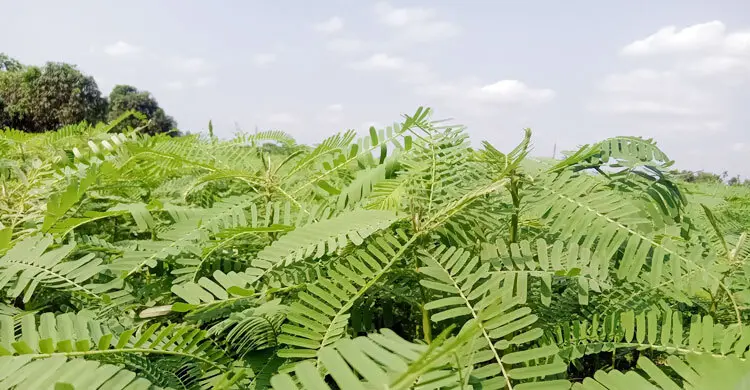
Farmers once regularly used dhaincha as a green (organic) manure to bring their land back to life. But with the spread of hybrid crops and chemical fertilisers the crop has almost disappeared. Now the Bangladesh Agricultural Development Corporation (BADC) foundation seed potato production farm in Domar, Nilphamari, has drawn attention by growing dhaincha on 200 acres.
The green manure is sown on the farm right after the foundation seed potato crop. At 45 to 50 days old, dhaincha produces 25 to 30 tonnes of green manure per hectare, supplying 100 to 150 kg of nitrogen - equal to 220 to 260 kg of urea.
A farm dating from 1957-58
According to sources, the government set up the Domar farm in 1957-58 and it began work under the then agriculture department. Considered especially suitable for seed potato production, it was brought under the potato seed division in 1989-90.
Chemical fertiliser use has risen in the push for expected yields and to keep soil productive, but unplanned use is damaging soil health and endangering biodiversity. With more people to feed than the country's size would suggest, land is the main hope, so the agriculture department has to make new plans to keep soil fertile - and dhaincha cultivation is part of that. Dhaincha improves soil fertility and physical properties. Its roots go deep, drawing nutrients up to the topsoil, and it conserves plant nutrients in the soil. It keeps soil moisture and workable condition (jo) right, softens clay soil, raises the water-holding capacity of sandy soil and checks erosion.
Workers and officials on the benefits
Rezaul Islam, a labourer at the farm, said: "Our fathers and grandfathers grew dhaincha once every year, but now you hardly see it anywhere. The Domar farm grows it every year. Within a month the fields are covered in green seedlings, and the land becomes fertile, soft and green."
Labourer Babu Islam said he had worked at the farm for four years, on dhaincha and all other kinds of land. "I have seen that transplanted Aman needs half the chemical fertiliser that was usually applied," he said.
BADC Assistant Director Subrata Majumder said: "Dhaincha use has fallen but not stopped completely. With a modern touch it is being grown on BADC farms. It is reducing fertiliser use on the land, and on the other hand the government farm is making a profit by using less fertiliser."
Agriculturist Abu Taleb Mia, deputy director of the Domar foundation seed potato production farm, said: "This year too, after lifting the seed potatoes, we took a special initiative and grew dhaincha on 200 acres despite the scorching heat. It will raise soil fertility and reduce crop diseases. Green manure adds organic matter and makes the soil fertile, improving its physical properties."
Source: Jagonews24. First published in Bengali on The Agro News.
Comments
(0)