
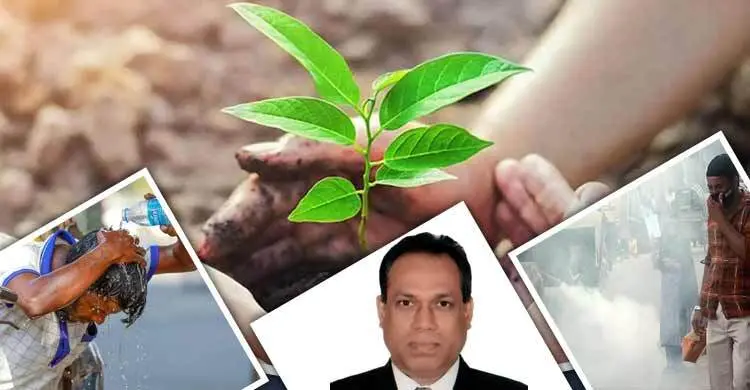
Thanks to its climate and soil, Bangladesh has been famous since ancient times for its greenery, and that richness was not limited to the number of trees; the diversity of species was also rich. Experts believe that forest must cover 25 per cent of a country's area to maintain ecological balance. Yet forest cover in Bangladesh is only 7.7 per cent of its total area, and 14 per cent relative to its land area. Trees do not only add natural beauty: they prevent soil erosion, resist floods and protect life and property by standing against storms. Their role in regulating the weather is immense.
Without trees the Earth would turn into a desert. Trees keep us alive by supplying oxygen. They have fed hungry people, given bark to clothe them, provided leaves on which scripts were written, and brought relief in sickness. The oxygen of trees has made the air clean, and they have absorbed the harmful carbon dioxide that people release. The Vedas of ancient India acknowledged with reverence the great importance of trees, and two and a half thousand years ago people were already concerned that the balance of the environment should not be destroyed. In modern times the need for tree planting has gained special recognition as a matter of concern in other countries.
A crowded city losing its green
Our beloved Dhaka today badly lacks open green spaces. This does not happen abroad, where enough room is kept for parks and open spaces when cities are planned. So if people are to survive, they must also save the trees and plants that were their neighbours in primitive life. Scientists in every country are calling for a return to the green shade of trees to escape environmental pollution. That is why tree planting is necessary.
Dhaka is a city of heritage. The 400-year-old city is described as one of the centres of education, culture and trade in South Asia. In this 134-square-mile city live 1.41 crore people, and the population is now higher still, estimated at close to 2 crore. With 115,000 people living per square mile, it can be called one of the world's most densely populated cities. The World Bank says the population will reach 3.5 crore by 2035. As the population grows, canals, rivers, ponds and trees are being destroyed to build houses, businesses, roads, schools, colleges and other infrastructure, harming the environment and reducing green cover.
Three researchers from Kyoto University and Hokkaido University in Japan studied Dhaka's greenery. According to them, the city's green area was 12 per cent in 1995 and 8 per cent in 2015, and is now no more than 6-7 per cent. Only a small share of the trees cut in Dhaka are replanted. Tree felling began after the 1980s, and the face of Dhaka began to change. Trees take in carbon dioxide and release the oxygen people need to live, and they also help bring rain. But because of tree felling, Dhaka's temperature is rising.
Dust, heat and pollution
About 1,000 tonnes of polluting particles are said to be floating in the air over Dhaka, of which 436 tonnes of dust settle on the city's trees every day. From this one can imagine the state of the industrial areas on the outskirts. Carbon dioxide and heat from urban life are exposing people to serious diseases. Trees can easily take in this poison, but we cannot. We need plenty of oxygen to survive, and only trees can provide it. Trees lead the fight against air pollution to maintain environmental balance. If sulphur dioxide, nitrogen dioxide and other pollutants cannot be absorbed, incurable diseases will spread in urban life, or the world will face great natural disasters.
The Earth's temperature will rise by 4-5 degrees Celsius and the Antarctic ice will begin to melt. Without trees rainfall will decrease, and excessive sunshine will make the soil harsh. So we must become aware now; people must become environmentally conscious. Only trees can provide us with environmental services, taking in polluted, poisonous air and turning it into clean air. Trees also have a proper role in preventing excessive rain and drought. Tree planting will save forests, wildlife and people, make settlements beautiful and the world free of pollution. We must remember that the environment and trees are inseparably linked.
The average summer temperature in Dhaka used to be 35 degrees Celsius; it now stays at 38-40 degrees or more. Unplanned tree felling brings drought and floods, so the need for trees is easy to see. Trees will help keep Dhaka shaded and cool and contribute to a healthy environment. Bangladesh is a populous country with 16 crore 57 lakh people. Thanks to various government measures, we are now self-sufficient in food. According to the United Nations, Dhaka ranks 11th among the most populous cities.
A study by the Global Cities Institute of the University of Toronto found that by 2050 Dhaka will be the world's third most populous city. Some 21.4 per cent of Bangladesh's population lives in cities, most of it in Dhaka. Dhaka's people are generally engaged in jobs, business, day labour, transport work, garments and other occupations, so they make almost no direct contribution to farm production. On the other hand, 78.6 per cent of people live in villages and are directly or indirectly involved in farming. Meanwhile, farmland is shrinking at a rate of 1 per cent.
Making Dhaka a green city
With will and proper planning, Dhaka can become a city of green. A tree-planting programme must be undertaken every year and needless felling stopped. Enough trees must be planted along roads, in open fields, by canals, wetlands, rivers and lakes, in parks and squares, on road dividers, and in and around homes. The city is growing day by day, so housing projects must be implemented only after ensuring 25 per cent tree cover. Interest in urban agriculture must be built among people. This will change the face of the city, and Dhaka will earn a place among liveable and healthy cities.
The writer is a lead agriculturist in Dhaka.
Source: Jagonews24. First published in Bengali on The Agro News.
Comments
(0)