
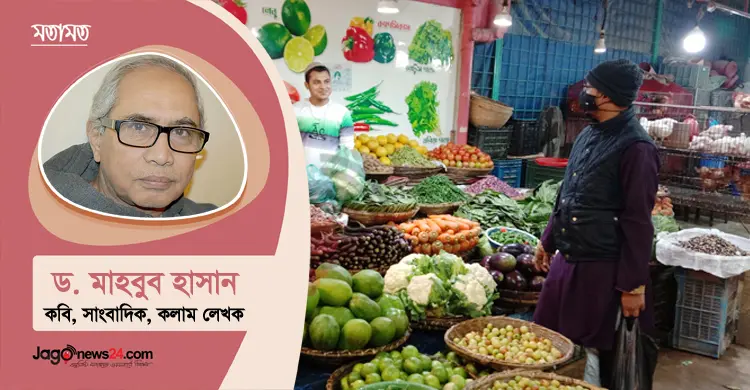
I don't want to write "fire in the kitchen market", because that fire doesn't burn houses; it burns people's pockets to ashes and empties their daily purse.
This morning (5/5/23) I went to the market to buy a few vegetables. I am not calling the vegetables "few"; I mean the amount I would buy. Once, on visits to Kolkata, I used to be startled to hear "give me a hundred, dada" or "give me 250, dada". I had to ask a Kolkata friend to understand that they meant 100 or 250 grams. Today in Dhaka's kitchen markets there is a rush to buy vegetables by the gram.
Buying by the handful
That rush is not a happy one; it comes from the pain of not being able to buy everyday needs. Nobody talks about buying a kilo any more; at most they dare to buy half a kilo. It is not that I never think of buying a kilo; I have to. When buying onions, I can't think of buying less than a kilo. Those weaker off than me buy a few onions from vendors who spread mats on the pavement.
Most of the time those poor people buy "a handful" of onions, as much as they can afford. They also have to buy other ingredients to cook a curry every day. Potatoes and pointed gourd, green chillies, aubergines, beans, yard-long beans, kochu lati and small fish are what they long for. Families of rickshaw pullers, handcart pullers, van shopkeepers, pavement cigarette sellers, hawkers, peons and guards cannot eat without them.
When prices rise, they can hardly breathe. It is they and their families who buy small amounts from the pavement mat stalls. But even there, the prices will make your eyes pop. On my way to the market today I asked the price of onions at one such stall: Tk 60 a kg, and the teenage seller would not sell for less.
Before going to the vegetable stalls, I looked into the rice, lentil and salt shop. None of the three or four kinds of lentils was under Tk 100; most were well above it. Lentils are rich in protein, which makes them the poor man's meat. Sugar was Tk 140, onions Tk 50 or 60 depending on the type, and potatoes, which I bought at Tk 30 last week, were Tk 50 today. During Ramadan, green chillies had come down to Tk 40 a kg; now they are at least Tk 120.
Can the poor bear the heat of green chillies? And why only the poor? How long can the so-called middle class like us, with no wealth or means but a show of ironed clothes and shoes, buy green chillies at Tk 120, or Tk 180 depending on the type? Green chillies do not come from India, or from Ukraine or Russia.
Soybean oil
But the startling price rise has come from government people themselves, together with importers, in soybean oil. The rate for loose soybean oil was fixed at Tk 187 a kg in December last year. Yesterday (dated 5/5/23 in the column) the two sides raised it to Tk 199. You can guess how much the price of bottled soybean oil could go up. On TV news I saw kitchen market shopkeepers dusting off the 5-litre bottles they had in stock and arranging them in their shops; although bought at the old price, they will be sold at the newly fixed price.
Shopkeepers will say there is a shortage of oil in the wholesale market: ask for ten cartons and you get three. I heard a shopkeeper say so. That shortage is artificial, and buyers and consumers understand it even if nobody says so. But the wholesalers and refiner-bottlers, like a cuckoo with its eyes shut, think buyers don't understand their manipulation. They do this shamelessly every time for a little extra profit, and the government is their partner today. They have the wisdom to understand that this is not a virtuous act but a wrong and sinful one, which in the end does more harm than good. Even so, greed has become the main attraction for our business community.
Notice that at every step from importer to retailer, people have turned profit into greed. Not once do they think that they too are victims of that greed, since each is at once a seller and a buyer or consumer, raising the price of their own goods and then buying them back. The crores of buyers and consumers in between do not have pockets full of money; the little they had has been emptied, and they have been made destitute. This consumerist hunger, this exploitation by capitalist corporate trade, is what is called an imperialist technique.
We ordinary people do not know on what grounds the government raised the price of edible oil. If they did so without knowing whether consumers can afford the extra money, it must be understood that the rise was made on the advice of big businesses to earn a little more. If they look at the average national income and think the poor also have the equivalent of three and a half thousand dollars in their pockets and are as financially strong as they are, what could be more foolish? In fact it is not foolish thinking; it is a price-rise trap set by the government to protect the standing of corporate business magnates.
Beef before Eid
Another festival, Eid-ul-Azha, is coming within the next two months. We know today that there is no shortage of cattle in the country for Qurbani. A huge number of cattle is now being raised at home, no cattle are coming from India, and the country's cattle traders have given up that route and turned to producing meat themselves. But if cattle production has become self-sufficient, why has the price of beef gone up in the kitchen market?
The government side is not keen to answer. Don't people know that cattle traders form syndicates and do not let the supply of meat in the market rise? Today a kilo of beef is Tk 800. Those who are aware of and research beef production and people's demand have said a kilo of meat cannot cost more than Tk 300 to Tk 400. Whom should we believe: the researchers, or the manipulation of syndicated traders?
Ordinary consumers want to be saved from the grip of such syndicated traders.
The writer is a poet, journalist and columnist.
Source: Jagonews24. First published in Bengali on The Agro News.
Comments
(0)