
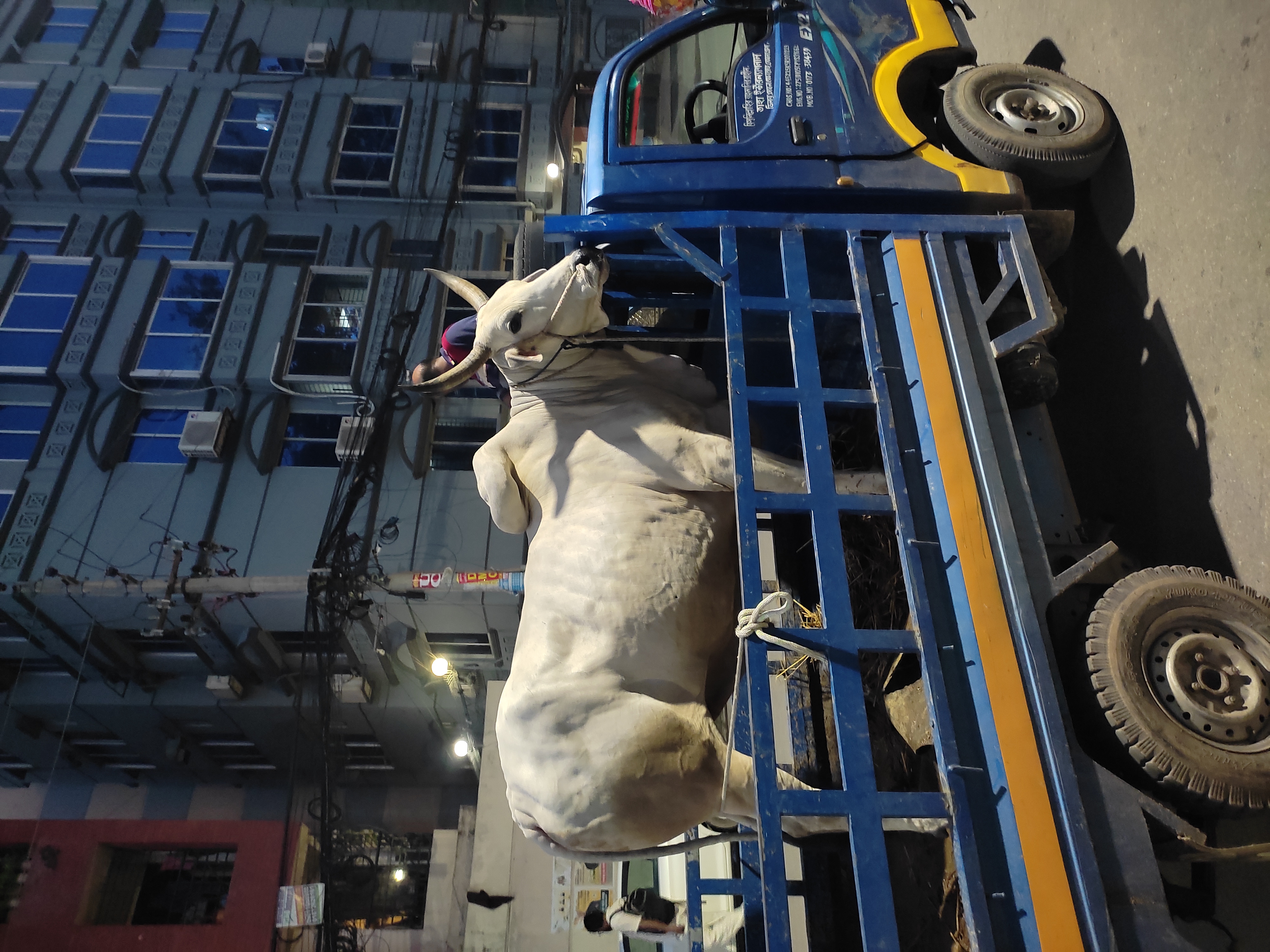
On the evening of Tuesday 26 May 2026, two days before Eid-ul-Azha, a special correspondent of Jago News spent an hour, from 5:30pm to 6:30pm, on roads in the Lalbagh, Dhanmondi, Ramna and Tejgaon areas of Dhaka. In that hour he saw only eight to ten cows being brought home from the city's cattle markets, and most of them had cost more than Tk 1.5 lakh. Only one of those buyers was leading his cow home on foot; the others were carrying their animals by vehicle, mostly on hired pickup vans.
The report, published by Jagonews24 that evening, set the scene against an older memory of Qurbani in Bangladesh: a time when a sacrificial animal bought at the haat was walked home, often over long distances, and the whole neighbourhood asked what it had cost. That custom, the paper wrote, has largely faded in the capital.
One hour on four city roads
The single buyer who was walking his animal was met in front of the Bata Signal on Elephant Road. He told Jago News he had bought the cow at the Gabtoli market for Tk 1.88 lakh. Gabtoli is Dhaka's only permanent cattle market; the others are temporary haats set up each year before Eid.
Near Shahbag, in front of the InterContinental Hotel, the reporter met a young man taking two cows on a pickup van. He said he had paid Tk 3.7 lakh for the pair. In front of Bangabazar, a buyer with two more cows on another pickup van said one had cost Tk 1.5 lakh and the other Tk 1.6 lakh.
These are the prices the buyers themselves gave the reporter. They are not market averages, and the paper did not present them as such. They do, however, sit in the range other reports of the same week described as the busiest part of the Dhaka market. On 25 May, the news agency UNB, after visiting three of the city's haats, reported that medium-sized cattle priced between Tk 1 lakh and Tk 2 lakh were dominating buyer demand, because many city residents were planning to share one animal for the sacrifice with family members, neighbours or friends.
How cows used to come home
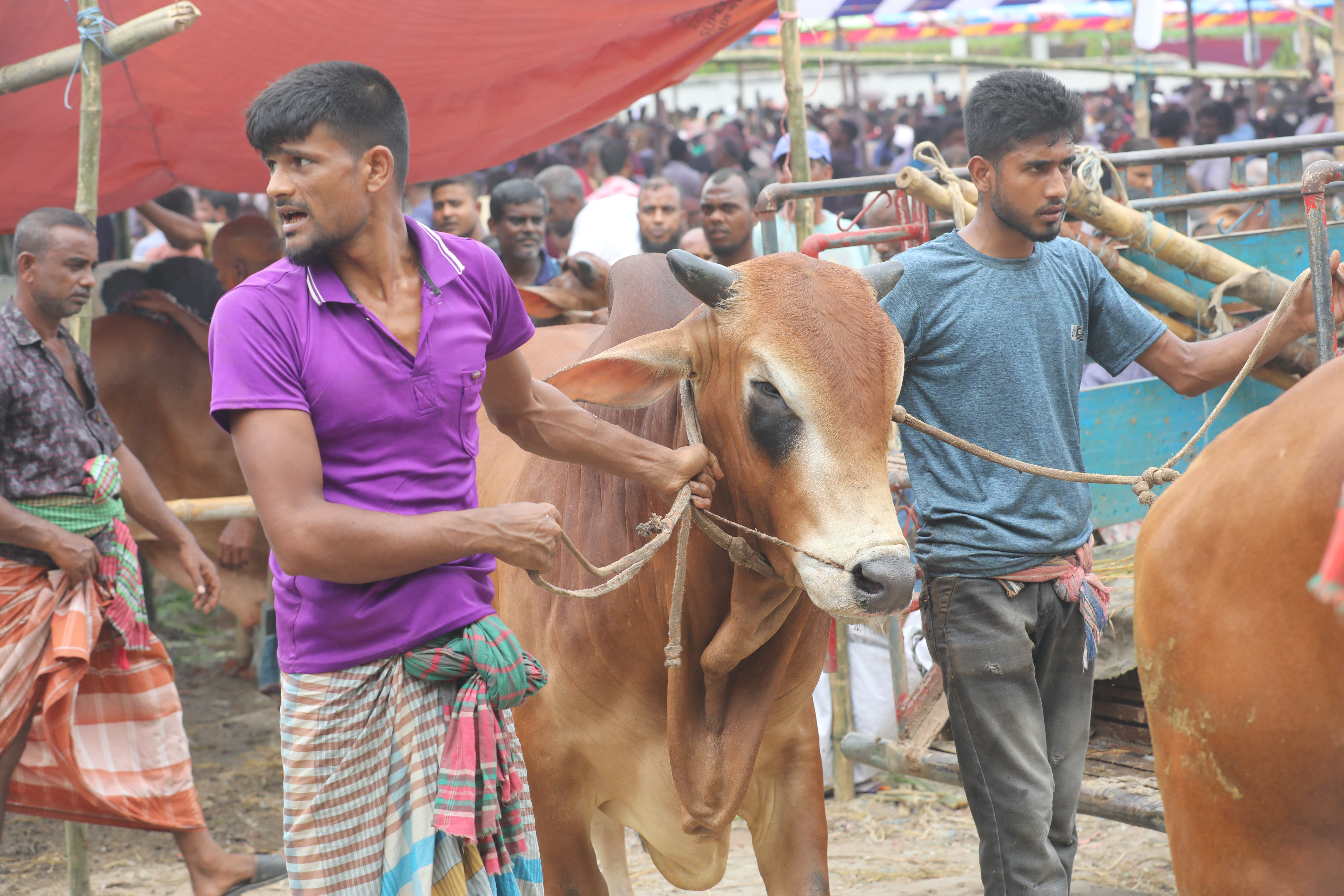
The Jago News report began with a picture of how things used to be. Animals bought for Qurbani, whether cows, buffaloes, goats or camels, were walked home from the haat on foot, often over long distances. The seller would often come along too. Brothers, sisters and children pleading to go with the family elders to fetch the cow was an everyday part of the season.
As the cow was led along the road, hundreds of people would ask, "How much?" Before the adults could answer, the children would grin and announce the price. Those waiting at home kept looking down the road for their relatives to return with the animal. Even after the cow reached home there were emotional scenes: many sellers left in tears at the parting, and small children ran about collecting grass and bran for the new arrival.
Over time, the report said, that scene has largely disappeared. Most buyers now see walking a sacrificial animal home as a hassle and extra effort, so they hire pickup vans or trucks to carry cows and other animals to their homes. On the roads the reporter covered, the one man leading his cow on foot was the exception.
Truck fares weigh on traders
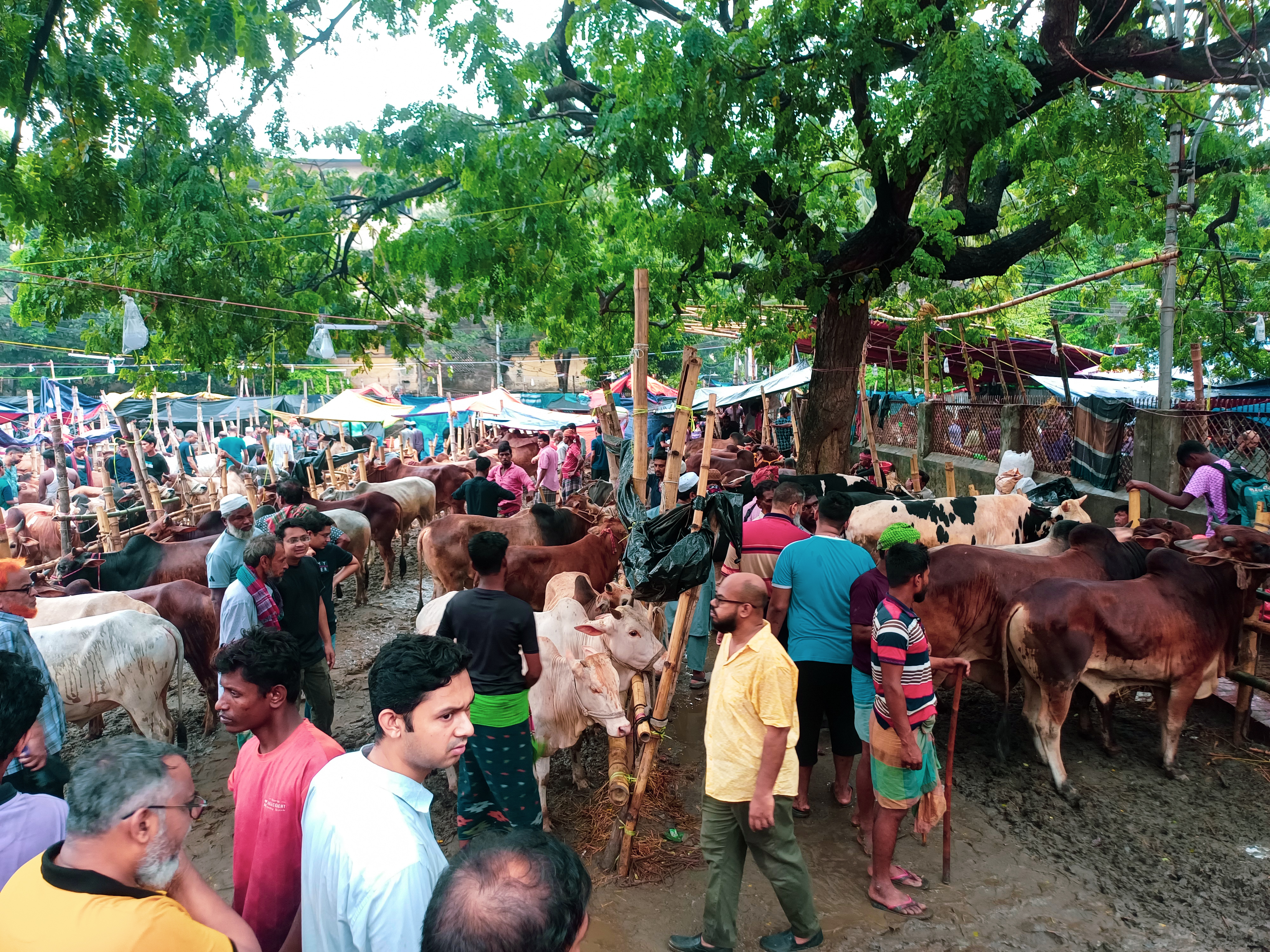
Transport was also the main complaint on the selling side that week. Earlier on 26 May, Jago News published a report from the Aftabnagar, Shahjahanpur and Kamalapur markets, where trucks full of cattle were arriving from the districts and all three markets were full. Traders there said that because of a rise in fuel prices they were paying Tk 6,000 to Tk 8,000 more per truckload than a year earlier to bring cattle to Dhaka, and that the extra cost was being passed on in cattle prices.
The traders gave the paper their own figures. A trader who brought 12 cows from Daulatpur in Kushtia said a truck he had hired for Tk 17,000 to Tk 18,000 the year before had cost Tk 24,000 this time. A trader from Singra in Natore said a small truck that used to cost about Tk 13,000 had cost up to Tk 19,000 over the same distance. A trader at Aftabnagar who came from Sirajganj with 20 cows put the rise at Tk 18,000 to Tk 24,000 for the same truck, about Tk 500 more per cow by his own reckoning. A trader from Chapainawabganj said tolls, road extortion and food costs on the way had always been there, and fuel had now been added on top.
Some traders complained that there is no fixed fare structure for trucks, so drivers and owners raise fares with demand at Eid time; one, a young trader from Rajbari, said many dealers had brought fewer cattle than usual to limit their risk. Truck drivers gave their side: a driver who had come from Pabna said that after the diesel price rise, trucks could not run at the old fares, and that spare parts, tyres and helpers' wages had all gone up. Another said hours stuck in traffic burned more fuel and that carrying cattle needs extra care on the road.
Buyers were noticing the effect. A man looking at cattle at Aftabnagar told Jago News that a medium-sized cow of the kind he had found for under Tk 1.4 lakh the year before was now being offered at close to Tk 2 lakh. UNB's report of 25 May quoted a trader from Kushtia making the same point: feed and transport costs had risen, so prices were somewhat higher.
Dhaka's cattle markets in 2026
The government said in early May that 27 cattle markets would operate in Dhaka for Eid. A report in The Daily Ittefaq's English edition on 20 May gave the breakdown: 16 under Dhaka North City Corporation, including the Gabtoli market, and 11 under Dhaka South City Corporation. The North's markets included sites at Mirpur Section 6 (Eastern Housing), Kalshi Balur Math, Basila 40-feet road in Mohammadpur and the Diabari area of Uttara sectors 16 to 18; the South's included Shahjahanpur railway colony's Maitry Sangha ground, Aftabnagar, Rahmatganj club open space and the Kazla Bridge to Matuail stretch. Formal trading was to run for five days, including Eid day.
Counts of markets actually running in the last days varied between reports. bdnews24 reported on 24 May that trading had begun that Sunday at 24 markets of the two city corporations. Jago News, citing relevant sources on 26 May, put the number of temporary markets at 21, 11 in the north and 10 in the south. In Old Dhaka, the South corporation had set up a temporary market on the open land south of the Sadek Hossain Khoka field and in the Dholaikhal truck terminal area, where Jago News found both sides of Dholaikhal road lined with cattle on 26 May and families visiting in spite of bad weather.
The city corporations and the government described the arrangements in the markets. Veterinary medical teams were to be stationed at major markets, and, according to the 20 May report, no animal would be allowed for sale without health clearance. Police in plain clothes were to be deployed at all markets, and separate task forces were formed for traffic, waste disposal, water supply and market management. On 24 May, the minister in charge of fisheries and livestock, visiting the Diabari market, said machines to detect counterfeit notes had been installed and banking services provided so sellers could deposit money or open accounts on the spot; he also said public announcements and monitoring had been arranged to help find lost animals.
Supply, demand and prices across the country
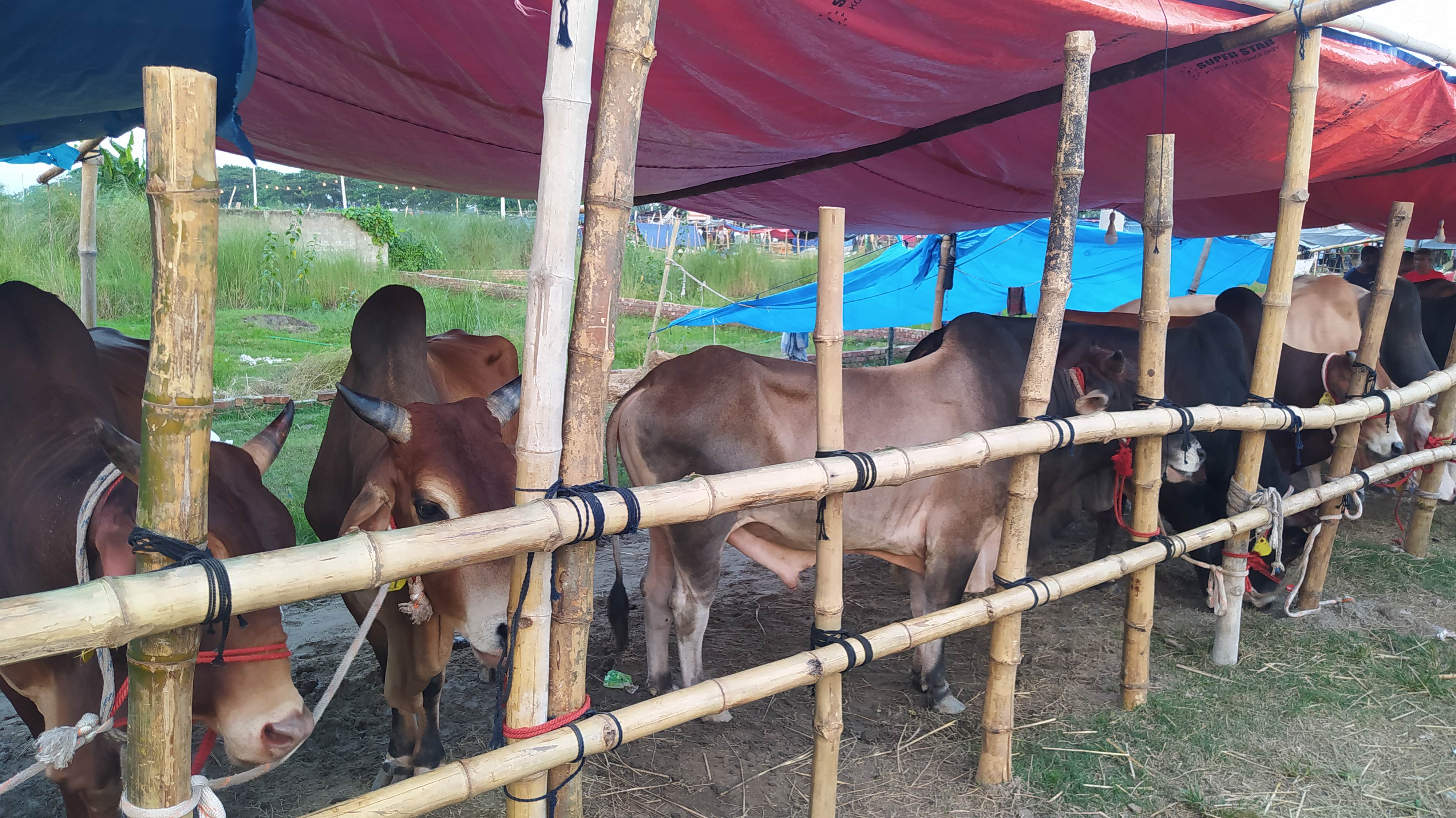
The cows on the pickup vans were a small part of a very large national market. According to the Department of Livestock Services (DLS), as reported on 20 May, an estimated 12,333,840 animals were available for sacrifice in 2026, against a projected demand of 10,106,334, leaving a surplus of around 2.2 million. The Financial Express reported on 4 May, from an inter-ministerial preparatory meeting convened by the Ministry of Fisheries and Livestock, that field-level data showed about 5.69 million cows and buffaloes, 6.63 million goats and sheep and more than 1,500 animals of other species ready for the sacrifice.
At that meeting the minister said more than 3,600 cattle markets would operate across the country before Eid, and that border cattle markets would be shut to prevent illegal imports. On 24 May he said the demand could be met entirely with domestic cattle, and that with thousands of buyers and sellers in the markets it would be difficult for anyone to create an artificial syndicate, since prices were set by competition, supply and demand.
UNB's report of 25 May listed where Dhaka's cattle were coming from: Kushtia, Chuadanga, Rajshahi, Pabna, Sirajganj, Faridpur, Jashore and Dinajpur, among other districts. It also gave the wider economic setting. The livestock sector accounted for 1.90 percent of Bangladesh's GDP and 16.52 percent of agricultural GDP in FY2021-22, and the Qurbani trade supports feed supply, veterinary services, transport, temporary labour, butchers and the hide, tannery and leather chain. Ahead of the 2026 Eid, the government fixed the price of salted cowhide at Tk 62 to 67 per square foot in Dhaka and Tk 57 to 62 outside the capital.
Buying online and home delivery
For some city households, the trip to the haat, and the trip home with the animal, no longer happens at all. In a report published on 24 May, bdnews24 wrote that interest in buying sacrificial animals online had been growing for several years as people tried to avoid traffic and crowded markets, and that several online sellers it spoke to had already sold most of their stock. Some platforms sell shares in an animal or packages that include the butcher and dressed meat.
The first government-run online cattle market, the Digital Haat, was launched in 2020 during the pandemic by Dhaka North City Corporation, the ICT Division, the e-Commerce Association of Bangladesh and the Bangladesh Dairy Farmers Association. According to bdnews24, it sold 27,000 animals that year, 387,000 in 2021 and about 60,000 in 2022, and the platform closed in 2024. In the 20 May report, the authorities said no market toll (hasil) would be charged on online transactions.
Online sellers also described the same transport problem the Jago News report captured from the buyers' side. A co-founder of one online platform told bdnews24 that city buyers often have neither space nor people to keep an animal, so they want delivery on the night before Eid, which is very hard for sellers because of traffic jams and because a cow, unlike a parcel, takes time to move, load and unload. He also said that on long journeys by vehicle, cattle from farms that had not vaccinated their herds sometimes fell ill with foot-and-mouth disease, which was why his platform sold only animals from its own farm.
What the law and welfare standards say about moving cattle
Whether a cow walks home or rides on a pickup, Bangladesh's Animal Welfare Act 2019 (Act No. 12 of 2019) applies to how it is treated. Section 4 makes every owner or keeper of an animal responsible for treating it humanely and refraining from cruelty without reasonable cause. Section 5 allows the government to make rules on the keeping, transport and slaughter of animals.
Section 6 lists acts that count as unnecessary cruelty. Among them are:
- making an animal overwork or beating it unnecessarily;
- not giving an animal the food and water it needs;
- tying, confining or carrying an animal in such a way that it cannot stand, sit or lie down naturally;
- striking an animal with a sharp metal object to control it.
Under Section 16, such an offence is punishable by up to six months' simple imprisonment, a fine of up to Tk 10,000, or both. The same section 6 states that acts done during slaughter for food, or during sacrifice for a religious purpose, by a follower of any religion in keeping with his own religious practice are not counted as unnecessary cruelty.
The government's own instructions for the 2026 season also covered transport. According to The Financial Express, the May preparatory meeting directed police, Border Guard Bangladesh, district administrations and livestock offices to work together so that animals could move smoothly by road, rail and waterway, to prevent robberies of cattle-laden trucks, and to have vehicles display the banner of the market they were heading to. The meeting called for compliance with the animal welfare law during transport and while animals were held in markets, and discussed bringing back or reviewing the special cattle trains used in earlier years.
The international standard on the subject is Chapter 7.3, "Transport of animals by land", of the Terrestrial Animal Health Code of the World Organisation for Animal Health (WOAH). It applies to cattle, buffaloes, camels, sheep and goats among other species, and its first principle is that the time animals spend on a journey should be kept to a minimum. Its main recommendations include:
- each animal should be checked for fitness to travel; sick, injured, weak or exhausted animals, and those unable to stand and bear weight on each leg, should not be loaded except for veterinary treatment;
- loading ramps and other facilities should have non-slippery flooring and be designed for the animals' size and abilities;
- cattle need space on the vehicle to lie down without being on top of one another, and enough headroom to stand naturally without touching the roof;
- painful methods such as whipping, tail twisting, pressure on the eyes or the use of large or sharp sticks should not be used to move animals, and conscious animals should not be thrown, dragged or dropped;
- in extreme heat or cold, animals should not be transported at all, and travelling at night may reduce heat stress.
The same chapter notes that cattle are sociable animals that may become agitated when singled out, that crowding can make them aggressive, and that they tend to avoid dead ends in passages: points that matter as much on a narrow city lane as on a loading ramp.
Eid-ul-Azha and the sacrifice
The National Moon Sighting Committee met at the Islamic Foundation in Baitul Mukarram on 18 May 2026, confirmed that the Zilhaj moon had been seen, and set Eid-ul-Azha in Bangladesh for Thursday 28 May. bdnews24 reported the same day that the government had declared a seven-day holiday from 25 to 31 May for the festival. In Saudi Arabia, Eid had been set for a day earlier, 27 May.
Banglapedia describes Eid-ul-Azha, also called Eid al-Qurban and known in Bangladesh as Qurbanir Eid or Bakra Eid, as one of the two main religious festivals of Muslims. It falls on the 10th of Zilhaj, and the sacrifice may be made after the Eid prayer and over the following two days, or three by some opinions. A camel, cow or buffalo may be sacrificed on behalf of up to seven people, which is why so many families in Dhaka share one cow, while a sheep or goat counts for one person. In Bangladesh, cows, goats and buffaloes are the main sacrificial animals. The animal must be of the prescribed age and should be free of defects such as blindness, lameness, a cut ear or a broken horn, which is why buyers at the haat look so closely at teeth, eyes, legs and horns before they pay. The meat is customarily divided into three parts, for the household, for relatives and for the poor.
Photo: Tanvir Rahat / Wikimedia Commons (CC BY-SA 4.0)
Sources: Jagonews24 ("Buyers return with cows on pickups, no one asks 'how much' any more", 26 May 2026; "Bringing cows to Dhaka costs Tk 6-8 thousand more", 26 May 2026; "Trucks full of cattle arrive, buyers come to the market with families", 26 May 2026), The Daily Ittefaq English (20 May 2026), The Financial Express (4 and 18 May 2026), UNB via The Business Standard (25 May 2026), BSS (24 May 2026), bdnews24 (18 and 24 May 2026), Animal Welfare Act 2019 (bdlaws), WOAH Terrestrial Animal Health Code chapter 7.3 (2024), Banglapedia, UNB (2025)
Comments
(0)