
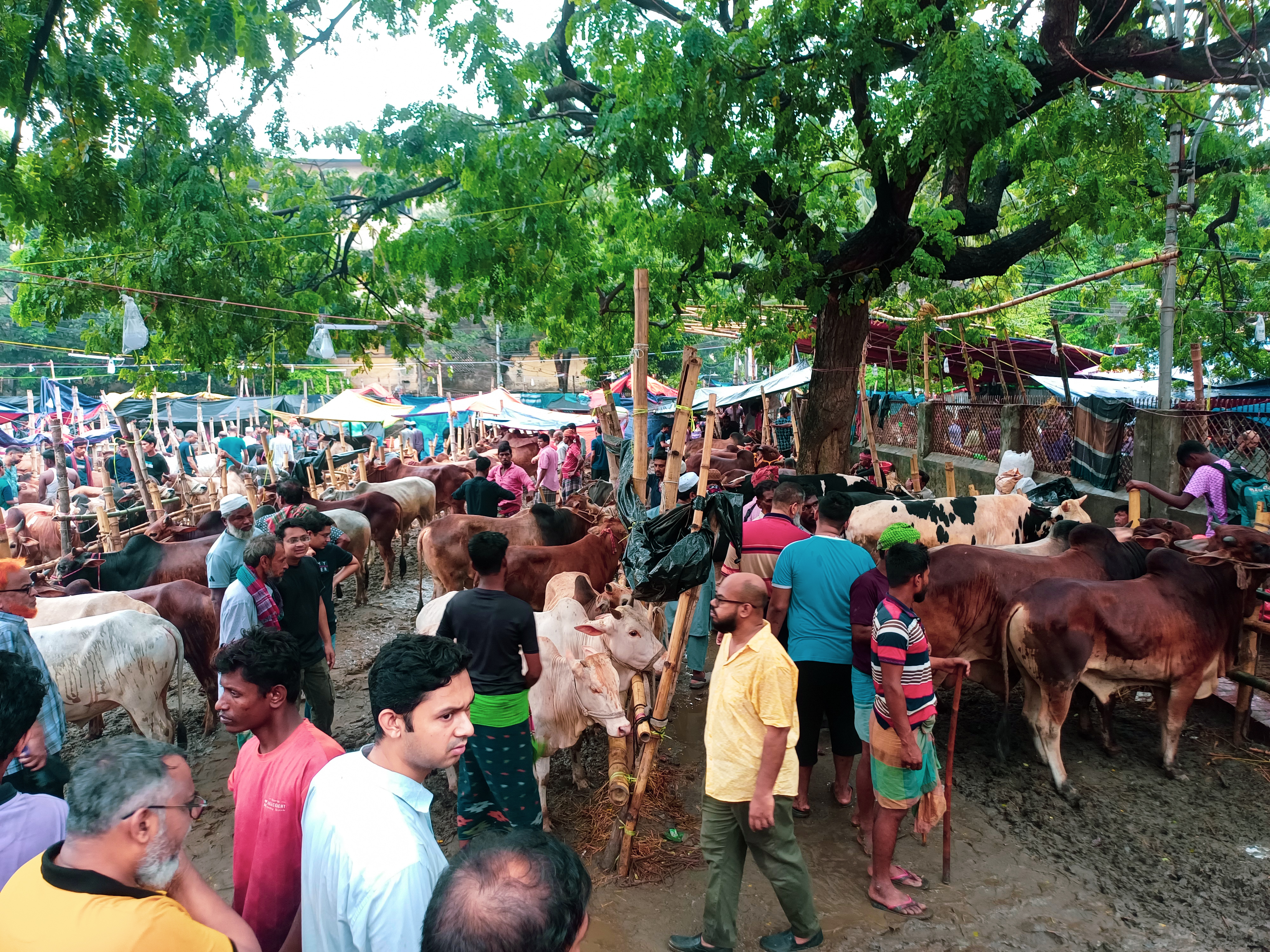
Three days before Eid-ul-Adha in 2026, on Monday 25 May, Dhaka's sacrificial animal markets were well stocked with cattle, but trade had still not picked up. Buyers who spoke to Jagonews24 that day said traders were asking far more than the year before for cattle of the same size, and that when buyers named their own price, the traders simply smiled and told them to look elsewhere. The National Moon Sighting Committee had announced on 18 May that Eid-ul-Adha would fall on Thursday 28 May.
Three days of searching for last year's price
Sadman Sakibuzzaman, a student at Dhaka University, had spent three days in a row going round the cattle markets at Diabari in Uttara, Keraniganj and Hazaribagh. The year before, he had bought a cow he liked for Tk 1.8 lakh, including the market fee. This year, even with a budget Tk 20,000 higher, he could not find a cow like last year's.
By Sadman's account, traders were asking Tk 3 lakh for a cow the same size as the one he had bought for Tk 1.8 lakh. When he opened the bargaining at Tk 1.5 lakh, the traders smiled and said, "Why don't you look around the market?" Even when he eventually offered Tk 2 lakh, one trader would not let the cow go, and instead consoled him: "Why buy from me? If you get it at this price from someone else, take it."
Speaking to the Jagonews24 reporter by phone on the evening of 25 May, Sadman said: "I have just got home after walking round the Diabari and Hazaribagh markets in the rain all day. There are plenty of cattle, but the traders are not giving any discount. They are asking too much. When we name a price, they smile. I can't tell whether prices will stay this high to the end."
The market fee Sadman mentioned, known in Bangladesh as hasil, is the commission a market's leaseholder takes on each sale. Mohammad Shafiqul Islam Khan, administrator of Dhaka North City Corporation (DNCC), told reporters on 20 May that leaseholders could take 5 percent of the sale price as hasil and nothing more. A buyer's total outlay at the market is therefore the price of the animal plus that fee.
Plenty of cattle, no agreement on price
According to the Jagonews24 report, the capital's markets were well supplied, yet by 25 May trade had not taken off. Buyers were coming but, unable to agree on prices, were still looking around. Sellers, too, were testing buyers' mood through bargaining. Even so, some cattle were selling for between Tk 1.5 lakh and Tk 2 lakh.
Gazi Salahuddin, a student at the private BRAC University, went to the Shahjahanpur cattle market that evening with his father and two brothers. He told Jagonews24 that prices seemed higher than last time. Traders had lowered their asking prices somewhat after dusk, he said, but the family might still have to pay Tk 20,000 to 30,000 more than last year's budget.
Nurul Alam Liton of Ashkona in Dhaka sacrifices a pair of cattle every year. Last year he bought two for Tk 4 lakh, he said, but for cattle of the same size traders were now asking more than Tk 5 lakh.
In Dhaka families that sacrifice every year, children wait for their guardians to come home from the market, and call several times while they are there to ask whether a cow has been bought. A schoolgirl from Azimpur told Jagonews24 that it was not only her family: her friends' fathers and brothers were also going to the markets and coming back without a cow. Friends were calling one another to say, "Friend, there are lots of cows at the market, but the prices don't work. The traders won't come down."
Buyers expected that on the last two days before Eid, Tuesday 26 May and Wednesday 27 May, sales of sacrificial animals would rise and prices might fall somewhat.
The same picture in other reports that day
The daily Desh Rupantor reported on the morning of 25 May that formal trading at Dhaka's temporary markets had begun the previous day, Sunday 24 May, but that visitors far outnumbered buyers. Amir Hossain, leaseholder of the Golapbag market, told the paper: "Sacrificial animals are still arriving at the market, but sales are not at the level we expected." At Gabtoli, a trader from Kushtia was asking Tk 12 lakh for a cow of about 25 maunds. At the Amulia market in Demra, a buyer named Aslam complained: "Yesterday I saw the cattle were cheaper; today they want more for the same cow." The same report noted camels brought from Benapole to the Tejgaon market with asking prices of Tk 20 lakh to Tk 35 lakh.
The Daily Inqilab reported around midday on 25 May that cattle of 200 to 300 kg were in the greatest demand at Gabtoli. With intense heat, traders were using fans and canopies to protect their animals. Imrul Hossain, a veterinarian at the Diabari market, told the paper that one large bull had fallen ill from the heat and had been sold to a butcher. Farmers and traders expected business to grow from that Monday, as the government's Eid holiday began and Eid drew closer.
bdnews24.com reported that afternoon that the DNCC administrator, inspecting the Diabari market, found animals tethered on the road outside the market's set boundary and beneath the Uttara Center metro station. He ordered the road kept open for traffic, the animals were moved, and he warned of mobile-court fines if it happened again. The leaseholder's side said the animals had been sheltered under the station only briefly because of the morning rain. Earlier that day the administrator had visited the Gabtoli market and ordered that no money be collected beyond the set fee, and he also inspected temporary markets on 300 Feet Road, at Beraid and at Swadesh Properties.
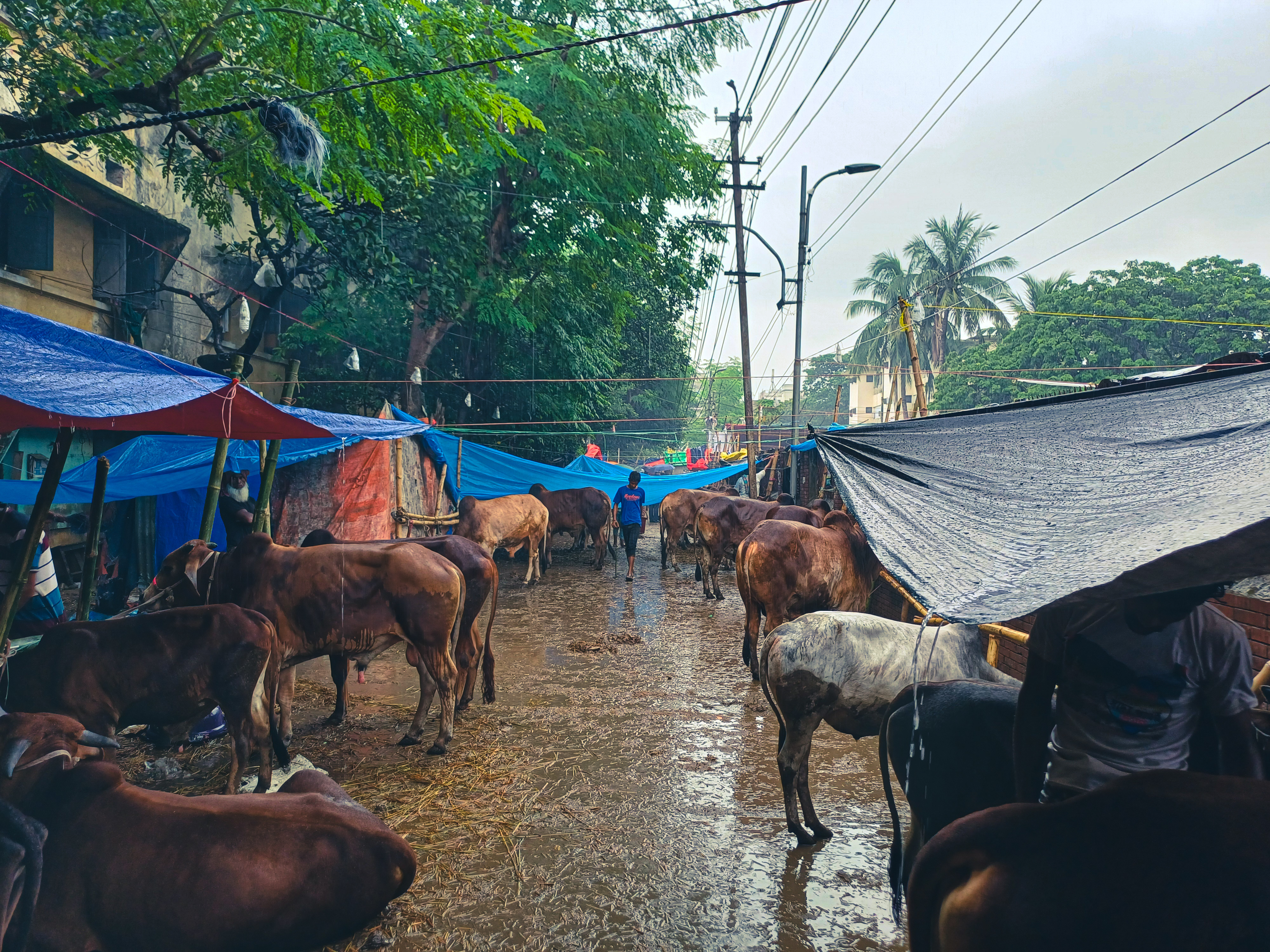
Why prices were higher: the farmers' costs
Farmers had been signalling higher prices for weeks. Bangla Tribune reported on 8 May that medium-sized cattle which used to sell for a little over Tk 1 lakh were being priced at Tk 1.2 lakh to Tk 1.5 lakh, and that farms held cattle ranging from 200 kg to 1,100 kg. Niloy Hossain, senior vice-president of the Bangladesh Dairy Farmers Association and owner of Samarai Cattle Farm in Demra, told the paper that the costs of feed, transport and herders' wages had all gone up.
In a second report on 22 May, six days before Eid, Bangla Tribune quoted farmers as saying that cattle feed, expensive all year, had become somewhat cheaper, but that this had not lowered the cost of raising animals. A farmer with HR Agro Farms, in business since 2007, said transport costs had risen sharply because of higher fuel prices. Adil Hossain, who owns a dairy farm, said that because of higher production costs a medium-sized cow that once sold for Tk 1 lakh could fetch about Tk 1.5 lakh this year.
Desh Rupantor gave one example of the transport bill: a farmer from Meherpur said it had cost him Tk 40,000 to bring 15 cattle by truck to the Amulia market in Demra.
Demand and supply of sacrificial animals
On 3 May Fisheries and Livestock Minister Mohammad Aminur Rashid presented the Department of Livestock Services (DLS) estimates for 2026. Demand for sacrificial animals was put at 1,01,06,334 head, against 1,23,33,840 animals ready for sacrifice: 56,95,878 cattle and buffalo, 66,32,307 goats and sheep, and 5,655 others such as camels and fat-tailed sheep. After demand was met, the department expected a surplus of about 22,27,506 animals.
The same announcement said no imports would be needed; special trains would carry animals from the north of the country through Dhaka to Chattogram; more than 3,600 animal markets would be held across the country with veterinary teams; and Dhaka's markets would have 20 veterinary medical teams and two specialist teams. Online sales of animals would carry no tax or fee, and the government said it would act firmly against extortion and the illegal entry of animals across the border.
On 14 May the minister said again that more than one crore sacrificial animals had been prepared to meet the country's demand and that the sacrifice would be made with animals raised by local farmers. Law enforcement agencies had been given strict instructions to stop cattle smuggling across the border. He also said that new rates for rawhide had been agreed with traders at a separate meeting led by the commerce ministry.
The national surplus did not mean every region had enough. Bangla Tribune's 22 May report, citing DLS figures, said estimated demand in Dhaka was 21,58,869 animals against 14,43,942 available, while Rajshahi Division alone had prepared about 19 lakh animals more than its own demand.
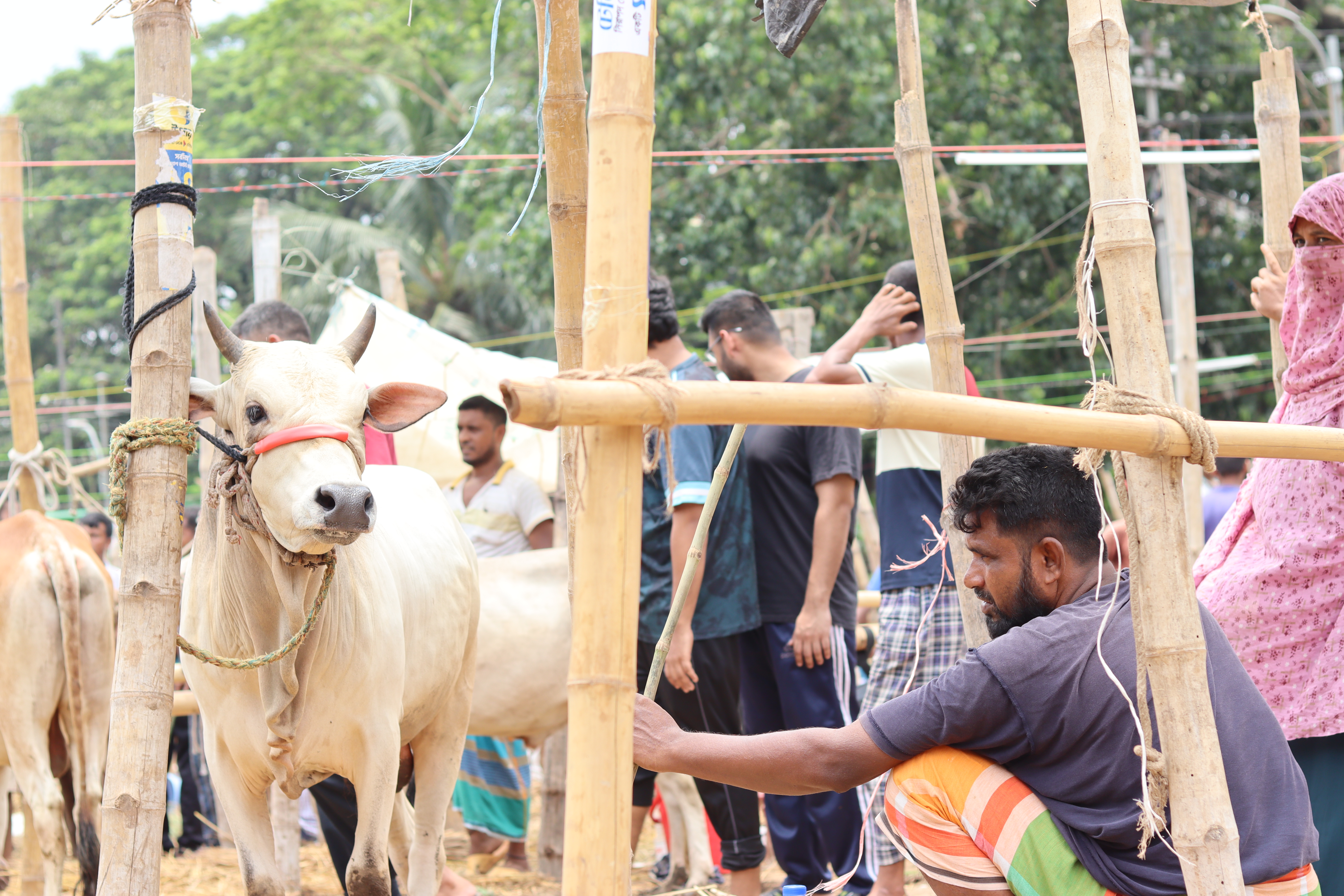
The previous three years
Supply had exceeded demand for several years. Prothom Alo reported on 14 June 2023 that demand that year was put at 1,03,94,739 animals against 1,25,36,333 available. The minister at the time said there were about 21 lakh more animals than needed and that no sick animal would be allowed into the markets.
By DLS figures, about 1.04 crore animals were sacrificed at Eid-ul-Adha in 2024. In 2025, 1,24,47,337 animals were available but 91,36,734 were sacrificed: about 47 lakh cattle and buffalo and about 44 lakh goats and sheep. Rajshahi Division led, followed by Dhaka Division; Sylhet Division had the fewest, at 3,19,823. About 33.10 lakh animals were left over after Eid that year.
The department reaches these figures by stratified random sampling: in every upazila it takes a sample of at least one percent from three kinds of village, small, medium and large, and estimates the number of sacrifices from that. Pre-Eid demand is therefore a projection, and the post-Eid count a survey estimate.
Behind the sacrificial market stands a large livestock sector. The DLS fact sheet Livestock Economy at a Glance put the 2023-24 population at 250.13 lakh cattle, 15.24 lakh buffalo, 271.17 lakh goats and 39.03 lakh sheep. Meat production that year was 92.25 lakh tonnes against a demand of 76.21 lakh tonnes. Livestock made up 1.80 percent of GDP at constant prices and 16.33 percent of agricultural GDP, and the department's table shows the sector providing 20 percent direct and 50 percent partial employment.
Dhaka's 27 markets, leases and rules
According to Bangladesh Sangbad Sangstha (BSS) on 10 May, 27 animal markets were approved for Dhaka's two city corporations for the 2026 Eid: 16 in the north, including the permanent Gabtoli market, and 11 in the south. The northern list included Bowbazar beside Sectors 16 and 18 at Diabari in Uttara, Mirpur Section 6, the Kalshi Balur Math field, land beside the Dhaka Polytechnic Institute, Boshila in Mohammadpur, the T&T ground in Mohakhali and Boro Beraid. The southern list included vacant land beside the Maitree Sangha Club in North Shahjahanpur, the riverbank by the Postogola cremation ground, Amulia Model Town, Aftabnagar, the stretch from Kajla to Matuail, and the Golapbag area. Trading was set for five days, including Eid day.
The Daily Observer reported on 22 May that leases had been settled for 19 of the 27 markets and that the rest were being re-tendered. The highest bid in the north was for the Bowbazar market at Diabari, Tk 141.5 million. The Boro Beraid market went for Tk 57 million, the market beside Dhaka Polytechnic Institute for Tk 38.7 million and the Eastern Housing market in Mirpur for Tk 17.9 million. In the south, the market from Kajla Bridge to Matuail was leased for Tk 43.5 million.
On 20 May the DNCC administrator set out the rules. Leaseholders could take no more than 5 percent as hasil; trading before or outside the five set days was illegal; and no market could be held at an unapproved site. About 100 officials were given magistrate powers to run mobile courts against violations. Leaseholders were also made responsible for removing waste every day, providing separate 'pink toilets' for women, and keeping drainage in place so that water did not collect.
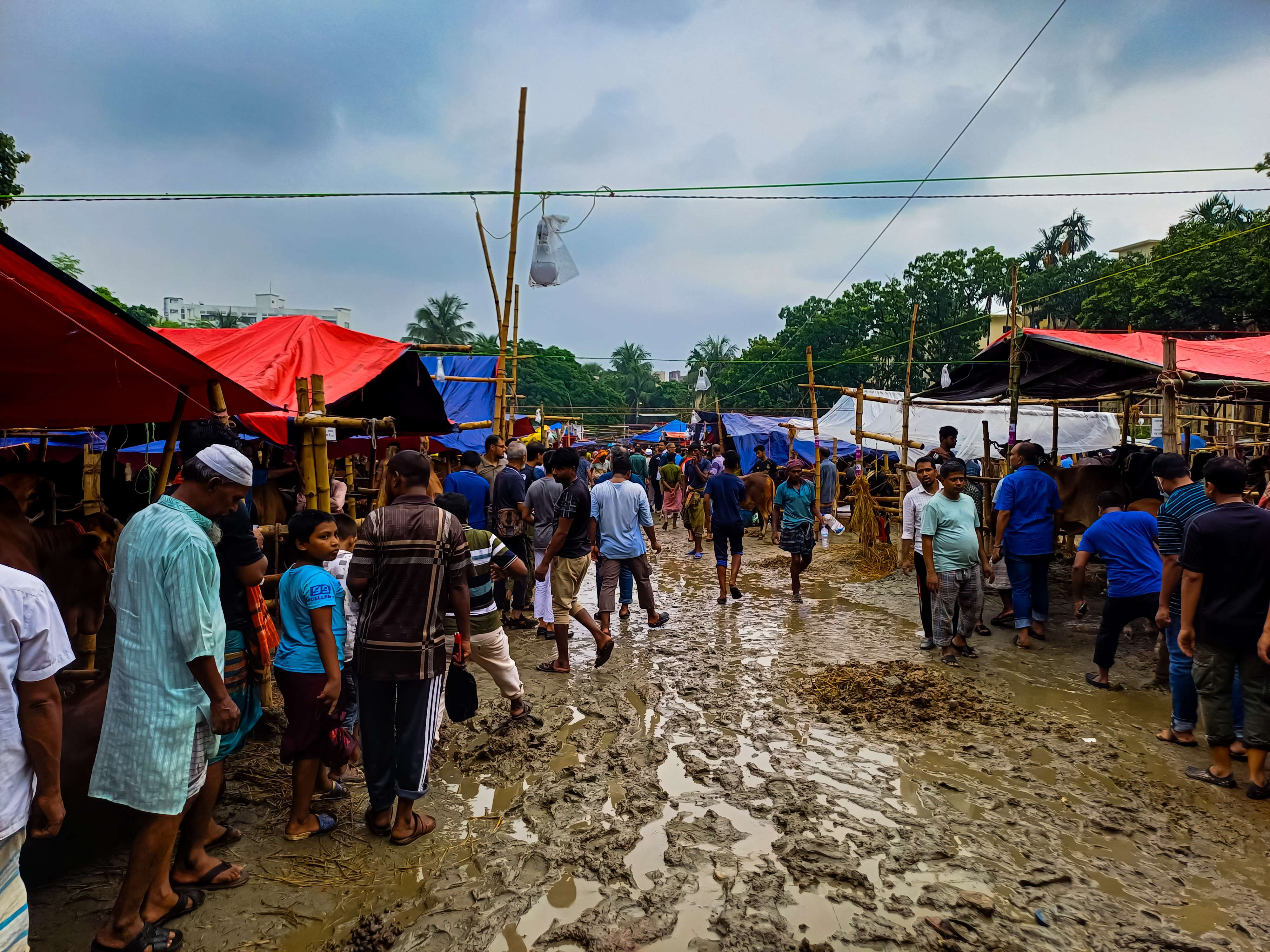
Diabari, Shahjahanpur, Keraniganj and Hazaribagh
The Diabari market Sadman visited lies in the third phase of Uttara, the residential town developed by the capital development authority RAJUK, whose foundation stone was laid on 25 June 1967. Uttara's third phase was announced in 1999 and covers 2,008 acres in four sectors. Dhaka Metro's MRT Line 6 runs from Diabari to Motijheel and has three stations in Uttara: Uttara North, Uttara Center and Uttara South. The Bowbazar market on open land at Sectors 16 and 18 was the most valuable lease in the northern city.
The Shahjahanpur market where Gazi Salahuddin went is on the southern city corporation's list, held on vacant land beside the Maitree Sangha Club in North Shahjahanpur.
Keraniganj is an upazila of Dhaka district, south-west of the city across the Buriganga river. Banglapedia gives its area as 166.87 square kilometres, its main rivers as the Buriganga, Dhaleshwari and Ichamati, and its hats and bazars as 18. It lies outside both city corporations, so its markets were not on Dhaka's list of 27.
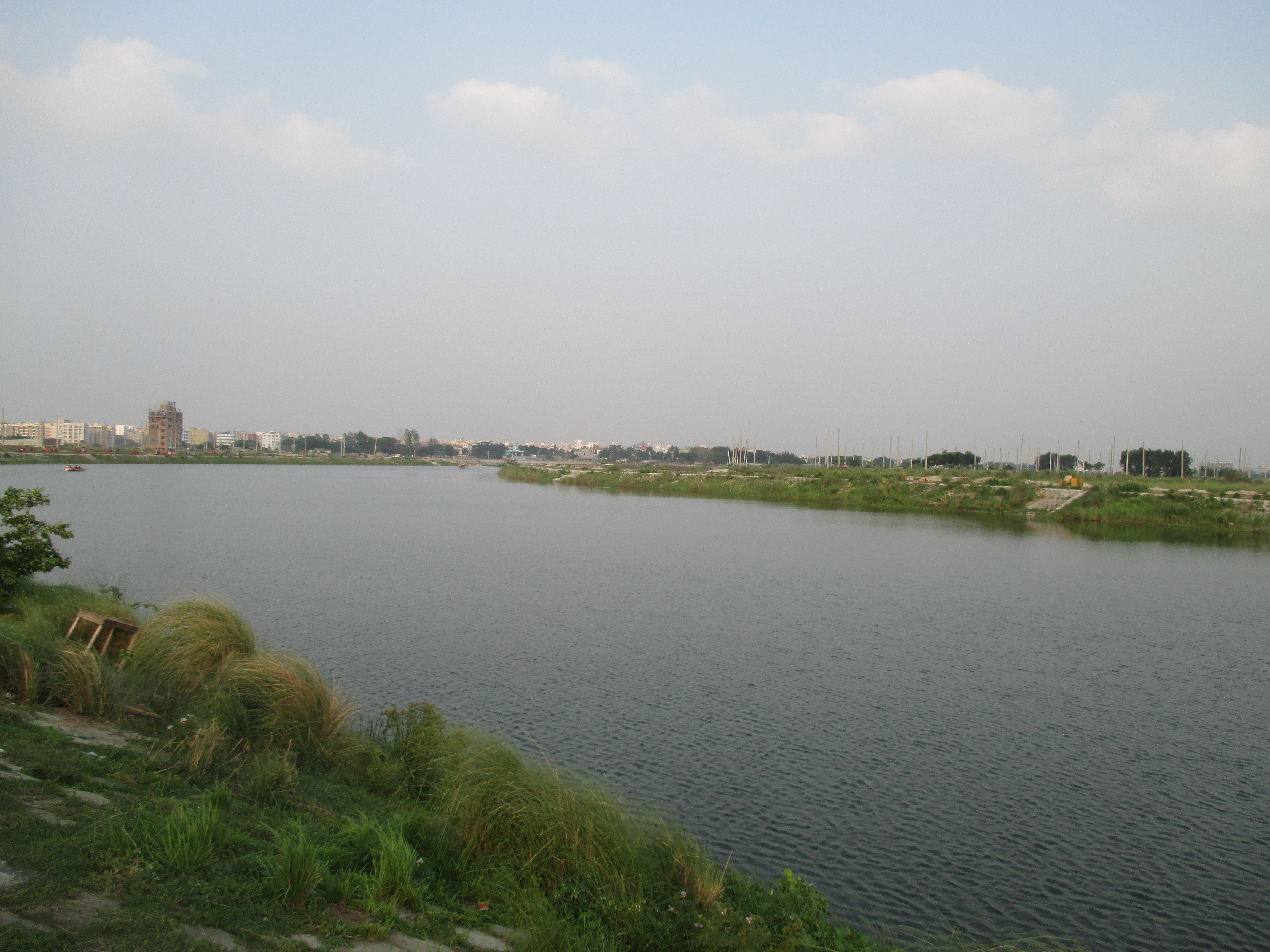
Hazaribagh is a thana of Dhaka formed in 1998 from parts of three thanas. Banglapedia gives its area as 3.94 square kilometres, bordered by Mohammadpur to the north, Kamrangirchar to the south and Keraniganj upazila to the west. The area is known for leather: about 95 percent of Bangladesh's tanneries were in and around Hazaribagh before they moved to Hemayetpur in Savar.
Eid-ul-Adha and the rules of sacrifice
The National Moon Sighting Committee met on the evening of 18 May in the Islamic Foundation's conference room at the Baitul Mukarram National Mosque. Afterwards the religious affairs minister announced that the moon of Dhul Hijjah had been sighted, so Eid-ul-Adha, the 10th of Dhul Hijjah, would be observed on Thursday 28 May. The Tuesday and Wednesday buyers were waiting for were therefore the last two market days before Eid.
The word qurbani comes from a root meaning closeness. In Islamic law it is the sacrifice of a specific animal on specific days to seek God's pleasure. It recalls the Prophet Ibrahim, who in a vision was told to sacrifice his son and was ready to do so, when God provided a ram in the son's place; Muslims sacrifice animals every year in remembrance.
Goats, sheep, cattle, buffalo and camels may be sacrificed. The animal must be healthy and free of disease, and defects such as blindness or the loss of a large part of an ear or tail disqualify it. Several people may share a larger animal such as a cow or a camel. The sacrifice may be made from the morning of the 10th of Dhul Hijjah until sunset on the 12th, or the 13th in the Shafi'i school. By custom the meat is divided into three: one share for the household making the sacrifice, one for relatives and one for the poor.
Photo: S.M.M.Musabbir Uddin / Wikimedia Commons (CC BY-SA 4.0)
Sources: Jagonews24 (25 May 2026), Desh Rupantor (3 and 25 May 2026), Daily Inqilab (25 May 2026), bdnews24.com (20 and 25 May 2026), Bangla Tribune (8, 18 and 22 May 2026), The Business Standard (10 June 2025 and 3 May 2026), Dhaka Tribune (3 and 14 May 2026), BSS (10 May 2026), The Daily Observer (22 May 2026), Prothom Alo (14 June 2023), Department of Livestock Services (Livestock Economy at a Glance 2023-24), Banglapedia (Keraniganj Upazila, Hazaribagh Thana), Wikipedia (Uttara, Hazaribagh Thana, Qurban)
Comments
(0)