
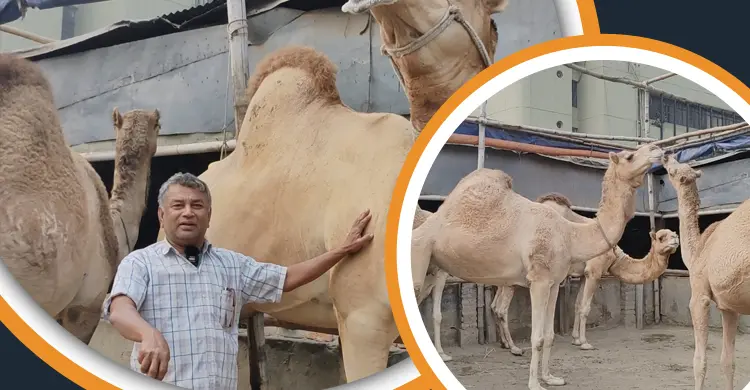
The camels are only a year old, yet they look almost like elephants. Nearly twice the height of a person, they are cared for with great attention. A large farm of camels, each worth Tk 20 lakh to Tk 40 lakh, has been set up in the capital itself.
Camel milk is in great demand for its many benefits, and a litre sells for about Tk 400. Each camel eats about Tk 300 worth of feed a day, and the farm spends more than Tk 1 lakh a month on camel feed alone.
At the farm at Dewanbagh Sharif in Arambagh, Dhaka, the first of its kind in the country, camels are raised like any other domestic animal. Visitors come constantly to see the desert camels, which are known as sacrificial animals.
From 10 camels to 65
The farm began in 2004 with 10 camels bought at the Gabtoli cattle market after they had arrived from Rajasthan. Over time the number grew to 65, though the farm no longer has that many. Sahar Ali has worked on the farm for 18 years. He said those in charge are trying to increase the number of camels.
The camels are given straw twice a day. After 11am, bran and oil cake mixed in water are also served to them together in a set container.
Like other animals, camels fall ill. Fever, gastric problems and skin disease often affect these camels, which are used to a desert climate. And because they have no hooves on their soles, their feet sometimes swell from various problems, Sahar Ali said. He believes camels can be raised well in the country's conditions, but these huge animals need special care and must be kept in groups.
Care and upkeep
The desert animals charge a little at strangers, but they have formed a special bond with those who have cared for them for a long time. The workers here even know each camel's traits in depth.
The farm was set up by Sufi Samrat Shah Dewanbagi. It is now run by those in charge of Pak Dewanbagh Sharif. About 20 employees look after the camels and do other work. They are not paid a fixed monthly salary, but their living costs are met by Dewanbagh Sharif.
Source: Jagonews24. First published in Bengali on The Agro News.
Comments
(0)