
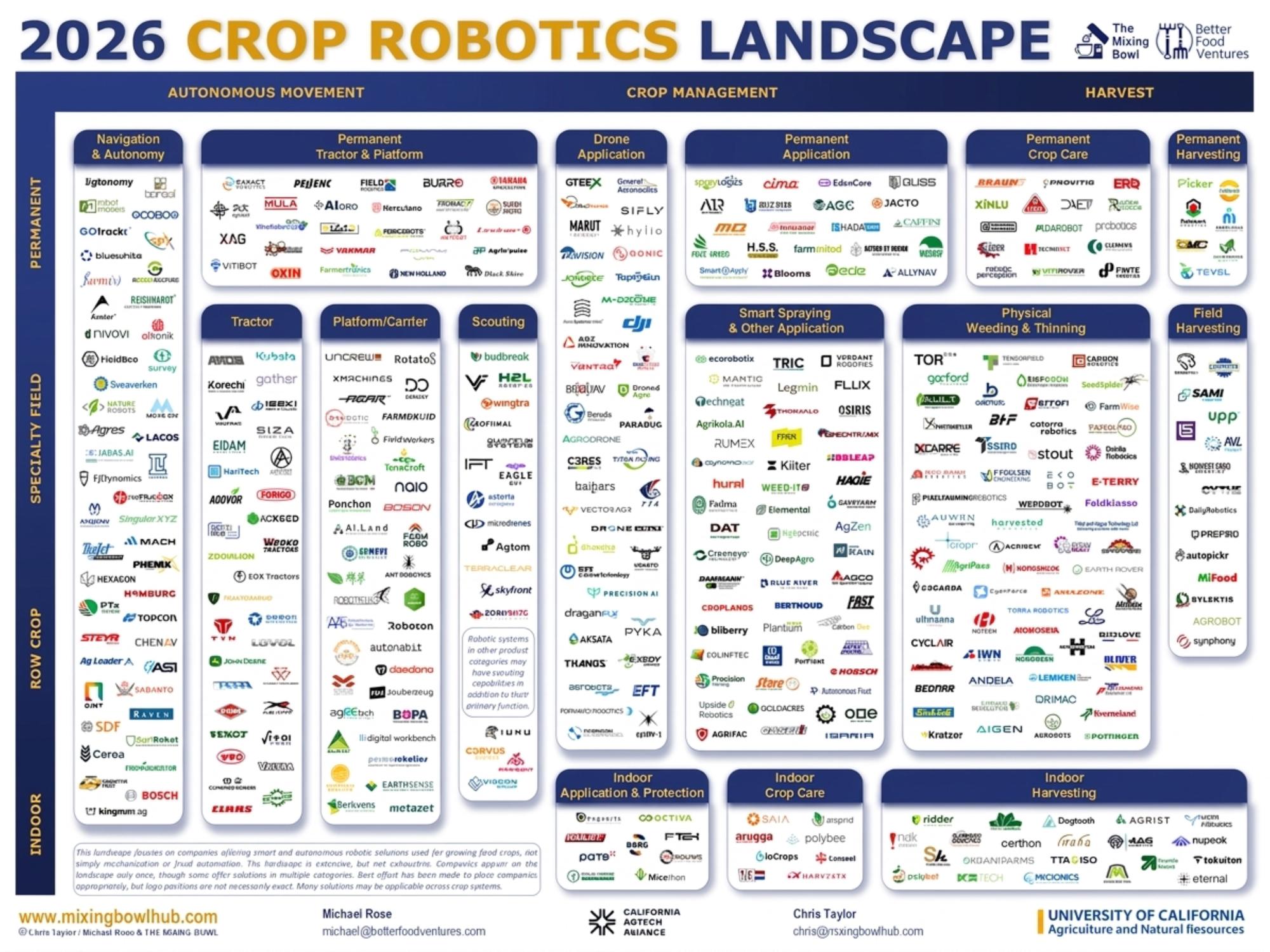
More than 400 companies around the world are now building robots for food-crop production, over 20 percent more than in 2024, according to the 2026 Crop Robotics Landscape compiled by The Mixing Bowl. The map started in 2022 with just over 240 companies and passed 330 in 2024, but the churn is as striking as the growth: 20 percent of the firms on the 2024 map have dropped off, and 36 percent of this year's are new.
Chris Taylor, a partner at The Mixing Bowl who has tracked the sector since the first landscape, said the practical question for growers is "how well these systems perform the tasks they need, at a cost and level of reliability that works on the farm". The landscape sorts the companies into 15 product and task segments across four crop systems (permanent crops, specialty field crops, row crops and indoor production) and three functions: autonomous movement, crop management and harvest. The fastest-growing segments are physical weeding and thinning and crop-care tasks such as pruning, mowing and de-leafing; harvest, Taylor said, still lags and remains the sector's holy grail.
Europe accounts for half of the companies mapped, with Germany and the Netherlands each supplying 10 percent of the global total. The United States has an 18 percent share, and more than 40 percent of those US firms are in California, which Michael Rose of The Mixing Bowl and Better Food Ventures put down to the state's mix of ag-tech development and farmland on which to test it.
On what is actually being adopted, Ben Pallone, senior director of commercialisation and automation at Western Growers, said weeding and thinning are clearly furthest along, with competing suppliers now visible across California's Salinas Valley and Arizona's Yuma region in the form of smart cultivators, precision sprayers and laser weeders. Irrigation, input management and yield mapping are well deployed in orchards and vineyards, while autonomous tractors have more traction in Arizona and Washington than in California. Danny Bernstein, founder and chief executive of Reservoir, cited an industry estimate that under 2 percent of high-value crop work is automated, with table grapes and strawberries the most labour-intensive targets and among the hardest to build robots for. One exception he named is Sami Robotics, which is automating the harvest of broccoli, romaine and, after a recent breakthrough, iceberg lettuce with a machine weighing 70,000 pounds and costing about three million dollars.
The panel's advice to farmers was to test a machine over many acres with modest weed pressure rather than in the weediest field, to treat suppliers' return-on-investment calculators with suspicion, and to insist on seeing equipment run on ground like their own; Pallone described a growers-only Western Growers field day at which two machines were bought on the spot. Bernstein said a step change in price moves sales quickly, pointing to Bonsai Robotics, which sells a platform for about $60,000 against competitors near $250,000 and has sold more than 400 robots. Both flagged light platforms as an underrated advantage, since they compact soil less and can enter wet fields sooner.
For smaller growers, Pallone suggested sharing the cost of a laser weeder with neighbours or using robotics-as-a-service offers to try before buying. Sebastián Sánchez of the California Labor and Workforce Development Agency said adoption is changing the skills crews need, and Pallone cited a worker who moved from a hand-weeding crew to running six to eight smart cultivators over thousands of acres. Sarah Masterson of the California AgTech Alliance closed by saying capital, a proven business case and the risk of first adoption remain the barriers between the 400-plus companies and working farms. The landscape graphic and executive summary are free at mixingbowlhub.com.
Source: Future Farming
Comments
(0)