
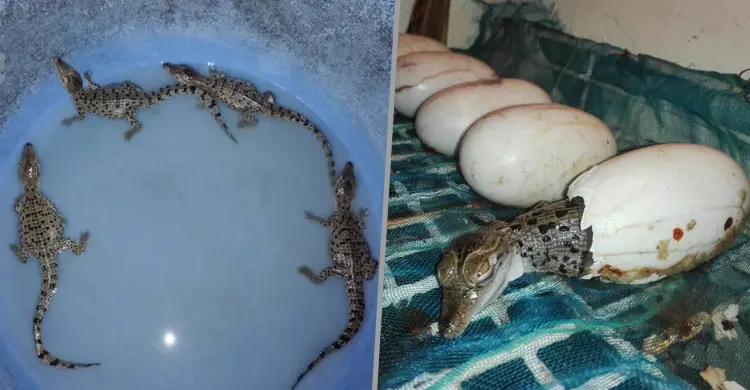
Just four hatchlings have emerged from the 44 eggs laid by Pilpil, a saltwater crocodile, at the Karamjal wildlife breeding centre in the eastern Sundarbans in Bagerhat. After Pilpil laid the 44 eggs on the bank of the centre's pond on 12 June, the eggs were collected: 21 were left in Pilpil's nest on the pond bank to hatch, 12 were put in an old incubator and 11 in a new incubator. On the morning of Saturday, 5 September, four hatchlings emerged from the 11 eggs in the new incubator.
Recently, tidal water flooded Pilpil's nest on the pond bank, and all 21 eggs there, along with all 12 in the old incubator, were spoiled. Earlier, on 29 May, another crocodile, Juliet, laid 52 eggs, but none of them hatched.
First hatchlings in three years
No hatchlings came from Juliet's or Pilpil's eggs for the past three years, so the Sundarbans forest division sees a ray of hope in the four hatchlings from Pilpil's 44 eggs this time. Officials at the breeding centre said Pilpil's eggs hatched after the older male Romeo was removed a year ago and a new young crocodile named Alexander was kept with Juliet and Pilpil.
With the four hatchlings, the centre now has 199 crocodiles in all. Breeding at the centre is carried out with just two females, Pilpil and Juliet.
Md Azad Kabir, officer in charge of the Karamjal wildlife breeding and tourism centre in the Sundarbans' Chandpai range, said four hatchlings emerged from the 11 eggs in the new incubator on Saturday morning. In 2020 Pilpil laid 44 eggs and Juliet 52; four of Pilpil's hatched but none of Juliet's. In 2017, 2018 and 2019, not a single hatchling came from Pilpil's or Juliet's eggs.
He blamed the failures on not getting the right temperature at the right time and on faults in the centre's incubators. He believes that, using this year's experience, more hatchlings can be produced from crocodile eggs in future using the new incubator.
The forest department set up the breeding centre at Karamjal in 2000 mainly to breed and multiply the saltwater crocodile, which is nearly extinct in the Sundarbans. The centre now has 199 crocodiles of all sizes. The forest department has also released 97 adult crocodiles from the centre into the rivers of the Sundarbans.
Source: Jagonews24. First published in Bengali on The Agro News.
Comments
(0)