
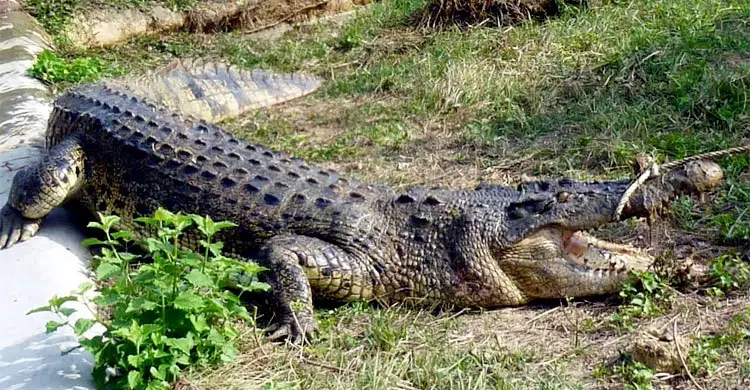
Reptiles Farm Limited began the country's first commercial crocodile farming project at Hatiber village in Bhaluka upazila of Mymensingh. The farm, which started in 2004 with 74 adult crocodiles, now has about 3,500 crocodiles large and small. It began exporting in 2010 by sending frozen crocodiles to a university in Germany. Over the past four years, 1,256 crocodile skins have been exported from the project. Sixty-nine frozen crocodiles were exported for about $100,000 to a German university the report names as Haiberg University.
The entrepreneurs say that from 2021-22 it will be possible to export 1,000 crocodile skins every year. They also plan to export crocodile meat, skin, teeth and bone from the farm in future.
According to the farm authorities, Japan is a major market for the skins, where one square foot currently sells for about $12. A crocodile yields 45-50 feet of skin, so one skin sells for $400-600 depending on type. The project has earned more than Tk 60 crore from crocodile exports in the past four years, or about Tk 15 crore a year.
How the farm began
Sources said several entrepreneurs, including Mejbaul Haque and Rajib Som, took up the crocodile farming project in 2003 and named it Reptiles Farm Limited. It was set up on about 14 acres at Hatiber village, where 14 ponds were dug on 4 acres using scientific methods. The Ministry of Environment and Forests approved the project in 2004. Later, subject to approval from the international body CITES, 75 crocodiles were brought from Sarawak in Malaysia on 22 December that year at a cost of about Tk 1.25 crore. One died in transit. The crocodiles were then 10-14 years old and 7-12 feet long, and 15 of those imported were male. The farm now has about 3,500 crocodiles.
Breeding and care
Farm manager Dr Abu Saim Mohammad Arif said the breeding season is April-May, the rainy season. Females lay within a week of mating, an adult laying 50-60 eggs on average. The eggs are kept in international-standard incubators, since control of humidity and temperature is vital for hatching. Hatching takes 80-85 days, and temperature decides the sex of the young: above 32 degrees, males are more likely.
After hatching, the young are kept for a while in small houses and moved step by step, with intensive care, to the hatchery. After a few months they are moved to separate ponds. With regular care, the skin is ready to harvest in 3-4 years. Crocodiles have almost no diseases, he said. The young are fed minced meat every day, while adults are fed once a week, on chicken, beef and fish.
Export plans
He said about 300-400 crocodile skins are now exported every year, with 1,256 exported in the past four years in total. It is hoped that from 2021-2022 the farm will be able to export 1,000 skins a year. Each skin sells for $400-600, the price depending on size and quality. With government permission, crocodile meat could be sold to five-star hotels at home and abroad to earn foreign currency, and the farm also plans to export teeth, bones and other parts.
The manager added that production rises every year. Male crocodiles grow faster than females, so the farm is trying to raise more males. About 60 permanent and temporary workers are employed on the farm. Because of it, Hatiber has become known as "the crocodile village".
Source: Jagonews24. First published in Bengali on The Agro News.

Comments
(0)