
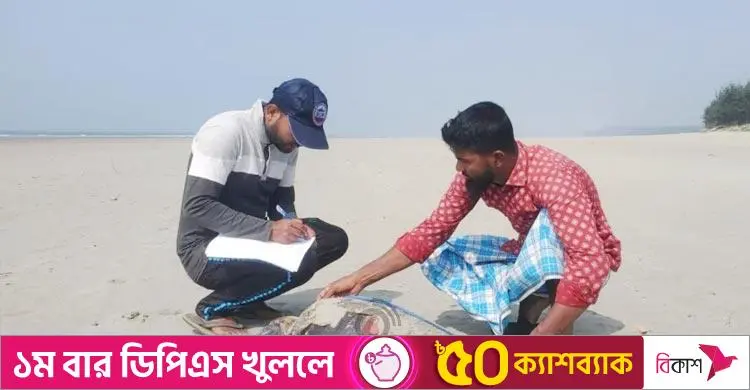
The Cox's Bazar coast of two or three decades ago has changed a great deal, and with it ways of life and nature. Countless people have lost their homes to sea and river erosion, and there is the impact of climate change as well. Now countless mother turtles, known as the "cleaners" of the sea, are being caught in fishermen's nets as they head for the beaches to breed. Most alarming of all, the toll of turtle deaths keeps growing.
Last week the Bangladesh Oceanographic Research Institute (BORI) recovered the carcasses of more than a hundred mother turtles from various parts of the Cox's Bazar coast. BORI scientific officer Muhammad Shimul Bhuiyan said the dead turtles were recovered from beaches at Teknaf, Ukhiya, Himchhari in Ramu, and Nazirartek in Cox's Bazar municipality.
He said: "Local people saw turtle carcasses lying at various places on Cox's Bazar sea beach and informed us. We went to the sites and recovered them. They are olive-coloured, or olive ridley, turtles. After examining them, we buried them in the sand."
Survey on foot
Muhammad Shimul Bhuiyan said that over four consecutive days, on 24, 25, 26 and 27 January, 70 dead turtles were recovered between Sabrang Zero Point in Teknaf and Ruppati, Sonarpara, Pencharadwip and Himchhari in Ukhiya upazila. After a one-day break on 28 January, the final search on 29 January found 14 more dead turtles between Nazirartek and Pencharadwip-Monglapara.
He said a five-member BORI research team surveyed about 30 km on foot. Most of the turtles recovered were olive ridley sea turtles, and most were carrying eggs. They were buried after the necessary information was collected. "Not all the turtles died recently. Some died two months ago; we found many skeletons. More than a hundred dead turtles have washed ashore in the last 24 days," he said.
The scientific officer said 29 dead turtles were found at various points on the Cox's Bazar coast in January-February 2024. So many turtle deaths in the breeding season have worried researchers, and they point to the destruction of the turtles' breeding grounds.
According to BORI, the sea turtle breeding season runs from November to March, when mother turtles come to the coast to lay eggs. Many are killed after being caught in fishermen's nets set along the coast or struck by vessels at sea. The real cause of these deaths will be known after investigation.
According to the institute, at least 29 dead turtles were found on the beaches at Sonadia, Himchhari, Sonarpara, Inani and Teknaf between 1 January and 20 February 2024, when three dead dolphins also washed ashore.
Nesting sites shrinking
Nature Conservation Management (NACOM), an organisation working on nature and the environment, says mother sea turtles are now in grave danger. A survey by the organisation in 2003, described as ten years ago, found that turtles came to lay eggs at 52 points on the Cox's Bazar coast, which were then safe havens for them.
Dr Shafiqur Rahman, NACOM's deputy project director, said that where mother turtles came to lay eggs at 52 points ten years ago, the number has now fallen to 34. The turtles laid eggs in secluded stretches of beach from Sonadia in Maheshkhali to St Martin's Island. The conditions they need to return to the deep sea after laying are being disrupted, so mother turtles are dying all the time.
Abdul Kaiyum, NACOM's natural resource management and climate change manager, said turtles come to lay eggs on secluded beaches, and for various reasons the nesting sites are now at risk. Along with the growth of tourism, unplanned infrastructure, lighting on Cox's Bazar beach, abandoned nets dumped in the sea, and beach diving, sports and walking on the beach during the laying season are destroying the turtles' nesting environment.
He added that illegal current nets planted on the beach disrupt the mother turtles' movements, and turtles also die after being caught in trawl nets in the deep sea. Even when they lay eggs on the beach, the eggs cannot be protected: dogs eat them, and packs of dogs pounce on turtles as soon as they come ashore to lay.
Calls for action
Expressing concern at the deaths in the breeding season, HM Ershad, president of the Cox's Bazar district unit of Bangladesh Poribesh Andolon (BAPA), said the unregulated movement of tourists is keeping turtles from coming ashore to lay eggs. Meanwhile, about 20,000 trawlers from Sandwip, Sonadia, Kutubdia and other coastal areas go fishing in the deep sea. Fishermen set floating nets, sinking nets, trawl nets and 40 to 60-foot-long behundi and laikkha nets at sea, and many tong nets are set near the coast. Turtles get caught in them.
Omar Faruk Joy, chief executive of the environmental volunteer group We Can Cox's Bazar, said dead turtles are found every breeding season, with injury marks on their bodies. When turtles are caught in fishing nets planted at sea, fishermen kill them by beating them with sticks or striking them with sharp weapons, and throw them into the sea. When they wash ashore on the tide, dogs eat them. Fishermen must be made aware, nesting sites made safe and dogs kept off the beach, or the turtles cannot be saved.
ANM Helal Uddin, president of the Cox's Bazar Citizens' Forum, said climate change has altered nature along the coast. Many old villages have been lost to erosion, and in many places new chars have changed river courses and the shoreline. As turtles come ashore to lay eggs, fishermen often see them as a nuisance and kill them with bamboo, wood, iron and other hard objects, and the carcasses later wash ashore with the waves.
Calling on BORI and fisheries officials to pay attention to controlling this, he said dead mother turtles also washed up at various points on the beach at this time of the breeding season last year. But compared with last year, the death rate this time seems abnormal.
Source: Jagonews24. First published in Bengali on The Agro News.
Comments
(0)