
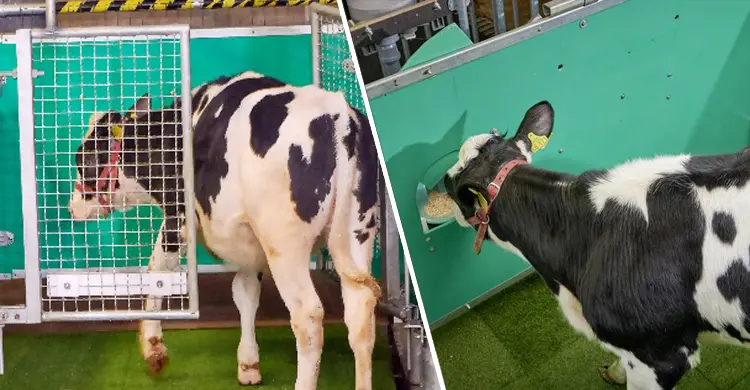
When angry, we often call foolish people "cows". But cows are not as foolish as they seem. They are quite clever, pick up what they are taught quickly and can master many things faster than human children.
When needed, these animals can even open a door and go to a toilet. They do not relieve themselves just anywhere on the farm, and they understand that a bathroom becomes dirty after use, so they can flush it clean afterwards. Then, with the job done, they open the door and walk out of the bathroom as normal.
This information comes from a recent study published in the international scientific journal Current Biology. The research was carried out jointly by Germany's Research Institute for Farm Animal Biology (FBN) and the University of Auckland in New Zealand.
Why livestock waste matters
As farming areas expand, air pollution from the waste livestock leave on farms is steadily rising. It produces highly toxic ammonia and greenhouse gases, adding to the danger of warming, which is becoming a cause of fast-paced climate change. The United Nations climate report last August also expressed concern about this and asked scientists to suggest ways to cut greenhouse gas emissions from livestock waste on farms.
Ammonia itself is not directly one of the causes of climate change. But when livestock dung and urine mix with the soil, bacteria and some other micro-organisms turn the ammonia into nitrous oxide, the third most dangerous greenhouse gas after carbon dioxide and methane. Agriculture is the world's biggest source of ammonia emissions, and livestock dung and urine are responsible for half of it.
Three common ideas proved wrong
The researchers have disproved three widely held ideas. First, they showed that livestock prepare in advance to relieve themselves; it is not that they suddenly do so because they cannot wait.
Second, the researchers showed that if cattle are trained to relieve themselves in a bathroom, they learn the habit very quickly, faster than newborn babies and even children of one or two years old.
Third, when rewarded with treats, livestock pick up the habit faster than human children, which the researchers say proves them cleverer than human children.
One of the researchers, animal psychologist Jan Langbein, said that when cattle and buffaloes relieve themselves anywhere on a farm, the farmland and the channels inside it become polluted. And if livestock relieve themselves in the farm's crop stores, the waste stays there for a long time and produces toxic ammonia gas, a greenhouse gas. "So by getting livestock into the habit of using a toilet, we wanted to reduce emissions of toxic greenhouse gases such as ammonia into the air," he said.
How the training worked
The researchers used a special method to train the animals, called "Mulu training". The livestock were first lured with tempting food. They were then taught how to open the door and enter the bathroom just before relieving themselves, and how to keep the bathroom clean when they had finished.
Langbein said the researchers initially also set some fairly strict punishments to get the animals into the habit. Whenever they relieved themselves outside the bathroom, they were punished harshly; the report says these punishments involved food or water over long periods, and some minor penalties were also given.
The researchers said a good response came within a few weeks of training. Of the 16 cattle, 11 took up the habit of going to the toilet to relieve themselves and cleaning the bathroom within three weeks.
Another finding surprised the researchers: livestock also have a sense of self-respect. When one animal sees another picking up the bathroom habit quickly, it feels uneasy at not having managed it, and tries to learn the habit as fast as it can.
Source: Jagonews24. First published in Bengali on The Agro News.
Comments
(0)