
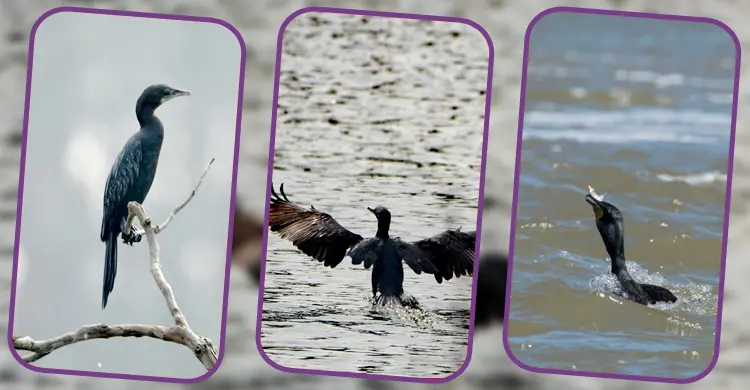
Travelling by boat through ponds, rivers, canals, haors, baors and beels, you will often see a darkish bird perched motionless, wings spread, on top of a bamboo stick or pole planted in the water. This natural beauty seems to outdo even a famous sculpture. The bird, one of the best underwater swimmers, is the cormorant, known in Bengali as the pankouri. It features widely in literature, art and culture. In rural Bengal, when a restless child stayed under water too long, people would say the boy or girl was diving all day like a pankouri.
The water bird is very familiar to everyone in Bangladesh. Because of its black colour it is also called the water crow. In rural areas it is known as paniuri, panikabadi, panikaur, panikahur, panikauya and panikukkut. In English they are known as cormorants and shags.
Three species in Bangladesh
There are about 40 species of cormorant in the world. Three are found in Bangladesh: the large, the medium or native, and the little cormorant. Their bodies are a bright black, but in sunlight the back gives off a bluish-green sheen. They grow to about 50-60cm long. There is a white patch on the throat and the underwing feathers are grey. The tail is shaped rather like a winnowing tray. The bill is slender with a hooked tip. The legs are short like a duck's, and the eyes greenish-brown. There is a crest-like tuft of feathers on the head. The large cormorant's bill is entirely black, while the little cormorant's is slightly white. Their call is hard to hear; only at nesting time do they give a harsh "hoop-hoop" call, rather like a muffled cough.
The cormorant is an excellent swimmer and can dive deep in search of fish. This diving skill is put to use in China, Japan, Korea, Vietnam and Cambodia, where they are used to catch fish. In China, Japan and Vietnam in particular it is regarded as part of tradition, and many tourists still travel to rivers in these countries to watch fishing with cormorants. Guano, a fertiliser produced from cormorant droppings, is well valued as a commercial product.
Watching the bird dive for long spells to catch fish is delightful. Every little while it dives swiftly into the depths, then pops up with a fish and swallows it. Seen from afar, its underwater swimming can be deceptive: it looks like a snake racing through the water. Best of all is when, after a long time under water, it climbs onto bushes, branches, weeds, a bamboo post or a stick and holds its wings up to the sun to dry.
Diet and breeding
The cormorant's diet includes small and medium fish and fry such as taki, shol, gajar, shing, magur, baim, puti and tengra. It also eats snails, water spiders, aquatic insects, other insects and small water snakes. The rainy season is its favoured time for breeding and nesting. It likes tall tamarind, mango, jamun and hijal trees in villages beside water bodies. Several pairs of cormorants and egrets nest together in the same tree, or a single pair takes over a tree on its own.
By habit, they nest in the same place for several years running. Building a nest takes them 4 to 6 days, but the nest is not as artful as those of many other birds. The female lays 4-5 eggs, and male and female take turns to incubate them. The eggs take 27-29 days to hatch, and the chicks learn to fly 35-40 days after hatching. They try to fly as soon as their wings grow, and once they can fly, the parents train them in diving. The parents bring fish back in their stomachs and regurgitate it at the nest for the chicks to eat.
Now threatened
Cormorants are found across South and South-East Asia, including Bangladesh. Even 50-60 years ago there were plenty all over Bangladesh. They roamed freely in ponds, large ponds, paddy fields, beels big and small, haors, baors, ditches, canals and rivers across the villages; wherever there was water and fish, they could be found. Now they are seen mostly in beels, haors, baors and some river mouths or creeks.
Over time, nature's hostility and human abuse have left the cormorant threatened and nearly endangered. To keep nature balanced and diverse, it is the duty of us all to protect this water diver, which is protected under Bangladesh's wildlife law.
The writer, Benazir Ahmed Siddiqui, is a pharmacist and social worker.
Source: Jagonews24. First published in Bengali on The Agro News.
Comments
(0)