
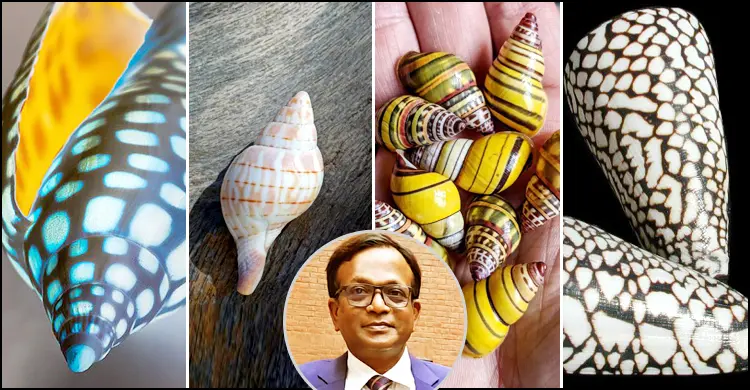
On coral islands in the seas of the Philippines, Australia and other tropical countries, and on trees in swamp forests, lives a killer snail called the cone shell. These snails lie in wait for prey. Of the 500 species of killer snail, two are extremely dangerous: their sting can threaten not just fish but even human life.
The snails survive by eating venomous insects, though they sometimes do not hesitate to eat their own kind. For some cone shells, fish are the main food, and they catch and swallow them with great skill.
How the snail hunts
The snail pushes out a long, tube-like venomous proboscis from its mouth. When an unwary fish or insect snaps at it thinking it is food, trouble begins. The spear-like tube sticks into the fish's body, and the fish is instantly struck by the powerful venom. It either dies on the spot or hangs helplessly, pierced as if paralysed. Even when the prey is large, the snail does not shrink from killing it. It draws the prey on the tip of the tube to its mouth and the meal begins. A few hours later it spits out the bones and skeleton; by then the rest has been digested.
From poison to medicine
Recently the venom of these snails has come into wide use in making medicines. What is harmful to insects or fish can sometimes benefit people. Most venomous animals carry only small amounts of toxin, but cone shells carry a great deal. Research has shown that the venom can prevent and relieve agonising pain, severe brain injury, stroke and so on. The venom is also a powerful remedy for leprosy, depression and schizophrenia. Because of these uses, the killer snail is now being called the "doctor snail". Drug companies have begun competing to see who can discover the most new medicines using cone shell venom, and are waiting at laboratory doors with sacks of money to buy the rights to any toxin discovered from the snails.
Researchers at the University of Utah laboratory in Salt Lake City, Utah, in the United States found that the snail's venom is far more powerful than cobra venom. Once it enters the body, death is certain: first the muscles go numb, then the blood stops circulating, and the result is death. The venom of some cone shells is like that of the Japanese fugu pufferfish, stopping the flow of sodium ions in the victim's body.
Numbness caused by venom is nothing new. What makes the cone shell in demand among researchers is that its venom has short amino acid chains. Where cobra venom has 60 to 80 amino acids and a spider's has 1,000, this snail's has the fewest: from 10 to 30. Fewer amino acids mean it can be synthesised quickly. Because its toxin level is low, the venom works as a medicine. For patients who do not respond to morphine, pethidine and the like, or who have drug reactions, this low-toxin venom can bring quick recovery.
Early results
Using the toxin as a medicine is producing major benefits. The American drug company Warner Lambert says the toxin has encouragingly reduced the severity of stroke and serious head injury in patients. Scientist Olivera believes that leprosy will one day be completely cured with the venom. Researchers have also expressed hope that the toxin could play a strong role against incurable diseases such as AIDS and cancer. What is needed now is wider research and testing.
Although Australian scientists were the first in the world to isolate venom from the killer snail, scientists in the United States have already begun using it to treat disease. The journal Nature has reported that University of Utah researcher Olivera observed differing side effects when the venom was given to mice: some fell asleep, while others shook their heads, ran about and became more active. Health scientists hope the venom can be used to treat diabetic neuropathy, and even to cure epilepsy.
Researchers at the Institute of Biological Chemistry at the University of Vienna in Austria told Science Daily that it is a thousand times more effective in treating disease. Moreover, it is not addictive like morphine, heroin or opium, which have side effects, whereas the snail's venom has none. For this reason the conotoxin has already been approved by the US Food and Drug Administration (FDA), and it is being given as an injection directly into the spine to relieve chronic pain.
Keep your distance
Still, researchers give a word of caution: unless you want to end up at the doctor's in a dangerous state, avoid cone shells however beautiful they look, because their venom can kill you instantly. When visiting sea coasts or swamp forests, take every step carefully. Even if you want to collect the snail's attractive shell, touch it very carefully. Pick up a cone shell for fun or out of bravado, and its movement on your hand or foot may be the last movement your hand or foot ever makes.
The writer is a science writer and researcher.
Source: Jagonews24. First published in Bengali on The Agro News.

Comments
(0)