
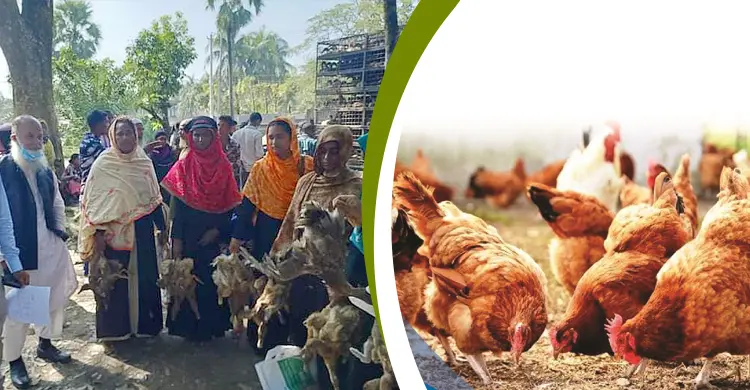
Women are playing a major role alongside men in the country's overall economy, keeping pace with the times, and their progress in the rural economy is far greater than before.
The "Integrated Livestock Development Project in Coastal Char Areas" is playing an important role in creating rural women entrepreneurs. After basic training through the project, women receive ducks, chickens and sheep, and with that small capital the women of the coastal region are establishing themselves as entrepreneurs alongside men.
How the project works
The project, under the Department of Livestock Services, has generated wide enthusiasm among deprived people on the coastal chars of Bangladesh. It is being implemented in 68 unions of 16 coastal upazilas in Barishal and Chattogram divisions, with 500 beneficiaries in each union, 34,000 in all. After three days of basic training, each beneficiary receives 20 ducks, 20 chickens or three sheep free of charge, along with free sheds, feed, medicine, vaccines and treatment for the animals.
Of the 34,000 beneficiaries, 90 per cent, or 30,600, are women. Rearing ducks, chickens and sheep at home, they are supporting their families and helping to enrich the rural economy. The project is contributing to women's empowerment, reducing unemployment among deprived char people and meeting the need for quality nutrition.
Beneficiaries in the project areas said many have already received their 20 ducks, 20 chickens or three sheep after the basic training, together with sheds, feed, medicine and vaccines.
Beneficiaries' stories
Shamsunnahar Begum, a beneficiary from Nabagram in Ward 6 of Dhansiri union in Noakhali's Kabirhat upazila, said: "We got 20 chickens after three days of training, and now we have 120. I have sold about 600 eggs."
Morjina Begum, a beneficiary from South Jagadananda village in Ward 6 of the same union, said: "I took the three-day basic training and received three sheep, a shed, feed, medicine and vaccines free of charge. Now I have seven sheep."
Mst Monika, a beneficiary in the chicken-rearing group in Barguna Sadar upazila, said she gets 12 to 13 eggs a day on average from the 20 chickens she received from the project and has so far produced about 50 chicks. She has built up capital of about Tk 8,000.
Livestock, jobs and nutrition
In the 2018-19 fiscal year, the livestock sector contributed about 1.53 per cent of Bangladesh's GDP, but like other sectors it stumbled somewhat during Covid-19. According to the Economic Review 2019, Bangladesh's unemployment rate was 4.19 per cent. During the Covid-19 outbreak about 53.64 million people in the country lost work whose daily income had been only Tk 160, or $1.9. Average household income fell by about 74 per cent from March to May. In this difficult situation, rearing cattle, goats, ducks, chickens, turkeys, sheep and pigeons can show unemployed people a way forward.
An adult in Bangladesh needs 120 grams of meat and 250 ml of milk a day. Against this background, the project is playing a major role in meeting the demand for milk, eggs and nutrition, reducing unemployment and involving neglected people on the coastal chars, especially women, in economic activity.
Dr SM Ziaul Haque Rahat, director of the project, told Jago News that there is no alternative to bringing deprived and neglected sections of society, especially the people of the coastal chars, into the economic mainstream to implement Vision 2021 and Vision 2041 announced by Prime Minister Sheikh Hasina. The project is playing an important role in helping them become self-reliant by giving training and, free of charge, 20 ducks, 20 chickens or three sheep, plus sheds, feed, medicine and vaccines, he said.
He added that local public representatives and beneficiaries have thanked the prime minister for the project, and have asked the fisheries and livestock minister, the secretary and the director general of the Department of Livestock Services to expand the project area.
Source: Jagonews24. First published in Bengali on The Agro News.
Comments
(0)