
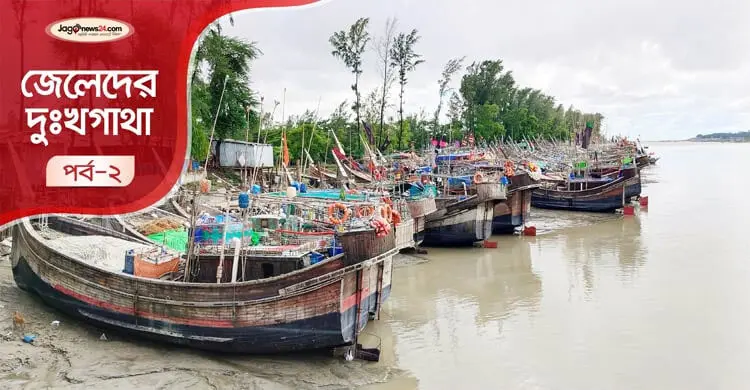
Dadon advances and loans are the bane of more than a million fishermen in Bangladesh's 19 coastal districts. The profession carries risks to life, hardship and grief, and there is no relief even in death: the family has to carry the burden of debt. The country's fisher protection law is neither up to date nor realistic, incentives do not reach fishermen properly during fishing bans, and the government has no plan to improve the lot of people in this profession. Today brings the second of a three-part series on fishermen's hardships by Kajol Kayes, Lakshmipur district correspondent.
Mosharaf Malakar, 55, a resident of Parabogula on the Water Development Board (BWDB) embankment at Char Bhairabi in Chandpur, died on 1 July. He fished in the rivers and the sea. Nazrul Islam Fakir, an arotdar at the Char Bhairabi fish landing, is owed Tk 1.5 lakh in dadon by him. A samity, local shopkeepers and several others are owed around another Tk 2 lakh.
Mosharaf's wife Farida claims her husband died from the stress of these debts. Now the creditors go looking for them, and she has to keep moving around with the children.
Dying in debt
Sharif Jamaddar, 58, a fisherman from the Mainuddin Ghat area of Char Fasson in Bhola, died at the start of the year. He had taken at least Tk 10 lakh in dadon from several arots in Chandpur, Bhola and Lakshmipur. Yet after his death, local people raised money with his wife Hanufa to pay for his shroud and burial.
In anger and grief, Hanufa told Jago News: "It would have been better if I had died with him. Where will I get the money to pay people back?"
Latif Majhi, an elderly fisherman of Jahajmara in Hatiya, Noakhali, died recently. Fishermen say Latif had been in debt since birth, and he wasted away and died worrying about repaying loans of at least Tk 25 lakh.
Most fishermen die with the burden of debt. This is not only the case in Lakshmipur, Chandpur, Bhola and Noakhali; to a greater or lesser degree the picture is the same in all 19 coastal districts of Bangladesh. More than a million fishermen live in this region, and only a few of them can be found who have no debts.
From childhood they go to the rivers and sea with their fathers or other family members to earn a living. Though they learn to grip the oar firmly and master the art of casting nets, each fisherman seems like a soldier defeated in the battle of life. Want is their constant companion. With time, even when the skin clings to their bodies in old age, the struggle does not end. Then, in the end, there is no relief even in death, and their families go on being crushed under the burden of debt.
Widows left with the loans
At noon on 3 October, in blazing sun, an elderly woman signalled a motorcycle to stop on the part of the BWDB embankment at Hatcheryghat in Charbangshi, Raipur, Lakshmipur. Coming close, she said: "Which samity are you from? I haven't received any relief, son!"
Her name is Buli Begum, 55, and she lives in Char Kachia. Her husband Moktar died about a year ago leaving debts of Tk 6 lakh. Her father-in-law died 15 years ago, also leaving debts, which Moktar paid off by fishing in the river. Now she lives in a house built on someone else's land. She has no children, and she has no peace for worrying about her husband's debts.
Aziz Dewan, 65, a fisherman of Baranaiya Bari in Raipur, died last Ramadan leaving five children. He had gone fishing in the river the day before. His wife Nazma Begum said he owed Tk 4 lakh to trawler owner Babul Majhi and dadon lender Nasir Khan, and Tk 1.5 lakh to NGOs and samitys. Describing an uncertain future, Nazma Begum said: "What can be done! The children will have to pay off the debts little by little."
Joynal Uddin Bepari, a fisherman of Baranaiya Bari, fell ill and died in hospital at the start of 2021. He owed Tk 25 lakh. Joynal lived with his six children in a house built on someone else's land at his in-laws' home. Thirteen months after his death, his schoolboy son Nirob was killed by lightning while fishing in the river.
Joynal's other son, Farhad, told Jago News that after his father's death the creditors held back the body for the money. "My brother died while fishing in the river. We got no help, government or private," he said.
This is the cruel and inhumane situation that descends on the families of fishermen who die in debt. Almost every fisher family is tied up with loans from fish-landing arotdars, moneylenders, village usurers, samitys and NGOs. Holding back bodies after death, obstructing shrouding, burial and funeral prayers, abducting family members, beatings and threats, keeping signatures on blank stamp paper and naming people as accused in cases happen all the time.
How the dadon system began
Fishermen said that until the 1980s fishing was done mainly from small sailing boats on the rivers, and there was no dadon or loan system. It all started after 1980, when fishermen needed engine-driven boats because more fish could be found in the deep sea. In those days it took Tk 2-3 lakh to build a boat and fit it out with nets and gear. Capitalists such as arotdars and moneylenders then arranged for fishermen to go to sea by giving dadon or loans. They caught plenty of fish at sea and everyone profited.
In 1985 the non-governmental organisation (NGO) Community Development Centre (CODEC) launched, for the first time, a programme for "protecting the rights and improving the socio-economic lives of coastal fishermen". It was the first to approach fishermen by forming samitys, encouraging them to take loans with the dream of becoming self-reliant. Gradually new NGOs and samitys spread, and fishermen slowly became trapped in a web of loans. An unhealthy competition in fishing began, with the indiscriminate killing of fry, jatka and mother fish.
The impact of climate change was added to this. Alongside reckless human activity came adverse behaviour by nature. Fewer fish came into the country's rivers and sea, and fishermen's nets came up short. They often had to return empty-handed, and as they fell into want their debts grew further. Where a trawler needed Tk 2-3 lakh in the 1980s, it now costs Tk 40-50 lakh.
Calls to end dadon
Mostafa Bepari, president of the Raipur upazila unit of the Jatiya Matsyajibi Samity, said: "Fishermen seem to be deprived from birth. Generation after generation, the government has taken no effective steps to secure their rights. Apart from a handful, every fisherman in the country is weighed down by a lifetime of debt. In many places creditors even obstruct the burial of the body after death. It is possible to improve fishermen's lives by drawing up a non-partisan list and providing rehabilitation and loans on easy terms."
Rafiqul Islam Montu, a native of Barguna, has been reporting on the hardships of coastal people for 25 years. He said there are more than a million fishermen in the coastal districts, each with their own story of struggle. Because of new chars rising in the rivers, climate change and other reasons, fishermen are no longer getting the fish they hope for, leaving their families in financial crisis. "Even after death, fisher families have to carry the shame of want and the burden of debt - that is the reality," he said.
Dr Anisur Rahman has been researching hilsa for 33 years. The former chief scientific officer of the Bangladesh Fisheries Research Institute told Jago News that hilsa and fishermen's lives are tightly bound to the dadon syndicate, and that research is needed on the dadon, arotdar and middleman networks.
He said fishermen catch fish at the risk of their lives while the dadon lenders reap the benefits. Fishermen must be freed from the dadon trap. For that they need to be made aware through training, and if necessary rescued with low-interest loans and a one-off government grant.
At an awareness meeting in Bhola on 22 October, Farida Akhter, adviser to the Ministry of Fisheries and Livestock, said the dadon system for fishermen must be stopped. "Because of it, fishermen cannot stand on their own feet. In response to fishermen's demands, we have already started raising these issues with the government. Even if we cannot give fishermen completely interest-free loans, arrangements will be made for low-interest loans," she said.
Read the third part tomorrow: The law to protect fishermen exists, but it is not enforced.
Source: Jagonews24. First published in Bengali on The Agro News.

Comments
(0)