
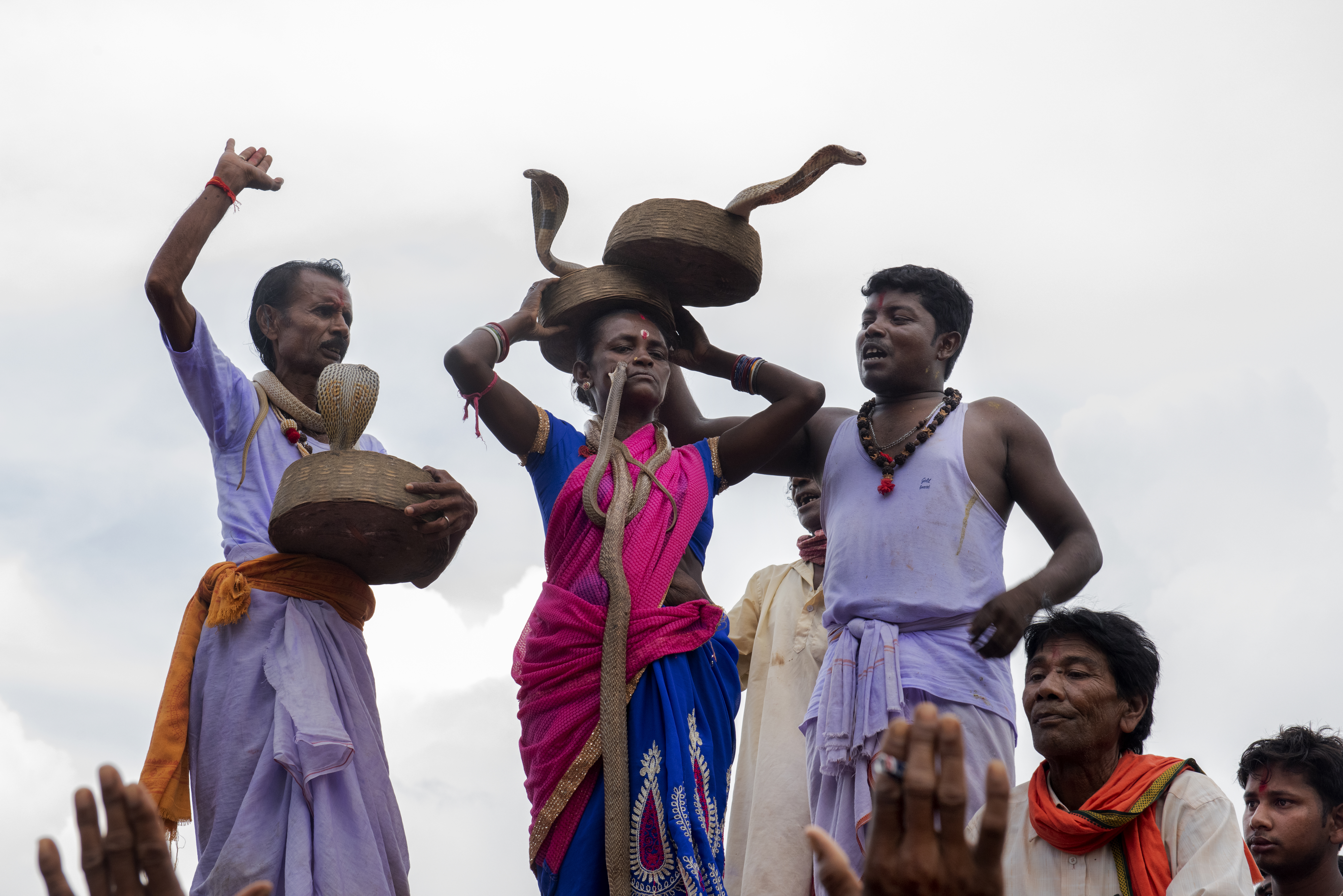
A jhapan, the snake charmers' contest long staged as popular entertainment in rural Bengal, was held in Chuadanga town on Saturday, 25 October 2025. According to the Chuadanga district correspondent of Jagonews24, the game ran from 9am to 2.30pm at the Police Line Para field in the town and was organised by the Ward 1 unit of the BNP in Chuadanga municipality. Five teams from different areas took part in the day-long event, and hundreds of spectators gathered to watch.
The day at the Police Line Para field
The opening ceremony that morning was chaired by Abdul Karim, president of the ward unit that organised the game. Sirajul Islam Moni, president of the party's Chuadanga municipal unit, attended as chief guest and opened the game. Hafizur Rahman Happy, joint general secretary of the Chuadanga Sadar upazila unit of Jubo Dal, attended as special guest. Members of the organising committee and local dignitaries were also present, the report said.
Jagonews24 described the event as held in a festive atmosphere and wrote that it once again recalled the rural heritage of the area. The report did not name the five teams, the snakes they showed or any prize, and it did not say whether the game was linked to a religious observance. Earlier reports of jhapan from Chuadanga and the districts around it, set out below, show how such contests are usually run and why they draw crowds.
Chuadanga, a border district on the Mathabhanga
Chuadanga is a district of Khulna division covering 1,174.10 square kilometres, according to Banglapedia, the national encyclopedia of the Asiatic Society of Bangladesh. It is bounded by Kushtia and Meherpur districts on the north, Jhenaidah on the south and east, and Meherpur and the Indian state of West Bengal on the west. The 2011 population census counted 1,129,015 people in the district. Its main rivers are the Mathabhanga, Bhairab, Chitra, Nabaganga and Kumar. Chuadanga was a subdivision of Nadia district before the partition of 1947, joined Kushtia district afterwards and became a district in 1984.
Agriculture was the main source of income for 65.14 per cent of the district's households in the census figures Banglapedia gives. The Sadar upazila, where the town stands, covers 298.27 square kilometres and had 313,935 people in 2011; its main crops are paddy, jute, sugarcane, wheat, betel leaf, cotton, maize, oilseeds and vegetables. Chuadanga municipality was formed in 1960 and began functioning in 1965. Among the district's folk traditions Banglapedia lists Murshidi, Marfati and Baul songs, jatra, Bhab songs, Bhasan songs, kavigan, the songs of Manik Pir and Gazir Geet. Bhasan songs belong to the worship of Manasa, the goddess of snakes, the same tradition that jhapan comes from.
How a jhapan contest is played
A report in the daily Ittefaq of 25 August 2022 from Bheramara upazila of Kushtia, a district that borders Chuadanga, set out the rules of one such contest. The snakes were released on a wooden platform. The snake charmers then swayed their hips, played the been, the snake charmer's pipe, and danced and sang to make the snakes raise their hoods. The charmer whose snake raised its hood highest won, and points were deducted each time a snake struck at its handler. Sixteen snake charmers from Bheramara, Mirpur and other areas took part in that contest beside the sugarcane centre at Juniadaha Paranakhali village, and it went on into the night. The winning snake raised its hood 24 inches and the runner-up 23 inches; the prizes were a castrated goat, a goose and a duck. A local snake charmer and his wife organised the event, the paper reported, to revive the lost glory of the game and introduce it to a new generation.
A year later, on 29 August 2023, Ittefaq reported a second contest in Paranakhali village, to which 12 teams of snake charmers came from the surrounding districts, carrying their snakes in earthen pots and wooden boxes. The local snake charmer who organised it held the game every year, the paper said, and a local engineer it interviewed said the tradition needed patronage if it was to survive for future generations. Rain interrupted the show for a while, but spectators of all ages stayed to watch. The paper wrote that winning or losing was not the main point and that the audience was happy simply to see the snakes.
In neighbouring Jhenaidah, Dhaka Mail reported on 20 August 2022 that a day-long jhapan held on 18 August around Manasa puja in Baidanga Sahebnagar village of Saganna union, Jhenaidah Sadar upazila, drew thousands of people. Three teams took part; the winner received Tk 10,000 in cash and the second and third prizes were Tk 5,000. Snake charmers told the paper that they caught venomous snakes from village homes and fields, kept and sold them and showed them at events, and that the work alone did not support their families. One said he showed several venomous snakes, among them those known locally as gokhra and keute. The president of the puja committee told Dhaka Mail that his community, which depended on fishing in the beels, had watched the snake game at Manasa puja since their forefathers' time and that they could hold it on a larger scale if the government helped.
On 23 August 2023, Dhaka Mail reported a day-long jhapan organised by the local puja celebration committee in Bhagabannagar village of Shailkupa upazila, Jhenaidah. Cobras and other venomous snakes were brought out of baskets and pots one by one to the beat of drums and the sound of the pipe, while pala songs from the Manasamangal and other songs were sung; the charmer had to dance himself as the snake raised its hood. Eight teams with more than fifty snakes competed over three rounds, and the first three teams received Tk 7,000, Tk 5,000 and a mobile phone. The winning charmer told the paper that their ancestral occupation was under threat because few people now organised such shows.
Jhapan in Chuadanga before this event
Jhapan was not new to Chuadanga. The daily Jugantor reported on 17 September 2024 that, as in other years, a day-long jhapan contest had been held that Tuesday in front of the Kalidaspur Durga temple in the Adivasi neighbourhood of Darshana municipality, Damurhuda upazila, on the occasion of Manasa puja. Two teams of snake charmers took part, one from Gaidghat village in Chuadanga and one from Sadabari village in Damurhuda, and they performed with their snakes on a stage to the songs of singers and the beat of drums. The president of the puja and temple committee told the paper that they organised the game every year at the end of the Bengali month of Bhadra for the worship of Manasa, and that people of other faiths came to watch as well. The officer in charge of Darshana police station told Jugantor that he had been impressed by the event and that it was held every year.
Similar games are held elsewhere in Bangladesh under other names. Bangladesh Pratidin reported on 19 August 2022 that in Birol upazila of Dinajpur a local organisation had staged the 'pata khela', a snake game led by mantra-reciting performers, at an Adivasi village, with hundreds of men and women watching. The paper wrote that the game grew out of the legends of the goddess Manasa, also called Padma Devi, whose puja Hindus hold at the turn of the Bengali months of Shraban and Bhadra, and that such games are held in different places from the day after the puja.
Manasa, the snake goddess behind the game
Manasa is the goddess of snakes and one of the most popular goddesses in Bengal, Banglapedia says. Hindus of every caste worship her in the Bengali months of Ashad and Shraban: in the rainy season, when snakes move about more, devotees seek her protection from snakebite, and they also pray to her for prosperity and the welfare of their children. She is absent from the ancient Puranas and appears only in later ones such as the Brahmavaivarta Purana and the Devi Bhagavata, but her legends were told at length in the medieval Bengali poems known as the Manasamangal. She is also known as Bisahari, Jangguli and Padmavati.
The Manasamangal tells of the merchant Chand Saodagar, a worshipper of Shiva, who refused to worship Manasa. The goddess killed his six sons and sank his trading fleet. On the wedding night of his youngest son Lakhindar, she sent a snake into an iron bridal chamber built to keep snakes out, and Lakhindar died of the bite. His bride Behula set out on a raft of banana stems with her husband's body to reach the gods, and pleased them with her dance; Lakhindar and his brothers were restored to life, and Chand finally agreed to worship Manasa. Banglapedia describes the Manasamangal as the oldest strand of the mangalkavya. Its first poet was perhaps Kana Haridatta in about the 13th century, whose work has not survived; later versions were written by Narayandev, Vijay Gupta, whose Manasamangal of 1494 is perhaps the most popular, and Bipradas Pipilai, whose Manasavijay is believed to date from the mid-15th century.
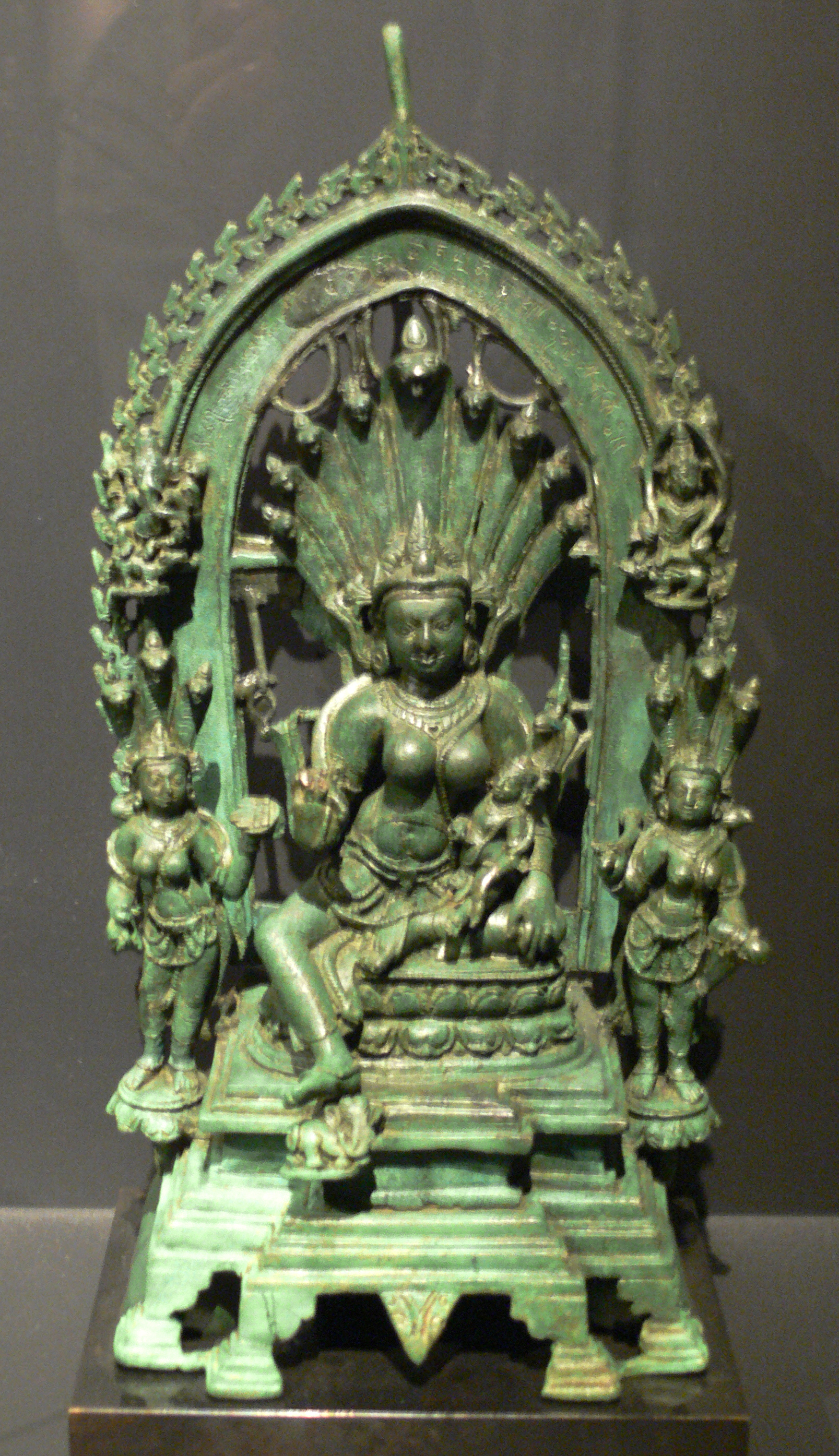
The cult is old in this region. More than 48 images of Manasa have been found in North Bengal, some of them made under the Guptas in the fifth or sixth century, and the image found at Mangalkot in Bogra is regarded as the earliest, according to Banglapedia. Archaeological sites in Bogra carry names from the story, among them the Basar Ghar, the bridal chamber of Behula and Lakhindar.
Music is part of the tradition. Banglapedia notes that snake charmers have their own songs, sung while they display their snakes; one calls out to the housewife to come and watch: 'sap khela dekhbi yadi ay re sona bau' (come, dear wife, if you would see the snake game), and Manasa, Behula and Lakhindar are among their subjects. Its Bengali article on musical instruments says snake charmers play the tubri to show their snakes, that the small dugdugi drum is used at snake shows, and that in West Bengal the larger bisham dhaki is played in Manasa's bhasan or jhapan songs.
Across the border the practice is tied closely to the puja. Anandabazar Patrika reported on 18 October 2023 that in Ashkola village of Gopiballavpur-2 block in Jhargram district, West Bengal, Manasa had been worshipped on Dak Sankranti, the last day of the month of Ashwin, for more than a hundred years, together with jhapan, which the paper explained as the snake game. A snake charmer was hired from outside; after the ritual pot was raised from the river he first showed his snakes before it, then toured the village with 10 to 15 venomous snakes before reaching the pavilion, and by custom the puja began only after the show. An AFP report carried by Gulf News on 18 August 2013 described an annual Manasa festival at Purba Bishnupur village, about 85 kilometres from Kolkata, where snakes were regarded by local people as incarnations of the goddess, who was believed to bring good luck before the harvest. AFP wrote that the number of snake charmers in India had dwindled after the government strengthened laws in 2002 against the commercial use of wild animals, including performances with live snakes, and that animal rights activists accused charmers of cruelty, a charge the charmers it met denied.
The snake charmers and the Bedey community
Banglapedia describes snake charming as a full-time profession for some and a part-time job for others, traditionally a family business whose art passes from one generation to the next and whose secrets are well guarded. Most snake charmers belong to the Bedey community. Charmers keep their snakes in boxes, gunny bags and earthen pots and carry them from one weekly market to another. Most do not catch snakes themselves but buy them from professional snake catchers. Cobras and pythons are the favoured species, along with many non-venomous snakes, and there is no snake charming without a cobra, because it can raise its head to a considerable height and spread its hood.
The swaying is not a response to music. Snakes have no external ear opening and do not hear airborne sound well, though their inner ears pick up vibrations from the ground through the lower jaw, Banglapedia explains. As the charmer plays his pipe and moves his head, elbows or knees, the cobra follows the moving object with its eyes, not the tune. The encyclopedia adds that most charmers exhibit snakes whose fangs have been removed; such snakes cannot use their venom to subdue live prey, usually die within about six months, and must be replaced every couple of months. The teeth behind a removed fang can become connected to the venom gland, so bites from these supposedly fangless cobras can be fatal, and Banglapedia states that most snake charmers ultimately die from such bites.
The Bedey, Banglapedia records, trace their origin to the Mong-tong (Mangta) people of Arakan who in 1638 accompanied the fugitive king of Arakan and later settled in the Bikrampur area near Dhaka; many converted to Islam over time. They have traditionally lived on boats or on platforms by rivers and travel from village to village in groups, a journey they call gawal, carrying baskets of snakes or bags of herbal medicines; snake catching and snake charming are a major source of their income. The encyclopedia lists nine Bedey groups, among them the Shapuria, who catch snakes and show them but do not sell them, and who worship Manasa, and the Mal, who catch and sell snakes but do not show them. Their number in Bangladesh is gradually decreasing, it says, and some Bedeys have changed profession.
The Daily Star described the same decline in a photo feature on 12 September 2013: demand for the Bedeys' entertainment at markets and festivals had fallen, snakes were losing habitat to unplanned urbanisation and industrialisation, and only a few Bedeys still clung to the old profession.
The snakes on show
Bangladesh has about 90 species of snakes, although more than a dozen of them have not been reported for decades, according to Banglapedia, and more than three quarters of them are non-venomous. Fewer than half a dozen land snakes are highly venomous. Several non-venomous species that live close to homes help control rats and mice. The national guideline for the management of snakebite, as cited by The Business Standard in August 2023, puts the number at about 100 species, of which 37 are venomous: 16 sea snakes, three cobras, five kraits, two coral snakes, six green pit vipers and one true viper, Russell's viper.
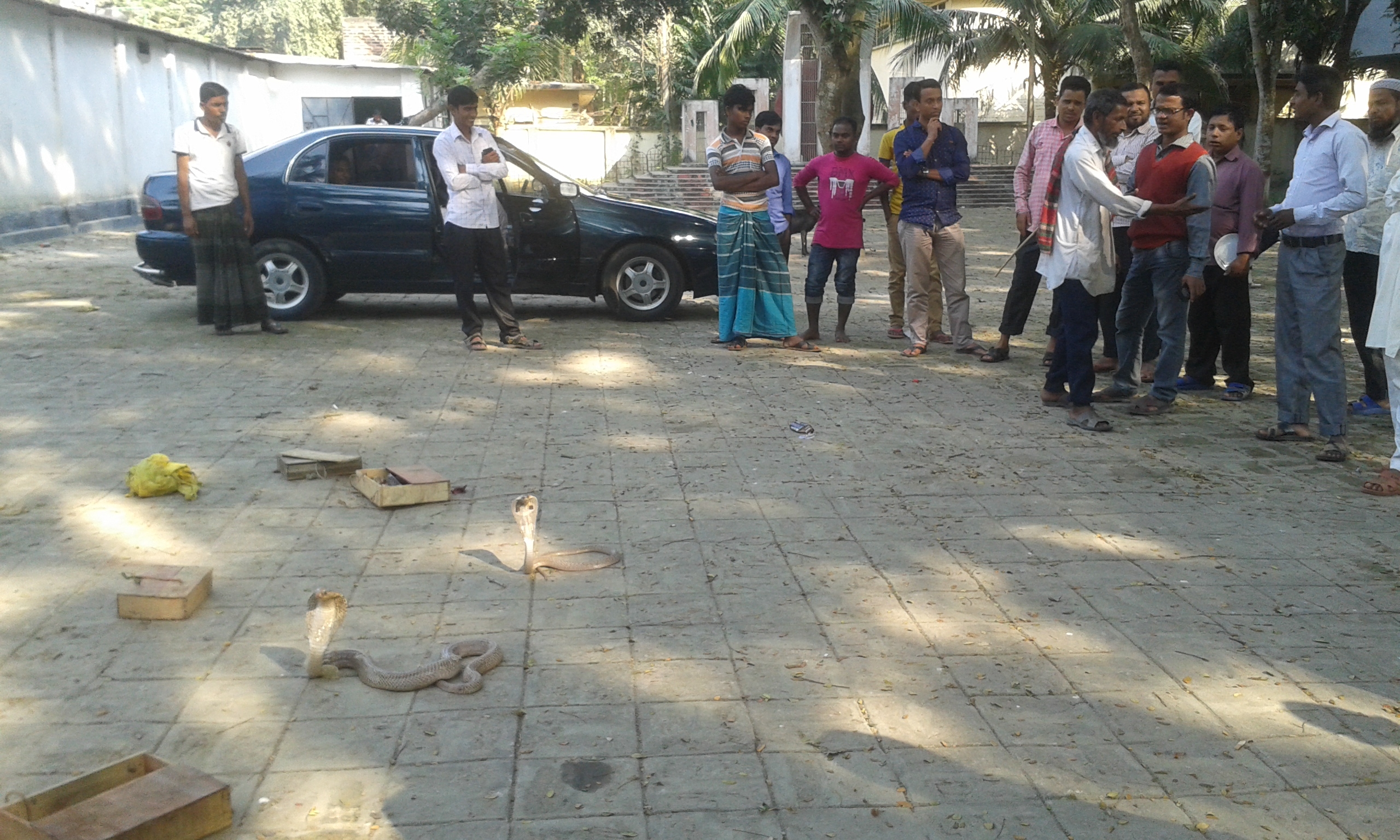
Two cobra species occur in the country, the spectacled cobra (Naja naja) and the monocled cobra (Naja kaouthia), known locally as gokhra. When excited a cobra spreads its elongated neck ribs to show its hood: the spectacled cobra's carries a black U-shaped mark, the monocled cobra's a ring-shaped mark. Cobras grow to about 1.5 metres, are active at night and live near homes, fields and forests, feeding mainly on rodents, small birds and amphibians. Their venom is neurotoxic and attacks the nerves. Banglapedia lists cobras as threatened in Bangladesh: the monocled cobra as vulnerable, and the spectacled cobra and the king cobra as endangered. Of the five kraits in the country, the common krait is possibly the most deadly snake in Bangladesh.
Snakebite, as health authorities described it
The World Health Organization's fact sheet of 12 September 2023 estimated that 5.4 million people worldwide are bitten by snakes each year, with 1.8 to 2.7 million cases of envenoming and between 81,410 and 137,880 deaths. Bites by venomous snakes can cause paralysis that stops breathing, bleeding disorders, irreversible kidney failure and tissue damage, and agricultural workers and children are the most affected. WHO describes antivenom as a highly effective treatment, included in its list of essential medicines, and notes that many victims opt for traditional practices instead of hospital care.
In Bangladesh, The Business Standard reported on 16 August 2023 that a national survey by the National Centre for Disease Control of the Directorate General of Health Services, published on 18 June 2023, estimated that about 4.03 lakh people are bitten by snakes every year and 7,511 of them die. An AFP report published by The Star on 9 October 2025 said the authorities had recorded 84 snakebite deaths and nearly 15,000 hospital admissions so far that year, after 118 deaths in 2024.
Close to Chuadanga, The Daily Star reported on 30 August 2014 that at least 58 people in Madandanga village of Meherpur Sadar upazila had been bitten by snakes in a week, that villagers usually took traditional treatment from snake charmers, known locally as ojha, and that the Meherpur civil surgeon had said snakebite victims should come to hospital for modern treatment.
The wildlife law in force
On the date of the event, wild animals in Bangladesh were protected by the Wildlife (Conservation and Security) Act 2012, Act No. 30 of 2012, dated 10 July 2012. The Act defines wildlife as animals of various kinds whose origin is regarded as wild, and defines hunting to include killing, catching or poisoning a wild animal, injuring it or taking any part of it, and collecting or destroying the nests or eggs of reptiles. Section 6(1) says no person may hunt any wild animal without a licence or permit under the Act. Section 39 makes a breach of section 6 an offence punishable by up to one year in prison, a fine of up to Tk 50,000, or both, and up to two years or Tk 1 lakh for a repeat offence. Section 8 requires the chief warden, an additional chief warden or a warden, stating the reason, to remove, kill or, where suitable, rehabilitate a wild animal that threatens human life or property, and section 9 requires a caught, rescued or seized wild animal to be released into a suitable natural environment if keeping it caged or confined endangers its life. The Jagonews24 report on the Chuadanga game did not mention the law or any permit.
Photo: Sumitthesanyal / Wikimedia Commons (CC BY-SA 4.0). The top picture shows snake charmers performing with cobras during Manasa puja in Purulia, West Bengal, India, in August 2019, as background; it is not a picture of the Chuadanga event.
Sources: Jagonews24 ("Traditional jhapan game of rural Bengal held in Chuadanga", 25 October 2025), Jugantor (17 September 2024), The Daily Ittefaq (25 August 2022 and 29 August 2023), Dhaka Mail (20 August 2022 and 23 August 2023), Bangladesh Pratidin (19 August 2022), Anandabazar Patrika (18 October 2023), AFP via Gulf News (18 August 2013) and The Star (9 October 2025), The Daily Star (12 September 2013 and 30 August 2014), The Business Standard (16 August 2023), World Health Organization (Snakebite envenoming fact sheet, 12 September 2023), Laws of Bangladesh (Wildlife (Conservation and Security) Act 2012), Banglapedia (Chuadanga District, Chuadanga Sadar Upazila, Manasa, Mangalkavya, Behula, Folk Literature, musical instruments, Snake Charmer, Bedey, Snake, Cobra, Krait).
Comments
(0)