
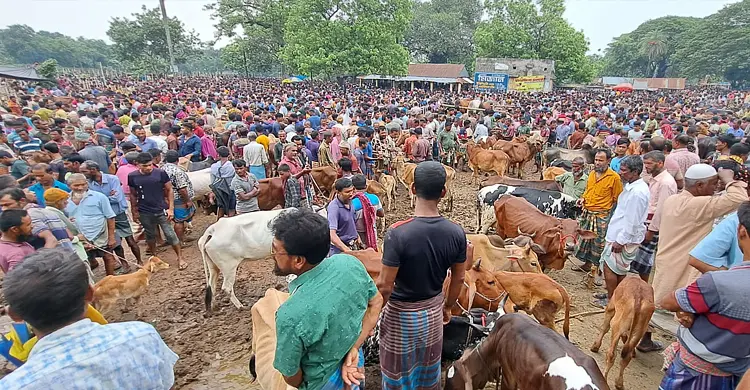
Only seven days remain before Eid-ul-Azha. More than 1.5 lakh livestock have been prepared for sale in Chuadanga, but trade has not yet picked up. Fewer buyers are coming to the markets, and online sales have also drawn little response.
According to the district livestock office, about 12,000 farmers in the district's four upazilas have raised more than 1.5 lakh animals this year: 43,000 cattle and buffaloes, and 93,000 goats and sheep. Local demand is about 70,000 cattle, buffaloes and goats, of which 20,000 are cattle and buffaloes and 50,000 goats. The surplus of about 23,000 cattle and buffaloes and about 50,000 goats will meet demand in Dhaka, Chattogram and other parts of the country.
Farmers taking animals home unsold
Farmer Shahidul Islam of Alamdanga upazila said: "Every year we raise cattle aiming at the Eid. Besides our own investment, we have to take loans from banks and NGOs to fatten and rear them, and we repay those loans by selling the animals. But this year the situation is completely different. There are four big cattle markets a week in the district, but few buyers come. So we are forced to bring the cattle back."
Farmer Mamun of Sadar upazila said that at this time of year, after meeting local demand, the district's animals are sent to Dhaka, Chattogram and elsewhere, but markets there are very slack this time. Because prices are poor, animals are often taken to market and brought back again.
Shahabul, a buyer at Dugdugi market, said he buys a cow from a farm every year. "Buying from a farm has advantages. You can keep the cow at the farm until Eid, and you don't have the extra hassle of taking it home. But prices are a bit higher this year."
Nasir Uddin, who came to buy, said he was looking for a medium cow. "Prices seem Tk 20,000 to 30,000 higher per cow this year. Since we have to sacrifice, we will have to pay more."
Veteran trader Anwar Hossain at the Alamdanga market said Alamdanga gets the most cattle of the district's markets at Eid time, and a very large number had come to that day's (Wednesday) market. There were cattle priced at Tk 65,000 to 70,000, and the biggest he had seen since morning was priced at Tk 17 lakh. But buyers were somewhat fewer, he said.
Khalek Shah of Sarishadanga village in Sadar upazila said he has more than fifty goats on his farm but is disappointed with prices, so he brought his goats back from the market without selling them.
On online markets he said: "We live in villages. We don't know much about online markets, and nobody has trained us. So we have little trust in online selling."
Officials pin hopes on online sales
Chuadanga district livestock officer Dr Mihir Kanti Biswas said farmers are being advised to fatten cattle by local methods to cut rearing costs and produce healthy meat, and online marketing is being emphasised for selling surplus animals.
He said a Facebook page named 'Online Pashuhat' has been opened, where the district's farmers post photos, descriptions, likely prices, addresses and mobile numbers for their cattle and goats. He expressed hope that online sales will rise just before the Eid.
Shahadat Hossain, nezarat deputy collector (NDC) of the Chuadanga district administration, said buyers and sellers were discouraged from going to cattle markets during Covid to prevent infection, and online sales were arranged as an alternative. That is still running and is managed by the livestock office, he said, but he does not know how much response it is getting now.
Source: Jagonews24. First published in Bengali on The Agro News.
Comments
(0)