
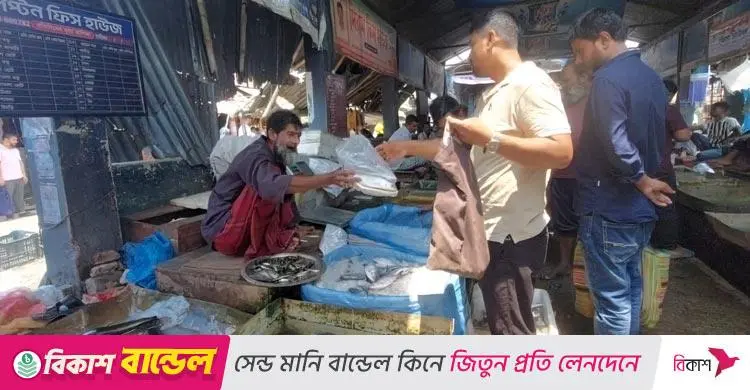
The Bengali New Year is not just a date; it is a symbol of Bengali emotion, culture and identity. Many events surround the day, but one thought unites everyone: panta-ilish, soaked rice with hilsa. Every year demand for hilsa peaks around the day. This year, though, a different picture was seen at Chuadanga's Boro Bazar.
Even on the day before Baishakh, buyers showed little interest in hilsa. A handful of traders had fish on display, but shoppers looked and walked away without buying. Many people buy hilsa even on the morning of New Year's Day, but no sales were seen on the morning of 14 April either.
On 13 April only four traders were selling hilsa at the fish market in Chuadanga Boro Bazar. They said that in other years demand for hilsa started two or three days before Pahela Baishakh, but this year there was almost none. Prices were relatively low, between Tk 700 and Tk 1,600 a kg, yet sales were very slow.
Buyers and sellers
Shahariar Hossain, who came to buy hilsa, said: "Every year we eat panta-ilish on Baishakh; it has become a custom. But this time I came to the market and found no fish, and the one or two people selling are asking high prices. They want Tk 1,200 a kg for a medium-sized hilsa. With the family's other expenses, buying hilsa is hard."
Fish trader Saheb Ali said: "I have sold hilsa before Pahela Baishakh for the past 10 years. In other years buyers would crowd in at this time and 20 to 30kg would sell in a single day. That is not the picture this time. I have cut my prices, but buyers still show no interest."
Shiuli Akter, a private-sector employee, had come to Chuadanga Boro Bazar to shop for a special holiday meal. Asked whether she would not eat panta-ilish, she said: "We are not very keen on panta-ilish. The children are not much interested, so we did not arrange panta-ilish at home this time."
Source: Jagonews24. First published in Bengali on The Agro News.
Comments
(0)