
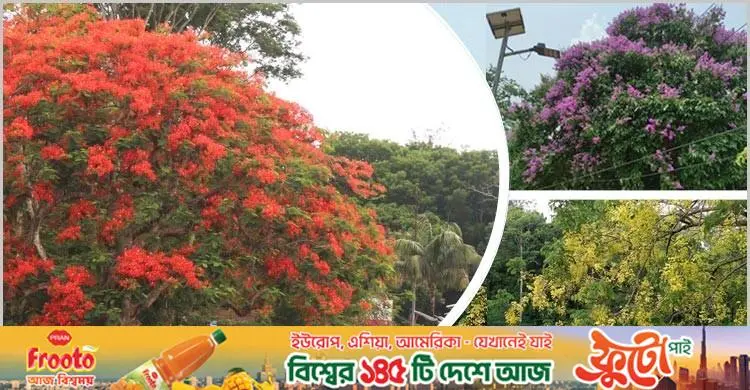
The hills are not just a stretch of green. They are sometimes rafts of cloud, sometimes the murmur of waterfalls, sometimes a world of wonder coloured by wild flowers. In this season, between mid-summer and the start of the monsoon, the hills seem to dress anew: along both sides of the winding roads, fiery krishnachura, purple jarul and golden sonalu turn the landscape enchanting, as if the hills were painting their own canvas.
In the hill districts of Rangamati, Khagrachari and Bandarban, nature takes on a different look at this time. When the soft morning light falls on the slopes, the red petals of krishnachura blaze like flames. A little further off, the purple of jarul is like the dim dusk light melting into a calm river, and the hanging yellow flowers of sonalu are like golden garlands swaying in the hill breeze.
This beauty moves the mind as well as the eye. For someone who leaves the smoke and noise of the busy city to walk a hill road, the flowers at every bend make the tiredness of life fall away and suggest that nature is still alive with all its beauty.
Krishnachura: the colour of fire
In summer krishnachura seems to paint the whole hillside the colour of fire; from afar it looks as if the green hills are burning. Its crimson beauty is a special attraction for nature lovers, and the trees standing along hill roads seem to beckon passers-by. The colour grows even brighter in afternoon light, and when petals drift down in the wind it looks as if nature has laid out a red carpet.
The Kaptai road in Rangamati, the hill roads of Sajek and the Nilachal area of Bandarban are especially striking in the krishnachura season. For local people the flower is not only a symbol of beauty but also a sign that the season is changing.
Krishnachura is bound up with Bengali emotion too: memories of school and college, love stories, the pain of farewells. So for many, seeing it in bloom in the hills brings back the old days.
Jarul: a quieter beauty
If krishnachura stands for exuberance, jarul is the name of a quieter beauty. Its purple brings a gentle mood to the hills. Jarul flowers usually bloom in clusters, and from a distance it looks as if someone has scattered purple clouds over the slopes. It is at its best in the dewy morning light. Standing beneath a jarul tree in the hills brings a sense of calm, with the silent hills, distant birdsong and swaying blossoms together creating a dreamlike setting.
Many tourists spend their time in the hills simply photographing these flowers, and pictures of hill jarul are now popular on social media. Some say a trip to the hills is incomplete without seeing jarul. Another feature is how long it lasts: while many flowers drop quickly, jarul holds its colour for quite some time, so it can be seen throughout the season.
Sonalu: a shower of gold
Sonalu is another wonder of the hills, its hanging clusters of yellow flowers like ornaments on the slopes. Many know it as the "golden shower", because when its flowers fall it looks as if gold is raining down. It is most striking at sunny midday, when light on the yellow blossoms makes the whole tree seem wrapped in gold, and people walking a hill road stop in their tracks when they come upon one.
Sonalu also plays a part in biodiversity. Bees and many kinds of birds crowd its flowers, bringing the hill environment to life. In many hill villages sonalu is still seen as a symbol of good fortune, and local people believe its yellow carries a message of happiness and prosperity.
A living canvas
The winding hill roads are beautiful anyway, but when krishnachura, jarul and sonalu bloom together the scene becomes a living canvas: green hills on one side, blue sky on the other, and a fair of red, purple and yellow in between. Many travellers say nature feels most alive in the hills at this time.
On the way to Sajek Valley the red glow of krishnachura covers the slopes; around Kaptai Lake in Rangamati the purple of jarul enchants; and on the hill roads of Bandarban the yellow of sonalu makes the tiredness of the journey fade.
People in the hills have a deep bond with nature and read the seasons from the flowers: krishnachura signals the height of summer, jarul announces the coming monsoon, and sonalu's yellow is a symbol of new hope. Hill children play with the fallen flowers, young people take photographs and the elderly sit and enjoy the view. The flowers appear in the work of local artists and poets, and in hill songs, poems and folk tales they live on as the language of nature.
Tourism and conservation
The flowering season is now drawing more tourists, some of whom go to the hills just to see the colours. For photographers it is like heaven, and many wait for hours to catch the flowers at dawn or in the last light of sunset. Pictures of hill krishnachura, jarul and sonalu are spreading widely on social media.
People in the tourism trade say visitor numbers rise in this season, with more people at hotels, resorts and on boat trips. But protecting this beauty is everyone's responsibility. Some tourists carelessly pick flowers or damage the environment, which harms the balance of nature.
Keeping the hills beautiful needs awareness. Deforestation, hill cutting and unplanned construction are reducing tree cover in many places. Trees such as krishnachura, jarul and sonalu matter not only for their beauty but also for the balance of the environment, from providing homes for birds to keeping the air clean. Loving nature means protecting it too: a visitor who enjoys the flowers without picking a single one shows true love for nature.
At dusk the three trees grow even more mysterious: the fiery red of krishnachura under a red sky, the soft purple of jarul in the fading light and the hanging yellow of sonalu. A silence drifts on the hill breeze, and distant birdsong, moving clouds and swaying flowers create an unearthly feeling. This beauty teaches people to live anew, however busy life gets. Along every bend of the hills, krishnachura, jarul and sonalu are not just flowers but the colourful language of nature and the life of the hills.
Source: Jagonews24. First published in Bengali on The Agro News.
Comments
(0)