
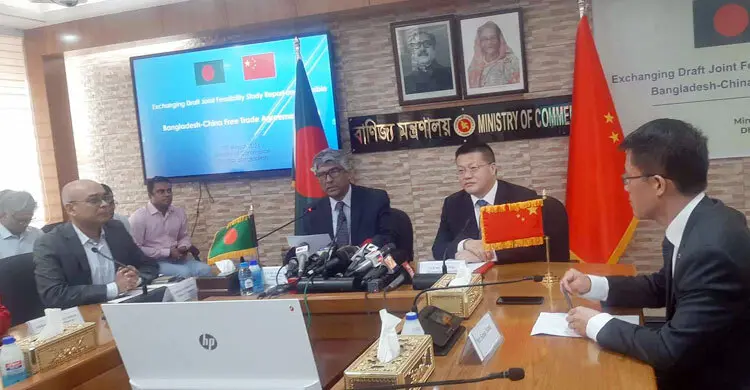
China is interested in importing mango, jackfruit, potato, leather goods and jute goods from Bangladesh. Commerce Ministry senior secretary Tapan Kanti Ghosh and China's ambassador in Dhaka, Yao Wen, gave the information.
They spoke at a joint press conference in the Commerce Ministry's conference room at the Secretariat on Thursday, 28 March.
The press conference was held on the exchange of a jointly prepared draft feasibility study report on signing a free trade agreement (FTA) to boost trade and investment between Bangladesh and China.
No timeline yet for the FTA
Asked by journalists when the FTA might be signed, the senior secretary said no agreement had been reached yet and talks would now begin. "It would be good if we can complete the agreement within the next three years. If not, we will have to continue the talks. Until the talks are over, we will ask that we be given these facilities as an LDC."
Asked what benefits Bangladesh would gain, Tapan Kanti said that among the main exports there are other products besides readymade garments. "When I was talking with the ambassador, he said mango has a lot of potential. Jute goods have a lot of potential. Then there are handicrafts."
He said there were other products too. "We are already exporting leather. We can export quality leather goods. China has 140 crore people. If we can take diverse products there, it could be a huge market. Once the agreement is done, investment is also likely to grow."
Tapan Kanti Ghosh added that Bangladesh mainly exports readymade garments. In the 2022-23 fiscal year, Bangladesh exported goods worth $677 million to China, against imports of $22.90 billion from China.
Replying to a journalist's question, Ambassador Yao Wen said China has large investments in Bangladesh and is now the second-largest investor in the country. Investment will grow further after the FTA is signed, he said, adding that Bangladesh can export mango, jackfruit, potato, jute goods and leather goods to China.
LDC graduation challenges
The Commerce Ministry said at the event that Bangladesh's graduation from least developed country to developing country is a notable achievement of the present government's economic progress. Besides creating a positive image of Bangladesh in the world and new prospects in investment and trade, it will also create several challenges.
Among them are the loss, after 2026, of duty-free and quota-free access when exporting to developed and developing countries as an LDC, and the rate of value addition. As a result, Bangladeshi exports will face the tariffs normally imposed when entering those markets, which could shrink Bangladesh's export markets in those countries.
The ministry said that, in line with the government's Eighth Five-Year Plan, it has already moved to sign regional trade agreements with commercially important countries and trade blocs to protect and expand export markets and meet the likely challenges after LDC graduation.
China is the world's second-largest economy and an important trading partner of Bangladesh, and a promising area for expanding Bangladesh's trade. There is also potential to develop relations with China in services and investment as well as goods. Against this backdrop, an initiative was taken to sign a free trade agreement to increase trade and investment between the two countries.
From MoU to draft study
As part of this, a memorandum of understanding on a joint feasibility study for a Bangladesh-China FTA was signed during the Chinese president's visit to Bangladesh on 14-15 October 2016.
As the next step in implementing the MoU, working groups were formed in both countries to conduct the feasibility study. The first meeting of the working group was held in Beijing on 20-21 June 2018, and the working group then prepared the draft feasibility study report.
Progress stalled afterwards because of the coronavirus pandemic, but both countries prepared their own parts of the joint feasibility study report, leading to the exchange of the draft report by Bangladesh and China on the day.
Source: Jagonews24. First published in Bengali on The Agro News.
Comments
(0)