
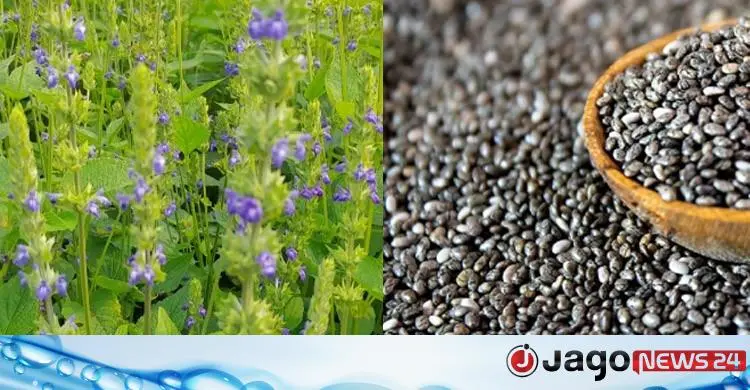
The tiny chia seed is a source of nutrition and energy, and its nutritional value is its special feature: among grains and oilseeds, chia is counted among the best. Chia is an annual medicinal oilseed plant, like sesame or linseed, and grows up to one metre tall. Its leaves are opposite and toothed. The flowers are arranged on spikes and can be blue, purple or white, with two enlarged lip-like petals, a trait of the mint family, and the plant is highly self-pollinating. The seeds are round or oval, brown to greyish-white in colour. Chia first won acceptance as a grain and health food in America, and then around the world.
Black and white chia
There are two main kinds of chia seed, black and white. Chia plants with purple flowers produce brown seeds, which are called black chia. Plants with white flowers produce only white seeds. White chia seeds are marbled white, grey and yellow.
Chia spreads by both seed and seedlings, but it is best grown from seed. Chia seeds begin to germinate within 5-7 days.
Climate and sowing time
The crop needs a minimum temperature of 11 degrees Celsius and a maximum of 36 degrees, with an optimum of 16-26 degrees. It grows well at warm temperatures of 20 to 25 degrees Celsius. The length of the crop's life cycle depends on location and is affected by altitude or latitude. Like many vegetable crops, chia is a short-day flowering plant with a photoperiod threshold of 12-13 hours, and its growth and fruiting period depend on latitude or altitude. In the northern hemisphere chia begins to flower in October and in the southern hemisphere in April. Across different ecosystems, the crop's life cycle runs from 100 to 150 days.
In the country's climate, chia can be grown as a rabi (winter) crop. Winter is the ideal time to plant and grow it, because as a short-day flowering plant it does not thrive in the long-day season. For a higher yield it should be sown by 15 November, although it can also be sown in the last week of October and the second week of January. The crop takes 90-100 days to harvest.
Soil, seed rate and spacing
The crop can be grown on all kinds of soil. It needs light to medium clay or sandy to sandy loam soil, and gives a good yield on well-drained, moderately fertile land. It can tolerate acid soils and moderate drought. Sowing and seedling establishment need fully moist soil, but mature chia plants cannot tolerate wet soil while growing.
Usually 100 grams of seed are needed per bigha. Prepare the land with 3-4 ploughings and harrowings until the soil is fine and crumbly, and keep it free of weeds. Because chia seeds are very small, mix them with about five kilograms of dry sand or ash before broadcasting. Then sow the sand- or ash-coated seed continuously in rows 40-50 cm apart, as with mustard, sesame or amaranth seed. Alternatively, raise seedlings and transplant them at 15-25 days old into moist soil, with 40-50 cm between rows and 20 cm between plants.
Harvest and yield
Chia is ready to harvest when 60-80 per cent of the flower heads have turned brown and yellowish-brown. Cut the whole plants above the ground and dry them in the sun on a tarpaulin or a clean floor. After one or two days of sun, tapping the plants gently with a bamboo or wooden stick will separate the seeds. The seeds are then winnowed clean and stored. Depending on the method of cultivation and the region, the yield can range from 150 to 200 kg per bigha.
Source: Jagonews24. First published in Bengali on The Agro News.
Comments
(0)