
Research is carried out every year on hilsa that come from the sea into the rivers to breed. The work is done by researchers at the Fisheries Research Institute's riverine station in Chandpur. This year too, catching hilsa and all other fish was banned for 22 days, from 13 October to 3 November, on about 70 km of the Padma and Meghna in the district. Hilsa research went on during the ban and is continuing now.
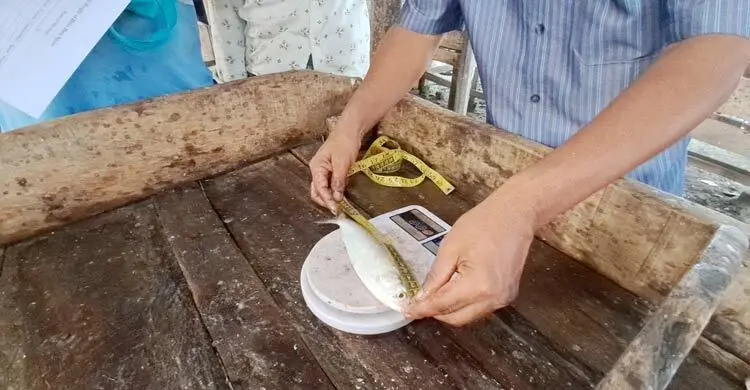
On the morning of Monday (4 November) a fisheries scientist and a research assistant were seen measuring spent hilsa, fish that had already released their eggs, at the fish wholesale market next to Harina ferry ghat in Sadar upazila.
Measuring the catch
Hilsa caught in the Padma and Meghna are brought straight to this market, which is why fisheries researchers chose it as a suitable place to learn the real state of the hilsa. Hilsa is sold at about 10 wholesale shops at the ghat. The researchers measure the length, width and weight of small, medium and large hilsa brought in by fishermen. They also survey how many hilsa have spawned, how many are being caught with eggs, and whether small hilsa are spawning.
Fisheries scientist Rizvi Kaiser and research assistant Abdus Salam of the Fisheries Research Institute's riverine station in Chandpur carried out the research at Harina fish ghat for about an hour.
According to sources, the survey runs every year at this time at wholesale markets in the riverside areas from Matlab Uttar upazila through Sadar and Haimchar upazilas. During the ban, the institute's hilsa researchers also catch hilsa with their own traps in the sanctuary areas, working from their own vessel.
Results go to the ministry
Fisheries scientist Rizvi Kaiser said: "Today we are surveying the state of hilsa at the Chandpur fish landing centre, Harina ferry ghat and several wholesale markets in Haimchar. We are not permitted to comment on the results of this work. Our chief scientific officer will send the results to the ministry as a report, and the ministry publishes it."
Source: Jagonews24. First published in Bengali on The Agro News.

Comments
(0)