
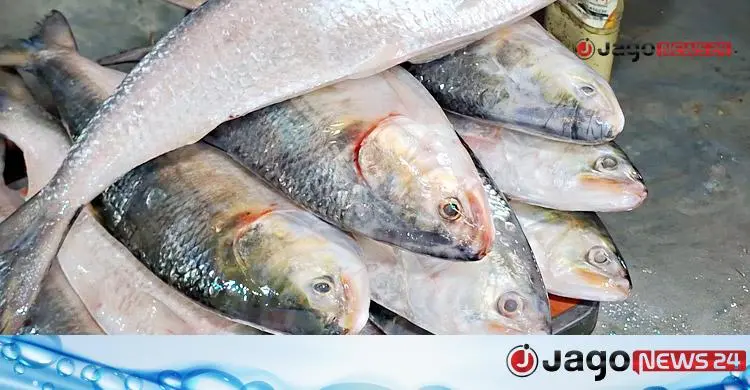
Every year there is talk of hope around hilsa, the national fish. Government figures say production is rising steadily, and the success is highlighted at Fisheries Week events and in official reports. But the experience of fishermen, wholesalers and traders on the rivers says something quite different.
They say that although production is rising on paper, hilsa are in fact declining in the rivers, creating a big gap between official data and the reality on the ground.
Shoals of hilsa were once caught across the Padma and Meghna. That scene is now largely in the past; fishermen say they no longer find hilsa as they used to.
The official figures
According to the Department of Fisheries, hilsa production was 5.29 lakh tonnes in 2023-24. It was shown as 5.71 lakh tonnes in 2022-23, 5.66 lakh tonnes in 2021-22, 5.65 lakh tonnes in 2020-21 and 5.50 lakh tonnes in 2019-20.
Production was 5.32 lakh tonnes in 2018-19 and 5.17 lakh tonnes in 2017-18. In 2024-25, however, it fell to 5 lakh tonnes, the lowest in eight years. The authorities said it was the lowest production year since 2016-17.
Fishermen question these figures. They say hilsa have not been found in the rivers as before for the past five years, and even after long hours on the river they often cannot cover their costs.
Several fishermen in Chandpur, Shariatpur and Lakshmipur said a few hours of netting used to fill a boat with hilsa, but now they do not get the expected catch even after a whole night on the river. They believe official figures show more hilsa than is really produced, because if production were rising there should be no scarcity.
Landings collapse at Chandpur
The gap between official data and reality is clear at Boro Station fish landing in Chandpur, one of the country's largest hilsa wholesale markets. According to people there, in 2020 an average of 1,000 to 1,500 maunds of hilsa arrived every day; now it has fallen to just 200 to 300 maunds. Even from July to September, known as the peak hilsa season, no more than 500 to 700 maunds now reach the landing.
Those involved with hilsa say one of the main reasons for the fall is climate change. Flows in the Padma and Meghna have fallen, and chars and submerged shoals are narrowing the fish's migration routes. Loss of navigability is also disrupting breeding. Chars emerging in parts of the Padma and Meghna in the Chandpur area have become a big problem.
Pollution of the Buriganga and Shitalakshya rivers has also become a major threat. Industrial waste and chemicals entering the rivers are destroying the natural water environment, making it unsuitable for hilsa to spawn.
To protect hilsa, the government runs mother hilsa conservation drives, bans on catching jatka (juvenile hilsa) and seasonal fishing bans every year, and gives food aid to fishermen. But fishermen complain that real fishermen are often left out of the aid, while current nets and other illegal nets are still freely used in the rivers. Locals say drives are run against small fishermen, but effective action is not always taken against influential unscrupulous gangs.
There are also limits in how hilsa production data are collected. In most cases the figures rely on sample-based data and estimates, which creates a gap with the real situation. People in the sector say river-based surveys, digital monitoring and accurate data collection at landing points are essential to determine real production.
They say publishing production growth on paper is not enough; practical steps are needed to protect hilsa. Without regular dredging to restore the navigability of the Padma and Meghna, removal of submerged shoals, control of river pollution and effective drives against illegal nets, hilsa could face a deeper crisis in future.
Fishermen and wholesalers speak
Rafiq Molla, a fisherman in Haimchar upazila of Chandpur, said the rise in hilsa production shown in government accounts every year is not reflected in the rivers.
"Even casting nets day and night, we do not get fish as before. The amount of fish in the river has fallen alarmingly. A net does not bring up even a third of the hilsa it caught a few years ago. Fuel, labour and boat costs have risen, but the catch has not kept pace, so many fishermen are struggling to support their families," he said.
"The number of fishermen on the river may have increased, but the fish have not increased at that rate. If you look at the real situation, you can see there are far fewer hilsa than before," Rafiq Molla said.
Mostafa, a fisherman in the Ananda Bazar area of Chandpur Sadar, said the hilsa shortage in the river has been obvious for several years, yet the government keeps saying production has risen. "If hilsa really are increasing, where are those fish in the river?" he asked.
He also pointed to some real causes of the decline. Many fishermen defy bans to catch mother hilsa and jatka, badly hurting future production. River pollution, loss of navigability, spreading submerged shoals and illegal barricades of nets across rivers in the Bhola-Barishal area are disrupting the hilsa's natural movement, so the fish cannot reach the Chandpur area as before. Mostafa believes that instead of just publishing data on paper, the real situation in the rivers must be observed, with strict and effective monitoring to stop illegal fishing.
Kamal Hossain, a wholesaler at Chandpur's Boro Station landing, told Jagonews24: "We used to struggle to cope with the rush of hilsa at the landing. Now the whole wholesale market is often empty. With less hilsa coming from the river, market prices have risen several times over, and the national fish is now going out of ordinary people's reach."
Another wholesaler, Nabir Hossain, said hilsa supply at the landing has not returned to normal even after the jatka protection drive ended, and there is now an acute shortage. "Outside the season, 300 to 500 maunds of hilsa used to arrive every day even in normal times, but that picture has completely changed. Most traders sit in the market with only a few hilsa. With supply low, prices are sky-high."
A hilsa weighing one kilogram now sells for Tk 3,500 to 4,000, and smaller hilsa for Tk 2,000 to 3,000. Many buyers are losing interest because of the high prices.
Nayan, a resident of Rajshahi visiting the Chandpur landing, told Jagonews24: "I came here to buy fish because Chandpur hilsa has good taste and quality. I expected prices to be a bit lower, but I found them very high. In videos I used to see heaps of hilsa at the landing, but the reality is different. There are very few hilsa here."
Parvez Hossain, from Dhaka, said: "I came to Chandpur by launch and came to the landing to buy some hilsa to take back. But the supply is very low and the prices are high. I am wondering whether to buy. If there were more supply, we could get it a bit cheaper."
A researcher's view
Dr Tayefa Ahmed, chief scientific officer of the Fisheries Research Institute, said research on hilsa conservation and production is continuing, and according to research data, the rising trend in hilsa production is being maintained.
But she warned that if the rivers are not protected, this production could be threatened in future, so what is most needed now is to protect rivers from pollution and encroachment. She hoped the hilsa production target would rise again this year.
On the gap between research data and the situation on the ground, she said whether hilsa production rises depends largely on how successfully mother hilsa and jatka conservation is carried out. Urging fishermen to be more aware, she said hilsa must be caught, but fishermen must refrain from catching mother hilsa and jatka, and the government must also do more to curb river pollution.
Source: Jagonews24. First published in Bengali on The Agro News.

Comments
(0)