
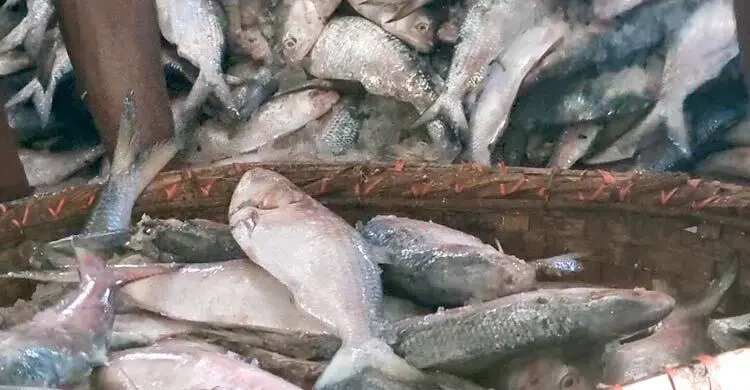
The government's 22-day ban to protect hilsa breeding is over. From midnight on Sunday (3 November) fishermen resumed catching hilsa and all other fish in the Padma and Meghna at Chandpur, and the riverside wholesale markets are busy again.
From the morning of Monday (4 November) 200-300 maunds of hilsa reached the Boro Station fish ghat, bringing back the familiar bustle for traders and labourers. Traders expected supply to rise further as the day went on.
But fishermen said they were not getting the hilsa they had hoped for in their nets, which is why prices are still sky-high. As always, buyers coming to the ghat were disappointed by the prices, though traders say prices may fall if supply rises.
Traders and buyers
Chandpur fish ghat hilsa trader Kamal Hossain said: "All sales were banned at Boro Station fish ghat for 22 days. Our trading has started again after a long time. Supply is low today, so prices are high. In today's market hilsa of 500-700 grams sells for Tk 1,300-1,400 a kg, and hilsa of 1 kg for Tk 1,700-1,800."
A buyer named Habib Ahmed said: "I thought hilsa prices would come down a little today, but they are as high as before. Every wholesaler has big pangas as well as hilsa, but that is expensive too."
Supply falling every year
Shobe Barat Sarkar, general secretary of the Chandpur Fish Traders' Association, told Jagonews24: "Hilsa supply is falling every year. Hundreds of trawlers used to come to Chandpur fish ghat from the Padma, Meghna and the southern region. But with fewer hilsa caught in the nets, those trawlers no longer come. Prices are still high because supply is low."
He added that he did not think hilsa supply would rise in the coming days, and if it did not, there was no prospect of prices falling.
Source: Jagonews24. First published in Bengali on The Agro News.


Comments
(0)