
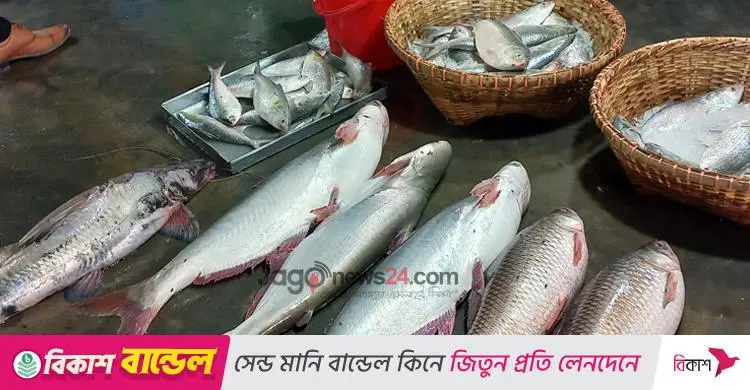
Three days after a long two-month ban ended, hilsa supply has still not picked up. At Boro Station fish landing centre in Chandpur, the largest hilsa landing centre in the south of the country, hilsa supply has fallen to rock bottom, mainly because the silvery fish are not turning up in fishermen's nets in the Padma and Meghna. Supply at the landing centre is therefore low and prices high. Instead of hilsa, however, the supply of pangas, rui, katla, poa, shrimp, air and other local fish has increased.
Although sales of all kinds of fish resumed at Boro Station on 1 May, buyers have shown little interest in hilsa because of the high prices, and sales of pangas, rui, katla, poa and shrimp have risen. There are no piles of hilsa in front of the wholesale stalls now, but there are big pangas, rui and katla, and they are what keep Chandpur's landing centre busy.
From morning to noon on Saturday (3 May), no hilsa was seen at Boro Station. Fishermen were bringing in pangas, rui, katla and poa caught in the Padma and Meghna, and were happy to sell them at high prices at the wholesale stalls.
Traders and fishermen speak
Masud Miji, a fisherman from the Rajrajeshwar area of Chandpur Sadar, told Jago News: "There is very little hilsa in the river. I don't catch hilsa any more. I catch pangas and air with my net. Big fish bring more profit, and the price is good at the landing centre, so I bring my fish here."
Nabir Hossain, a fish trader at Boro Station, said: "Our main business is selling hilsa, but there is almost no hilsa supply now. Although it is off-season, pangas, rui and katla are available. Pangas is selling at Tk 900 to 950 a kg and katla at Tk 1,000. Because supply is low, hilsa of 500–700 grams is selling at Tk 2,200–2,500 and kilogram-sized hilsa at Tk 3,000–3,200. I don't see any chance of prices falling at present."
Faisal, who came from Cumilla to buy fish, said: "What we hear or see from far away doesn't match the reality here. There is very little hilsa at the landing centre, and the prices are enough to make your head spin. But it is nice to see really fresh river pangas, poa, rui and katla. I'm looking around and will buy if I get the chance."
Shobe Borat Sarkar, general secretary of the Chandpur fish traders' association, said the drives during the ban were stricter this year than in other years. Fishermen should get hilsa once the jatka (young hilsa) grow, but it is not the season now, which is why hilsa is scarce. In a month or a month and a half, the supply of hilsa and all other fish will increase, he said.
Source: Jagonews24. First published in Bengali on The Agro News.
Comments
(0)