
The two-month jatka (young hilsa) protection drive for March and April, aimed at increasing the supply of hilsa, ended at midnight on 30 April. Fishers then went out to catch hilsa on the Padma and Meghna rivers in Chandpur. Thousands of fishers are now working the river boundary from Shatnal in Matlab Uttar upazila to Char Bhairabi in Haimchar upazila. But while other fish are coming up in their nets, they are catching little hilsa.
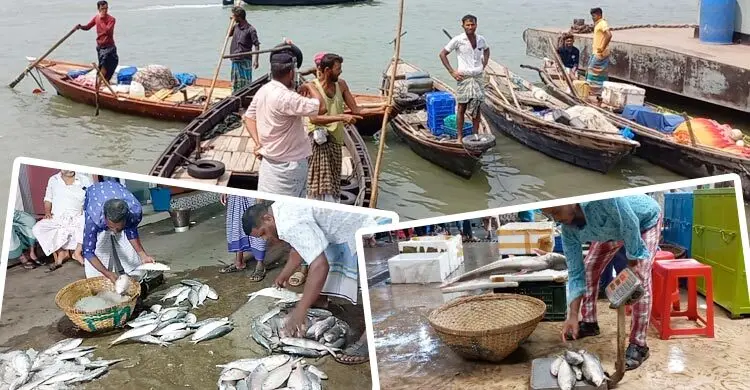
From 10am to midday on Wednesday (1 May), various fish were arriving at the Chandpur fish landing ghat, one of the country's main fish landing centres.
With the ban over, the Chandpur Baro Station fish ghat is busy again, ringing with the calls of traders and workers. Fishers are bringing fish caught in the Padma and Meghna to the wholesale sheds, and traders are auctioning them off.
Fishers are bringing fish by trawler from different parts of Sadar upazila on the two rivers, and many are landing directly at the ghat. Some wholesale traders also brought hilsa from the Harina ferry ghat in Sadar.
Few hilsa, high prices
Jahangir, a fisher from Rajrajeshwar, told Jago News: "I stayed off fishing for two months and went out today. There is little hilsa. I got some chewa fish and brought them to the wholesale shed to sell."
Solaiman, another fisher from the same area, said four of them went out to catch hilsa. What they caught from midnight to morning was small, but selling it would cover their fuel and their own costs.
Moniruzzaman, a buyer from Hajiganj, said fish had started reaching the wholesale market after two months, but hilsa was scarce and therefore expensive, so he had not been able to buy any. He will come back when supply rises.
Several local fishers alleged that some dishonest fishers secretly caught jatka and other fish during the drive, which is why supply is low. They took government support but did not stop fishing, the fishers said.
Kamal Hossain, a trader at Messrs Lutfa Arat, told Jago News that hilsa supply was low on the first day, so prices were high. Hilsa over 1 kg was selling at Tk 2,000-2,200 a kg, 800-900 g fish at Tk 1,600-1,700 a kg and 500-600 g fish at Tk 1,200-1,300 a kg.
Fish trader Omar Faruk said hilsa supply was low but other species had come in. Wholesale prices per kg were: poa Tk 300-320, shrimp Tk 1,000-1,400, small shrimp Tk 600-800, chewa Tk 250-300, large pangas Tk 1,000-1,100, air (long-whiskered catfish) Tk 800-1,000, and small bata and bele Tk 200-250.
Haji Md Shabebarat Sarkar, general secretary of the Chandpur Fish Traders' Cooperative Society, said fishing resumed on Wednesday after two months, but there is no hilsa in the rivers or the sea now, and little chance of getting any in the current weather. That is why supply to the wholesale sheds is low; an estimated 10 maunds of hilsa reached a few sheds that day. There is a chance of hilsa once the season begins in a few days, he said.
Source: Jagonews24. First published in Bengali on The Agro News.

Comments
(0)