
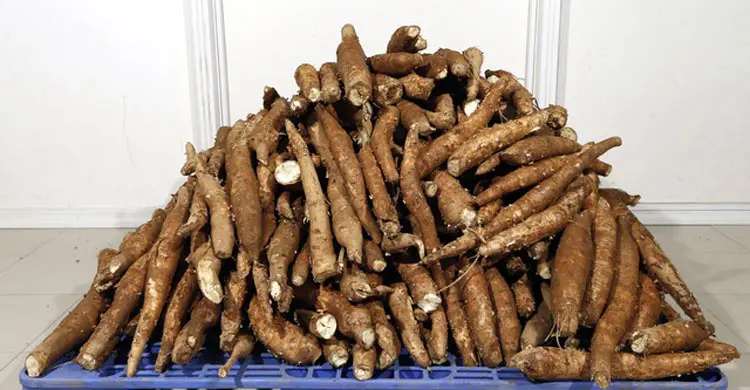
Most people on the African continent live on cassava, but in Bangladesh it is still largely unknown. Although this shrub is not cultivated in Bangladesh, it has long grown wild in hills and forests, and local people have used it for a long time. Villagers call the cassava tuber 'shimul alu', perhaps because the plant's leaves look much like those of the shimul (silk cotton) tree.
Nutrition
Cassava flour is far more nutritious than wheat flour, and besides bread it can be made into many tasty foods. Cassava is also rich in vitamins. It contains more than 10 percent protein, with amino acids and carbohydrates at 10 and 30 percent respectively, plus fructose and glucose. Every 100 grams of edible cassava contains 37 grams of carbohydrate, 1.2 grams of protein, 0.3 grams of fat, 35 mg of calcium, 0.7 mg of iron, 0.09 mg of vitamin A, 36 mg of vitamin C and 146 calories of energy.
Disease prevention
Together with cellulose, cassava provides minerals and the fibre glutamine. Its sticky part helps relieve diabetes and heart disease. Cassava fibre also fights excess cholesterol, and it even plays a role in preventing cancer.
Marketing and processing
If grown properly, cassava could play an important role in the national economy. Several private companies have already begun making and marketing flour and starch from cassava.
Processed cassava tubers yield flour and starch, and the flour can be used for everything from bread to other foods. Up to about 340 grams of flour and starch combined can be produced from each kg of tubers. One hectare of land can yield about 25.5 metric tonnes a year, that is 3,400 kg, of cassava flour and starch.
Food products
Besides bread, cassava flour can be made into papad, chips, noodles, crackers, biscuits, cake and loaf bread. Cassava tubers can be eaten boiled or cooked as a curry with fish and meat.
Raw material for industry
Cassava is not only used for food. Its starch is used as an industrial raw material and is a real substitute for starch imported from abroad. Cassava starch is used in the textile, pharmaceutical and chemical industries, and can also be used to improve the quality of cement and in the paper, glue, cosmetics, rubber and soap industries. It is also used to make maltose, liquid glucose and other converted sugars. Cassava starch can even be used in arms factories as the wax-free mould used in bullet detonation.
Source: Jagonews24. First published in Bengali on The Agro News.
Comments
(0)