
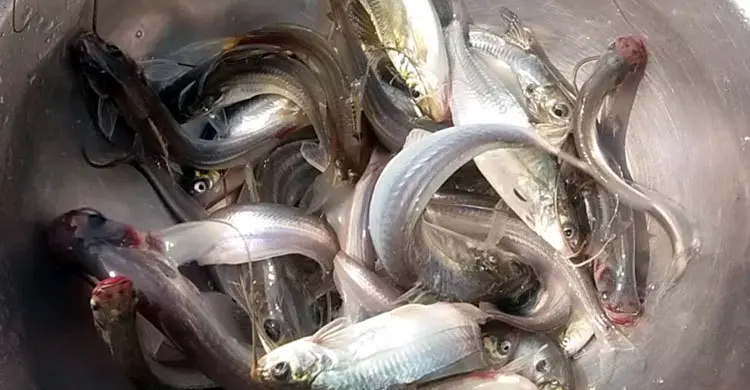
Mixed farming of pabda and gulsha with carp is easy and advantageous. Sultan Mahmud, fisheries officer of Kulaura upazila in Moulvibazar, told Jagonews24 about this low-cost, highly profitable fish farming, which he said can help reduce unemployment and has more advantages than other fish farming.
The benefits, method, care, stocking and harvest times of this farming are set out below.
Advantages
The fish can be farmed in seasonal ponds, perennial ponds and other water bodies. The system ensures food at every level of the pond is used. Several kinds of carp, as well as pabda and gulsha, can be marketed within five to six months. Profits are higher than from farming carp alone, and pabda and gulsha are tasty, so their market price is much higher.
Pond preparation
In the dry season, clear aquatic weeds from the pond and repair the banks. For small fish, the pond should not be dried out, so repeatedly drag a fine-mesh net to remove predatory fish and harmful creatures. Apply 1 kg of quicklime per decimal; the dose varies with soil quality. Before stocking fry, apply fertiliser so that enough natural fish food grows in the pond: 4–6 kg of cow dung, 100 g of urea and 100 g of TSP per decimal is good. When the water turns green or brownish-green, it is ready for stocking.
Stocking fry
Success depends on stocking the right number of healthy, strong fry of good strains and the right species. Before release, acclimatise the transported fry to the pond water temperature, then disinfect them by bathing them for 1–2 minutes in a solution of 10 litres of water with 1 teaspoon (5 g) of potassium permanganate or 100 g of salt.
Stock healthy carp fry of 10–12 cm and pabda or gulsha fry of 5–7 cm according to one of the following models (numbers per decimal as given in the source table):
- Carp-pabda model 1: catla 12, rui 8, mrigel 8, grass carp 2, pabda 70; total 100.
- Carp-pabda model 2: silver carp 8, catla 4, mrigel 8, grass carp 2, sarputi 8, pabda 70; total 100.
- Carp-pabda-gulsha model: catla 8, rui 10, mrigel 10, grass carp 2, pabda 50, gulsha 50; total 130.
Care after stocking
Apply fertiliser regularly, daily or every 7–15 days, to keep enough natural food in the pond. As a general rule, soak 150 g of cow dung or 300 g of compost, 5 g of urea and 5 g of TSP per decimal in water in a container for a day, and spread it over the pond at 10–11am the next day. If fertilising every 7 or 10 days, multiply these amounts by the number of days. Daily application is best, however. Mixing organic and chemical fertilisers and using them in the right amounts regularly gives higher production.
Supplementary feed
The recommended feed mix for carp-pabda-gulsha culture is fine rice bran 40%, wheat bran 20%, mustard oilcake 20% and fishmeal 20%. Mix mustard oilcake soaked for 10–12 hours with dry wheat bran or fine rice bran and roll into balls. Feed 3–5% of the total weight of stocked fish daily, reduced to 1–2% in winter. It is best to give the ration in two feeds a day, and the amount should be set by monthly sampling. Commercial pellet feed from established companies can also be used.
Precautions
If there is mud on the pond bottom, gas may build up. Make a harrow by tying iron or clay sticks or bricks to a rope and drag it slowly along the bottom to release the gas. Once a month, catch some fish to check their health. Feed regularly, top up the water if the level drops, and stop fertilising if the water becomes too green.
Partial and final harvest
Carp and pabda-gulsha do not all grow at the same rate. For more profit, harvest the larger fish so the smaller ones have room to grow: carp that exceed 500–700 g should be harvested and replaced with the same number of fry.
At the end of the year all the fish should be harvested. The timing of the final harvest depends on market prices and the availability of fry for the next crop. After 8–9 months, pabda and gulsha reach 25–30 g and 45–50 g respectively and are ready for sale.
Those interested can contact their upazila or district fisheries office for details.
Source: Jagonews24. First published in Bengali on The Agro News.

Comments
(0)