
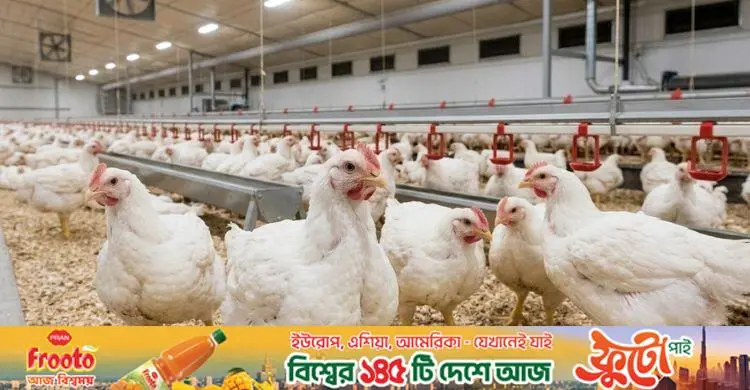
Chickens of many names and breeds are sold in the market today, but the one seen most often is what we commonly call "farm chicken" or "broiler". Because it is relatively cheap, it has become a staple in middle-class diets, satisfying our appetite in curries, fries, tandoori and many other recipes.
Whatever you call it, farm chicken or broiler, there is a long history of evolution behind this bird. It is not an artificially created animal, nor did it appear suddenly. The modern broiler is the result of thousands of years of domestication, decades of scientific research and selective breeding to meet human needs.
From the red junglefowl
The ancestor of this chicken was once a free bird of the forest. Scientists believe the modern domestic chicken descends from the red junglefowl that lived in the jungles of South and Southeast Asia. Today a major food source for billions of people, the chicken began as a wild bird.
People's relationship with chickens goes back thousands of years. Researchers say people in Southeast Asia first began keeping jungle fowl for their own needs. At first the aim was not just food: in many regions chickens were also kept for religious rituals, entertainment and cockfighting.
Over time people realised chickens were not only part of culture or entertainment but could be an important source of eggs and meat. They began choosing birds that laid more eggs, grew faster and adapted easily to living around humans. This continuing selective breeding gradually produced the various modern breeds.
The modern broiler is a type bred specially for meat. It is not a separate species; it was created by selecting birds with particular traits over many generations. Scientists chose chickens that grow quickly, gain more weight on less feed and produce more meat, so today's broiler is ready for market within just a few weeks. There is no magic or secret ingredient behind the fast growth: the main reasons are improved genetic selection, better feed management, modern farm technology and disease control.
The American beginnings of the broiler industry
One episode in the United States stands out in the history of the world's commercial broiler industry. In 1923 Cecil Steele, a farmer in Delaware, began raising chickens for meat. Steele had ordered 50 chicks but by mistake received about 500, and raised and sold them all successfully.
This showed that raising chickens specifically for meat could be a profitable business. Research then began in the United States on breeding fast-growing, high-meat birds. In 1946 the "Chicken of Tomorrow" contest was launched there, aiming to develop a breed that would grow quickly and yield more meat. This work later laid the foundation of the modern broiler industry.
Broilers in Bangladesh
In Bangladesh, chicken keeping was once mainly a small-scale activity for rural families. Native chickens were kept in yards, courtyards and open spaces. They grew slowly and produced relatively little. The modern poultry industry began with the introduction of improved breeds. In the 1960s, research and trials with improved chicken breeds began in what was then East Pakistan, and work on broilers started in poultry research at Bangladesh Agricultural University.
Improved broiler strains began arriving in Bangladesh in the 1980s. Improved broiler lines such as Arbor Acres, along with private-sector investment, played a big role in developing the country's poultry industry. After the 1990s the number of small and medium farms grew rapidly, and broilers gradually became part of ordinary people's daily diet.
Myths about farm chicken
One of the most common beliefs about farm chicken is that the birds are grown quickly with hormones. Scientifically, however, hormones are not the main reason for the broiler's fast growth. Broilers grow fast because of breed selection, improved feed, the right environment, temperature control and health management. Genetic improvement is the biggest factor in the modern poultry industry.
Another misconception is that the broiler is entirely artificial. In reality it is an improved form of the natural chicken, developed through many years of scientific breeding to meet human needs.
Today the broiler is not just a food source but a major economic sector. Farmers, hatchery owners, feed manufacturers, drug companies, transport workers and countless people in the market all work to bring a chicken to market. Bangladesh's poultry industry now provides jobs for hundreds of thousands of people. From small village farms to large commercial enterprises, farm chicken plays an important part in the country's food security and economy.
The story of a small jungle bird becoming today's modern broiler is really a story of human need, science and change in agriculture. Thousands of years of evolution and decades of research have brought farm chicken to our dinner tables.
The story cites the Food and Agriculture Organization, Oxford Academic and the NIH as sources.
Source: Jagonews24. First published in Bengali on The Agro News.

Comments
(0)