
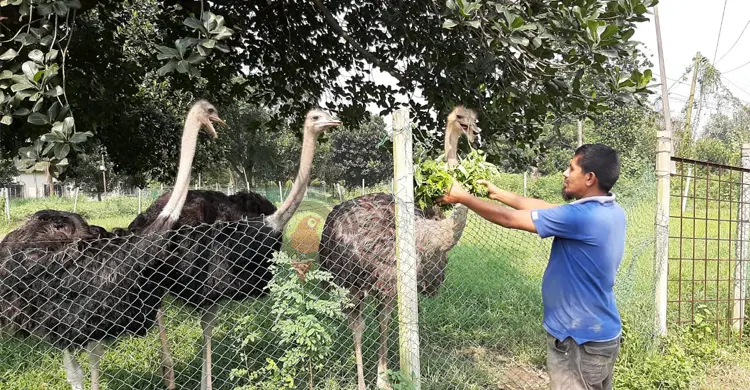
Researchers see great potential in ostriches, alongside cattle, goats and chickens, to meet the country's demand for safe protein. Ostrich meat is halal and the birds are cheap to raise. They grow three times faster than poultry. One ostrich yields more than 150kg of meat, equal to two local cows. If the bird can be farmed commercially, much of the demand for protein could be met.
To strengthen this important source of protein and spread commercial ostrich farming across the country, the Bangladesh Livestock Research Institute (BLRI) is carrying out research, with work under way to spread ostrich rearing nationwide by 2025.
The research is being done under the project to strengthen poultry research and development. The five-year project began in July 2019 and will end in June 2024. Last year BLRI at Savar began rearing 15 ostriches brought from South Africa, and some more were brought about two months ago.
The bird and its meat
The ostrich is the largest of birds, but it cannot fly. It stands seven to eight feet tall and can weigh 150 to 180kg. A herbivore, it lives on grass and leaves, which makes it fairly easy and cheap for farmers to raise.
Animal scientists say poultry includes about 11 species, among them chickens, ducks, quail, geese, pigeons, guinea fowl, turkeys and ostriches, and that technology has to be developed through research. With the future in mind, BLRI has taken up various research activities.
They say Bangladesh is already self-sufficient in meat and, from this year, in eggs. Each person needs 120g of meat a day, and people in the country are getting 126g on average. Against a minimum requirement of 104 eggs a year, each person ate 121 eggs on average according to 2020-21 figures, so the country is self-sufficient in eggs too.
"But if we look at the developed world, people there eat 220 eggs a year on average, and in some countries more. People in Japan eat more than 300 on average. Nutritionists say a person needs 180 eggs a year for the body to function well. So more safe protein must be supplied for mental development, and ostrich meat will play a helpful role here."
How healthy is ostrich meat?
The British Heart Foundation says ostrich meat is good for the heart because it is low in cholesterol and high in omega-3 fatty acids, which are called brain food. That is why the meat's value is being stressed. There are a great many diabetes patients in the world, and the American Diabetes Association recommends this meat for them.
Researchers say ostrich meat is of good quality and healthy. It is halal, and the ostrich is a herbivore, so it has great potential. The ostrich grows almost three times faster than broiler chickens, and its meat could be a very good way to help meet the country's protein needs. It can be called red meat, mainly because of its iron, which is very good for human health, especially for preventing anaemia.
Plan to spread farming by 2025
BLRI plans to spread ostrich rearing across the country by 2025 through trained model farmers in pilot schemes in different regions. As it is a foreign bird, farmers are not being encouraged to take it up widely at the moment.
The researchers said they were taking some time over commercial production and might reach a mature stage next year. "At this moment we are not recommending it for farm-level rearing. Research is going on into what vaccines are needed and what feed is suitable." South Africa is called the hub of the ostrich, and ostriches are also farmed in neighbouring SAARC countries and in Australia, Canada, the United States and a few other countries, which the researchers are also watching.
They said an ostrich starts laying eggs after two and a half years, so the birds they have will lay towards the end of next year. As in other countries, farmers will first be trained, and ostrich rearing will then be spread among poultry farmers at divisional level across the country, so that consumers in different regions can taste the meat. The project runs until 2024, by which time the research is expected to reach a certain stage. In 2025 it will be spread through trained model farmers in pilot schemes in different regions. If the research yields a sustainable technology, farmers will be given a manual and taught everything about rearing.
What will the meat cost?
Because of high prices, low-income families in the country cannot buy beef or mutton, and often these meats do not reach the plates of middle-income salaried workers either. So there is a question over whether ostrich meat will be affordable.
Officials involved in the research said ostrich meat tastes close to mutton and beef. Once the research is complete and farmers come forward, ostrich meat will be available at prices like those of mutton. The price cannot be stated yet, as it will depend on commercial production, but ostrich meat will come within people's reach, they said.
Some young ostriches were brought from Africa two months ago at Tk 15,000 each. The birds brought earlier have grown, and some are now worth several lakh taka. Because it is not readily available, ostrich meat still sells for Tk 1,500 to Tk 2,000 a kg in some places. One ostrich will yield about as much meat as two or three local cows.
BLRI officials said people often eat poultry to get safe protein. Broiler meat is now fairly easy to get and has supplied a lot of protein. But now people's purchasing power is rising, tastes are changing and people are becoming health-conscious. The project's research is going on with all this in mind.
A PhD fellow enrolled at Hajee Mohammad Danesh Science and Technology University is researching the birds. "We want to see how the ostrich's initial data holds up in our environment: how much meat it produces and of what quality, how far there is scope to breed chicks and raise them in our climate, and what feed it should be given."
Project director and DG
Dr Md Sajedul Karim Sarker, the project's director and a chief scientific officer at BLRI, told Jago News that 15 ostriches were first brought for research. "We are collecting research data on the quality of the meat, growth and various tests, to see at what stage the meat quality is best. About two months ago we brought in some more young ostriches. As the bird is not found in this country, I can't just get one whenever I want, like a chick or duckling. It would have been better if the sample were more representative for the research results, but we are gaining experience of rearing methods and management here."
He said this would be the basis for rearing on a large scale later, and some systems would emerge from the research, such as hatching ostrich eggs in their own hatchery to reduce dependence on others, though perhaps not all at once. India, Nepal and Sri Lanka are neighbouring countries with much in common, including culture, and BLRI wants to learn more about how they are developing their farms.
He said a number of people are raising ostriches privately as a hobby in Khulna, Narsingdi, Gazipur and other places. The plan is to spread ostriches across the country by 2025 through trained model farmers in pilot schemes. Model farmers can be developed at the offices of the Department of Livestock Services and the livestock research institute in divisional towns and around the country, where farmers already get services, so that regional farmers benefit.
BLRI Director General Dr Abdul Jalil told Jago News that with ostriches it takes three years; they do not lay eggs before two and a half years. "When the eggs mature we will be able to say what their production will be like. Our ostrich research will complete five years in 2025, and in those five years we will get chicks twice. Then we will be able to say what its weight will be, how much it will grow daily, how it will feed and what its management will be."
He added that BLRI would be able to hand over commercial ostrich production to farmers through training, with the aim of transferring it to farm level, including training, by 2025.
Source: Jagonews24. First published in Bengali on The Agro News.
Comments
(0)