
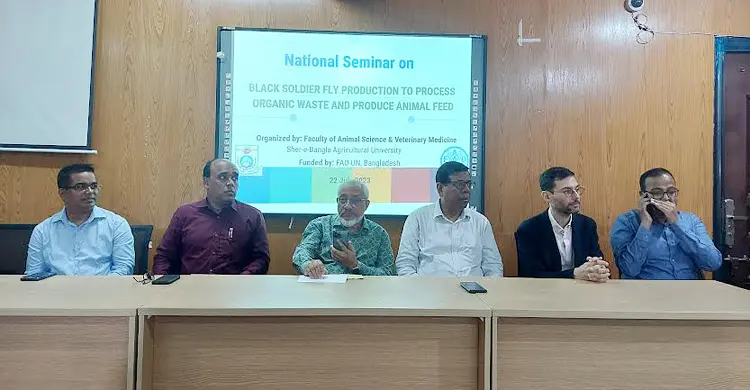
Black soldier fly farming could bring about a radical change in waste management, speakers said. The black soldier fly is an environment-friendly fly that grows by feeding on the organic rubbish around us. The larvae it produces, known locally as "parrot" insects, can supply fish and poultry feed and can be produced naturally at low cost for a profit, while proper management of urban waste would also protect the environment.
Speakers made these points on Saturday (22 July) at a seminar in the ASVM faculty seminar room of Sher-e-Bangla Agricultural University (SAU) on the project "Production of black soldier fly larvae through waste management and use of the larvae as a protein source in fish and poultry feed".
The project was implemented by SAU with funding from the government of the Netherlands and technical support from the UN Food and Agriculture Organization (FAO) and Wageningen University and Research. It is run by chief coordinator and animal nutritionist Prof Dr Md Mofazzal Hossain, contract manager and public health specialist Prof Dr KBM Saiful Islam, and entomologist Prof Dr Md Shakhawat Hossain.
Those at the seminar included SAU Vice-Chancellor Prof Dr Md Shahidur Rashid Bhuiyan, Pro-Vice-Chancellor Prof Dr Alok Kumar Paul, Treasurer Prof Dr Md Nazrul Islam, FAO representative Pedro, and senior officials of Dhaka North City Corporation and feed mills.
Waste that could become feed
Speakers said around 70 per cent of the waste produced every day in the capital's kitchen markets is food- and farm-related. Homes and hotels in urban areas also produce organic waste, part of which lies on the roads or in unauthorised roadside dumps. Dhaka alone produces about 6,000 to 7,000 tonnes of waste a day, though by other accounts it is about 11,000 tonnes, and more than 70 per cent of it is organic.
About half of Dhaka's waste goes to landfill and the rest is left unmanaged, they said. Narayanganj and Gazipur city areas have no landfill, so their waste ends up along roadsides and in rivers and canals. About 80 per cent of this organic waste is recyclable and could be turned into fuel, biogas, electricity, organic fertiliser and fish and poultry feed, yet there is little management of such waste in kitchen markets.
Fish and poultry feed prices have risen sharply, pushing up the market price of fish and chicken, the speakers said. Organic waste could be used to make feed naturally. Large amounts of foreign currency are now spent on imports to meet feed demand; producing larvae from organic waste and making poultry feed from them could reduce dependence on soybean meal. This would strengthen food security, ease waste management, raise incomes and keep feed prices under control.
Black soldier fly larvae are a protein-rich food that can be used in fish and poultry rations. No feed mill in the country has yet started commercial production of poultry rations from fly larvae, and speakers said entrepreneurs and others should come forward.
Research still needed
SAU Vice-Chancellor Prof Dr Md Shahidur Rashid Bhuiyan said the way carbon pollution is rising makes survival on Earth difficult, and it is also raising the planet's temperature, as we have felt in recent years. Using organic waste through this project can reduce pollution and help make the world more liveable, he said, and the project must find out how cheaply safe fish and meat feed can be produced.
ASVM faculty dean Prof KBM Saiful Islam said black soldier flies have been bought and sold in Bangladesh for some time, and the larvae are already used as fish and poultry feed. "Through a pilot project we have scientifically tested everything from waste collection to producing black soldier fly larvae and using them as fish and poultry feed," he said. Detailed research is now needed on whether black soldier flies can be farmed by recycling poultry litter, he added.
Source: Jagonews24. First published in Bengali on The Agro News.
Comments
(0)