

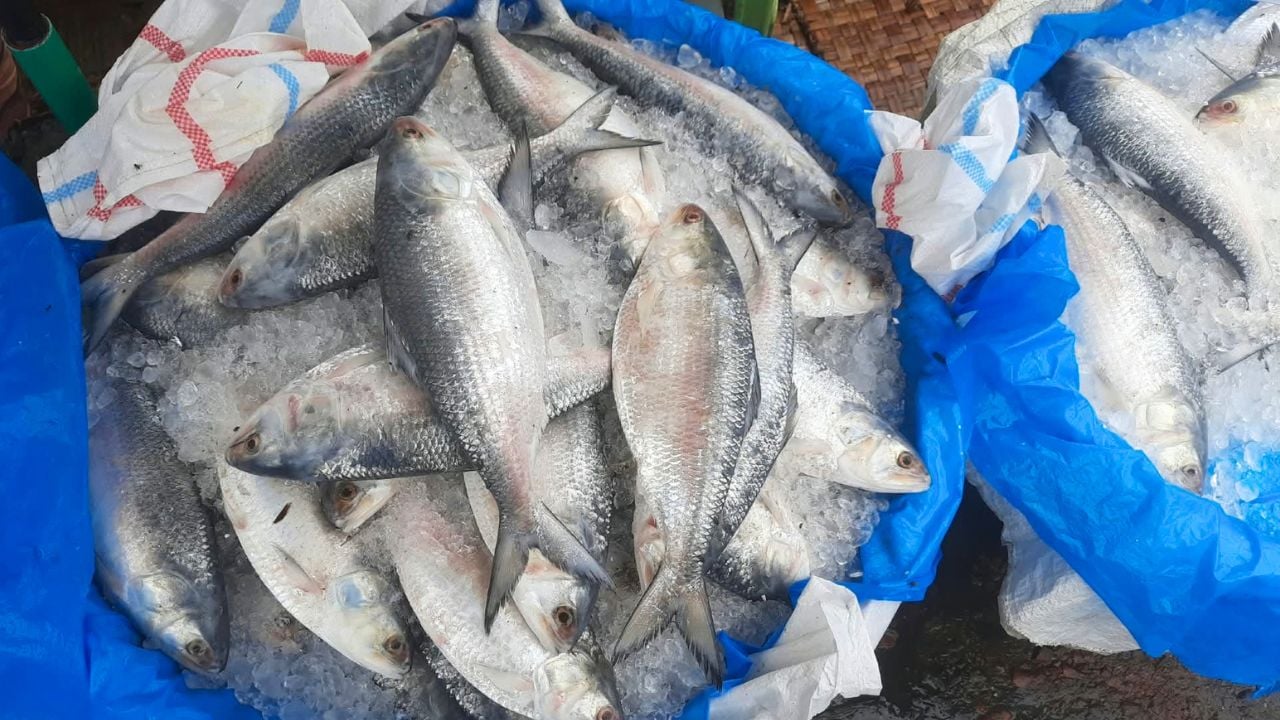
The peak hilsa season begins in August, but the hilsa fishers hoped for are missing from their nets. In past years hilsa were caught in the Meghna and Tentulia rivers from August, but over the last two to three years catches have gradually fallen, and this year there is still no sign of hilsa in September.
Fishers say the peak hilsa season has shifted, and they are demanding that this year's ban on catching mother hilsa be timed correctly.
In fishing villages across Bhola, fishers were seen going out in groups on the Meghna and Tentulia, but despite the season having begun in August, they are not getting the hilsa they hoped for and are returning to the ghats disappointed. Some groups get two or three hali (sets of four) of jatka; others four or five hilsa of 500 to 800 grams. After paying the fuel and tea stall bills, each fisher is left with Tk 50 to at most Tk 200.
Small catches
Md Lokman Majhi and Monir Majhi, fishers from the Bholar Khal area of Shibpur union in Bhola Sadar upazila, said, "The peak hilsa season is on. At around 10:30am, seven of us went out on the Meghna in a trawler and came back to shore around 2pm with just three hali of jatka. We sold them at Bholar Khal ghat for Tk 1,300. After paying for the trawler's fuel and the tea stall, each of us got Tk 50."
Md Karim Majhi and Md Kamal Majhi, fishers from West Ilisha in the same upazila, said that four or five years ago they got hilsa worth Tk 20,000-30,000 a day in August, and even those going out in small trawlers or boats got Tk 10,000 to 20,000 worth. But for two or three years they have not found hilsa in the river in August and September. Now hilsa are found from the start of October.
The fishers believe the peak season has shifted to October, which is why they are not getting hilsa in August. But they do not know why it is shifting.
Timing of the ban
Md Monju Majhi and Md Sharif Majhi, fishers from the Kachia Majher Char area, said the mother hilsa ban was not timed correctly last year, so when they went out after it ended, they caught many mother hilsa full of eggs.
In their view, most mother hilsa could not spawn last year, causing this year's shortage. So they are asking the government to set this year's ban in late October or early November.
Fishers Abdul Hakim Majhi and Ibrahim Majhi said the ban on catching mother hilsa is imposed every year at the full moon of Ashwin. Things have changed, but the timing of the ban has not. For two or three years fishers have asked the fisheries department to set the right time, to no avail.
They say that if hilsa cannot spawn properly, there will be a shortage in the rivers, hurting fishers and costing the government revenue.
Dr Md Anisur Rahman, former senior fisheries scientist at the Bangladesh Fisheries Research Institute (BFRI) and a hilsa researcher, said August and September are considered the peak hilsa season, but changes to the peak season are being seen because of climate change. The trend is seen in hilsa spawning and in the peak catch, especially as rain comes earlier or later. But extensive research is needed on these issues, he said.
Bhola district fisheries officer Biswajit Kumar Deb said the peak season begins in August, and the mother hilsa ban is imposed from the full moon in October. But for the past two or three years fishers have claimed they find hilsa full of eggs even after the ban ends, and have asked for it to be pushed back. This year, he said, he will send a proposal to the ministry covering climate change, the fishers' demands and information gathered in the field.
He added that Bhola's seven upazilas have 1,71,120 officially registered fishers, and this year's hilsa catch target is 1,80,000 metric tonnes.
Source: Jagonews24. First published in Bengali on The Agro News.

Comments
(0)