
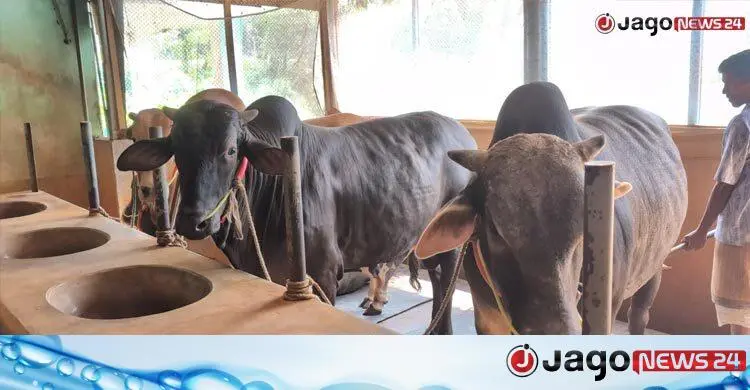
With Eid-ul-Azha approaching, farms in Bhairab, Kishoreganj, are busy with last-minute preparations. Although there are more animals than last year, the more than two thousand farmers have mixed feelings. On one side is the hope of a big profit from more than 28,000 healthy animals; on the other, high cattle feed prices and the fear of cattle imports from India. Farmers say they will make a profit this year if cattle are not imported from across the border.
As every year, 28,538 animals have been reared for the Eid sacrifice on 2,217 farms, large and small, in Bhairab. They include 9,265 bulls, 5,678 bullocks, 2,079 cows, 152 buffaloes, 11,114 goats, 219 sheep and 30 dumbas. The farmers are fattening the cattle entirely by local methods, and no harmful drugs have been used.
More animals than local demand
According to the upazila livestock office, about three hundred new cattle-fattening entrepreneurs have emerged in Bhairab upazila over the past year, and 28,000 sacrificial animals are ready. After meeting Bhairab's demand, animals can also be sold in neighbouring districts and upazilas. Farmers buy the animals from markets around the country a year in advance and begin rearing them. The number of animals fit for sacrifice in the upazila has risen by about 10,000-11,000 on last year, enough to supply other districts too. But farmers say they will profit only if the government does not import Indian cattle.
Siam Ahmed, owner of Sky Agro Farm in the New Town area of Bhairab, fattens and sells 30-40 cattle of different breeds every year for Eid. He told Jagonews24 that feed prices are higher this year, raising the cost of rearing animals. "This year 30 large cattle of Sahiwal, Sindhi, Nepali and local breeds have been fattened on my farm, reared entirely by local methods," he said.
Another farmer, Ashraful Alam Rujen, said: "Every year I fatten cattle on my farm for the Eid season. This year I have fattened 22 cattle. No banned drugs have been used. We rear our cattle entirely by local methods, fattening them on local feed and cultivated grass. So the animals are completely safe and halal. If Indian cattle are not imported this year, we farmers will profit."
Suman Mia, a caretaker at the farm, said four workers look after its 30 cattle, which are fed gram, lentils, maize, rice bran, wheat bran, zinc and silage. No harmful injections are given, he said.
Official view
Bhairab upazila livestock officer Dr Azaharul Islam said 28,000 animals had been prepared on 2,217 farms in Bhairab, 10,000-11,000 more than local demand. "We have encouraged farmers in various ways so that they can profit by selling their animals. The farmers here were under our supervision all year, and they were given the training, advice and veterinary services needed for fattening," he said.
He said feed prices were high this year, so farmers' production costs were higher. If Indian and Nepali cattle are not imported, Bhairab's farmers will be able to make a profit, he said.
Source: Jagonews24. First published in Bengali on The Agro News.

Comments
(0)