
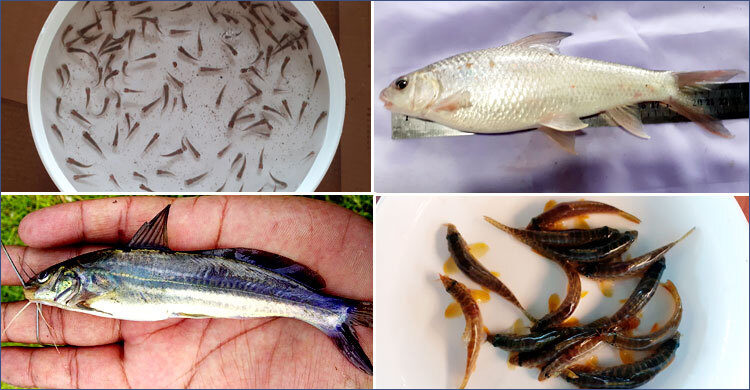
Of the 260 freshwater fish species in Bangladesh, 143 are small fish, and 64 of these had become nearly extinct. Through artificial breeding, the Bangladesh Fisheries Research Institute (BFRI) is bringing these endangered fish back, and successful breeding of 31 species has already been achieved. Three more native small fish, kursha, loitta tengra and botia puiya, are now returning to Bengali plates.
Research is also under way on kajuli, hiralu, native shol and bacha, and it is hoped that farming methods for them can be developed by June–July next year. BFRI researchers have developed farming methods for 31 endangered species, including pabda, gulsha tengra, guji air, chital, foli, mohashol, boirali, balachata, gutum, kuchia, bhagna, kholisha, gojar, rani, batashi and piyali, and handed them to fish farmers.
These fish are rich in vitamins and essential minerals such as calcium, phosphorus, iron and iodine. These strengthen the body's immune system and help prevent diseases such as anaemia, goitre and blindness. Because population growth, shrinking water bodies, over-harvesting and other causes have destroyed the fish's breeding and feeding grounds, small fish are becoming steadily scarcer in natural waters.
Small fish output up fourfold
BFRI officials said total production of native small fish in ponds was 67,340 tonnes in 2009, rising to 2.5 lakh tonnes in the 2018–19 fiscal year, a fourfold rise in 10 years. Native small fish contribute 30–35 per cent of the country's fish production. With farming expanding, hatcheries are now producing fry of native fish on a large scale, and because fry are easier to obtain, pabda, gulsha, shing, tengra, magur and koi are being farmed widely.
According to 2020 data from the UN Food and Agriculture Organization, although the growth of aquaculture production has slowed worldwide, Bangladesh's growth rate over the past decade has been 9.1 per cent. In 2019–20 the country's total fish production reached 45 lakh 3,000 tonnes, 1 lakh 19,000 tonnes more than the previous year.
Research on conserving and developing endangered fish used to be carried out only at BFRI's freshwater research station in Mymensingh. It is now also carried out at the sub-stations in Santahar in Bogura, Saidpur in Nilphamari and Jashore.
Breakthrough at Saidpur
Scientists at the BFRI freshwater sub-station in Saidpur, Nilphamari, developed breeding techniques for three endangered fish in June–July. Dr Khondaker Rashidul Hasan, chief scientific officer of the sub-station, who led the work, told Jagonews: "We have recently developed breeding and farming methods for kursha, loitta tengra and botia. Some fish are on the way to disappearing. Their habitat is being destroyed, and they cannot find places to produce a new generation, so they could vanish in future."
"Now it is the responsibility of our fisheries family to hold on to them. We have already brought back 31 species, of which the Saidpur sub-station alone has brought back nine. These fish were collected from the Teesta river. With our fry-production techniques developed, these fish have been saved from disappearing in future."
BFRI director general Dr Yahia Mahmud told Jagonews that many of the 64 endangered fish had been brought back. In June–July the institute's researchers developed breeding and farming methods for three more, several more varieties will return in the monsoon next June–July, and work is under way on four more.
"On the instructions of the Ministry of Fisheries and Livestock, BFRI's research has recently been strengthened and steps taken to spread it nationwide. Short-, medium- and long-term plans have been made to restore all native fish in phases. The main aim of this research is to bring all endangered native fish back to the dinner table in phases through developing and spreading technology."
A live gene bank for native fish
Last September, a live gene bank for native fish was set up at BFRI for the first time in the country, and it will play an important role in conserving native species. A total of 88 species have been conserved in it, among them bhagna, native koi, napit koi, gulsha, kholisha, lal kholisha, magur, boali pabda, sorputi, puti, shing, mohashol, rui, bujuri tengra, bhita tengra, bata, rita, mola, chela, lomba chanda, ranga chanda, lal chanda, piyali, boirali, darkina, ingla, rani, kakila, kajli, bhacha, batashi, angus, kanpona, ghaura, bheda and bashpata. All native fish will be conserved in the bank in phases, and the conservation work is continuing across the country.
A live gene bank is a modern concept for conserving fish germplasm. A gene bank is essentially a system for preserving the genetic material of an animal or plant, needed when that species is under threat. If any native fish disappears from natural sources, the live gene bank can be used to restore it.
Fisheries and Livestock Minister Sh M Rezaul Karim told Jagonews the government is working to develop and spread farming technology for endangered native fish. Scientists at BFRI, under the ministry, have already developed breeding techniques and farming technology for 31 endangered native species, and research on breeding techniques for several more is continuing.
"For the first time, a 'live gene' bank has been set up in Mymensingh to conserve native fish. Genes of 88 species have already been conserved in this gene bank in Mymensingh, and all native fish will be conserved in it in phases. Thanks to government initiatives, various native fish are now available in the market, and native fish of many flavours are returning to Bengali plates."
Source: Jagonews24. First published in Bengali on The Agro News.
Comments
(0)