
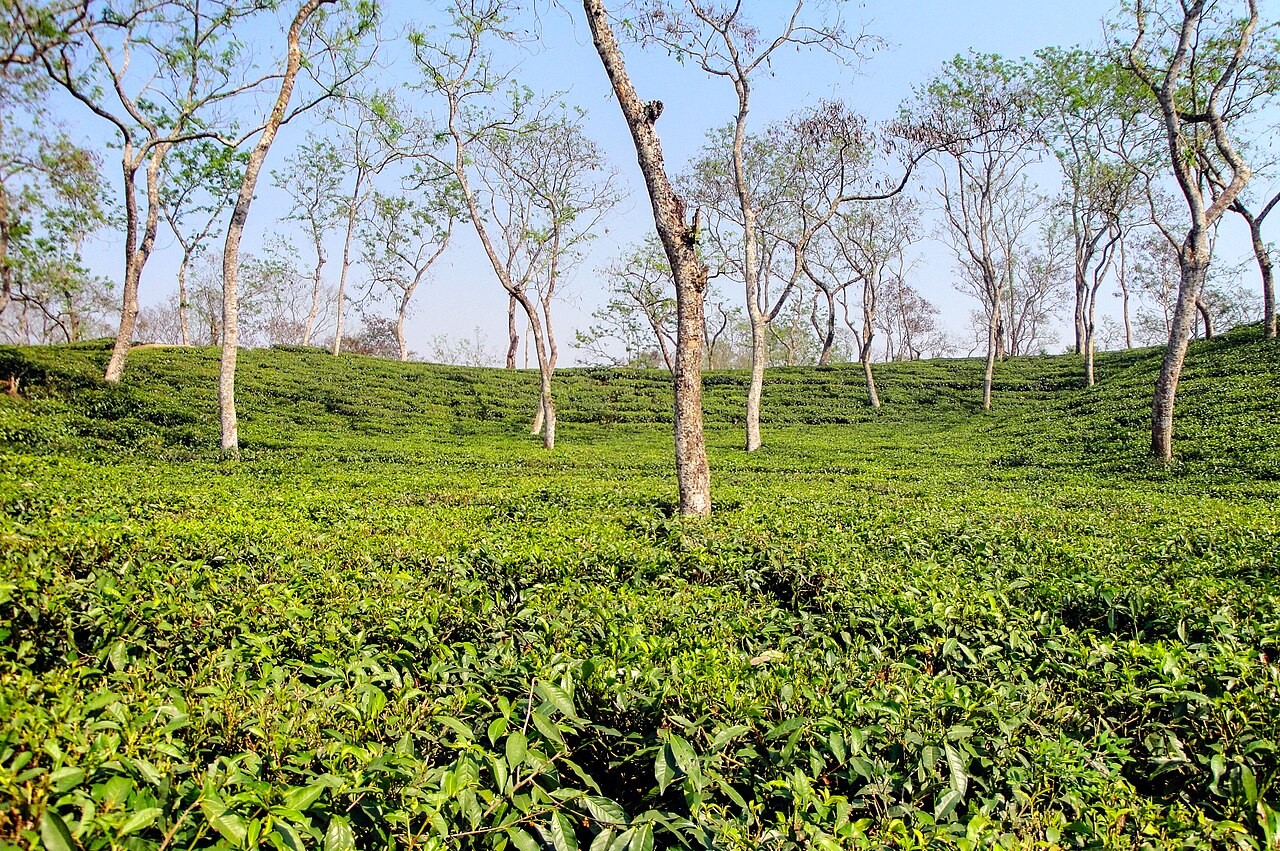
A team of researchers from Bangladesh Agricultural University (BAU) and the Bangladesh Tea Research Institute (BTRI) has identified tea genotypes that can withstand drought. Compared with four other genotypes and a standard variety, B/8/93 proved the most drought-tolerant, while MZ/39 showed good adaptability in the field.
The problem is climate change. Irregular rain, long heatwaves and drought are holding back the emergence of new buds, leaf growth and output in the tea gardens of Sylhet, Moulvibazar, Habiganj and Chattogram. Marketable tea is made from young leaves and buds, so when water shortage cuts root uptake and photosynthesis, yield falls directly. In April 2025, heat and low rainfall damaged tea bushes in the Sylhet region, and in 2024 tea output in five northern districts fell by about 20 percent from the year before.
The study was led by Professor Dr Md Ashrafuzzaman of BAU's Department of Crop Botany and Dr Ismail Hossain, director of BTRI. It tested the genotypes A/17/7, MZ/39, SH/9/65, B/8/93 and A/8/8 alongside the standard BT-2 variety for comparison. In the nursery and the field, soil moisture was held at 36, 30, 24 and 18 percent to impose different levels of drought, and the team measured plant height, root length and spread, dry matter, relative leaf water content, proline, total polyphenols and reducing sugars.
B/8/93 came out as the most drought-tolerant and A/8/8 the most sensitive; BT-2, SH/9/65 and A/17/7 were moderately tolerant. In the field, Professor Ashrafuzzaman said, B/8/93 averaged 67.5 centimetres in height, 7.60 branches per plant and 9.2 grams of green leaf, with total polyphenols of 89.81 ppm and catechins of 23.07 ppm. The paper appears in the Proceedings of the International Tea Symposium, published by Atlantis Press.
The report also sets out the limits: only six genotypes were assessed, the paper does not say that B/8/93 has been approved as a commercial variety, and a genotype that does well in one region is not guaranteed to do the same in the soils and climate of Panchagarh, Thakurgaon or Lalmonirhat. Professor Ashrafuzzaman proposes trials over several seasons in the main tea areas, comparing green-leaf and made-tea yields under normal and drought conditions, testing taste, aroma, colour and quality, costing seedlings, irrigation and growers' income, and demonstration plots with estate owners and smallholders.
According to the Bangladesh Tea Board, the country produced about 94.91 million kilograms of tea in 2025, more than in 2024 but below the 2023 record. Workers, smallholders and traders depend on the industry, and smallholders have little money to invest in irrigation, and the report calls for the Tea Board, BTRI, the agricultural universities and the estates to work together on drought-tolerant seedlings, training and extension.
The report is by Barta24's district correspondent in Mymensingh.
Photo: Moheen Reeyad / Wikimedia Commons (CC BY-SA 4.0)
Source: Barta24
Comments
(0)