
Satla beel is a remote area of Wazirpur in Barishal. People here are marooned by water for almost six months of the year, and with only one crop a year from their land, they live in want. Floating vegetable farming, however, has opened an alternative source of income. Because it is profitable, more than a thousand farmers now grow vegetables this way, and floating vegetables are currently grown on 150 hectares of water in the upazila.
Farmers of Nayakandi, Shibpur, Rajapur, Uttar Satla and Potibari villages in Satla are involved. Local sources say wholesalers in Barishal Sadar, Gournadi, Wazirpur, Banaripara, Agailjhara, Bakerganj and nearby areas used to bring vegetables from Jashore. Now, in winter, demand is met by vegetables grown in Guthia, Jalla, Bamrail and Harta in Wazirpur. But in the monsoon, floating vegetables from Satla are the only option.
An old practice that has spread
No one could say exactly when or how floating vegetable farming began at Satla beel. Bharat Mondal (70), a farmer of Satla village, said: "I have seen floating vegetable farming since I was a child. Our fathers and grandfathers farmed this way. I heard from them that a man named Ramen Baroi first started it here."
Rafiqul Islam, sub-assistant agriculture officer in Wazirpur, said a small amount of floating farming was done in the area 20 to 25 years ago, and it became widespread after 2010. Farmers were later trained through the project "Research, extension and popularisation of vegetable and spice cultivation on floating beds", and the number of growers is rising. Floating vegetables are now grown on 150 hectares.
How the beds are made
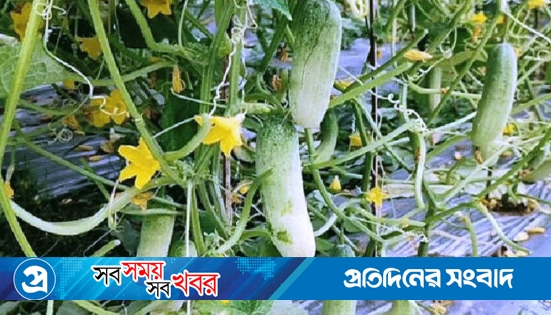
Two bamboo poles or banana trunks are laid lengthwise on the water and water hyacinth is heaped on top. The heap is then covered with algae; some people use coconut coir. Once the algae rot and dry, a little soil is sprinkled on top and seeds of red amaranth, spinach and Malabar spinach are sown. For okra, bottle gourd, cucumber, bean, lafa, spiny gourd, sweet pumpkin and aubergine, the water hyacinth bed alone is enough. The hyacinth is piled high and, once it has rotted, seeds are sown directly on it after five to seven days.
Each bed is made for one season. When the vegetables are finished, the rotted beds are used as organic fertiliser on the land before boro cultivation. A bed 20 metres long and 2 to 2.5 metres wide costs Tk 3,500 to Tk 4,000 to make, and each bed yields Tk 9,000 to Tk 10,000 worth of vegetables in a season.
Farmers' earnings
Shukchand Biswas (48) of South Satla said: "This time I grew vegetables on 10 beds. Making the beds cost Tk 35,000. I have sold Tk 60,000 worth of vegetables, and now I can sell Tk 70,000 to Tk 80,000 worth."
On a visit last Wednesday, floating beds on the water of Satla beel were full of cucumber, spiny gourd, sweet pumpkin, bottle gourd, aubergine, red amaranth, spinach and other vegetables. Besides the beel, vegetables are also grown this way in ponds beside homes.
Shuklal Baroi (45) of Shibpur village said most land in the area grows only one crop and stays under water for about six months a year. Want was constant before, and then he started floating vegetable farming.
"Twice a week I take vegetables to sell at the Bisharkandi and Chowmohoni markets in Banaripara. Sometimes traders come and buy vegetables right from my house. Because these vegetables are free of poison, there is great demand for them," he said.
Anwar Bahadur of the same village said: "Seeing many people in the area growing vegetables the floating way, I started too. It brings a big profit from little capital. People suffer in the monsoon, but for the people of Satla beel it is a blessing."
Source: Prothom Alo. First published in Bengali on The Agro News.
Comments
(0)