
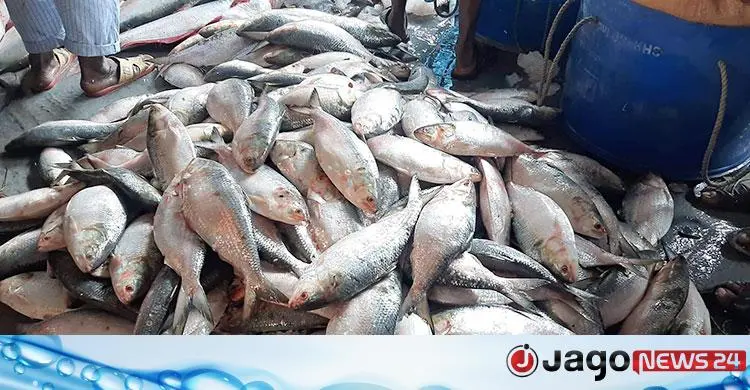
After a long spell of high prices, some relief has returned to Barishal's hilsa market. Supply at the wholesale markets has nearly doubled in the past few days, and wholesale prices have fallen by up to about Tk 20,000 a maund.
The information came from visits on Wednesday (16 September) to Port Road, the city's main wholesale hilsa market, and various retail markets, and from talking to traders, fishermen and buyers.
Traders said small, medium and large hilsa have been arriving in greater numbers for about a week. As supply rose, prices began to fall, bringing some relief to buyers.
Buyers feel the difference
Russell Howlader, shopping at Port Road, said: "A week ago one-kilo hilsa sold for Tk 2,800 to Tk 3,000 a kg. Today the same size is selling at Tk 2,400 a kg." Because prices had fallen, he bought two kilos.
Rezaul Islam, shopping at Bangla Bazar in the city, said: "Last week I bought two hilsa of 700 to 900 grams at Tk 2,500 a kg. The same size is selling at Tk 2,000 a kg today. Sellers say prices fell because supply has increased."
Port Road retailer Nasir Uddin said that last week he bought hilsa running four to a kilo at Tk 1,000 a kg; this week he bought them at Tk 600. One-kilo hilsa he now buys at Tk 2,200 a kg, against Tk 2,800 to Tk 3,000 before.
Wholesale prices by size
Md Zahir Shikder, president of the Port Road Fish Aratdar Association, told Jagonews24: "Last week about 75 maunds of hilsa arrived at the Port Road market. On Tuesday (15 September) about 160 maunds were sold. So supply has more than doubled in a week." If the trend continues, he thinks prices may fall further.
He said that seven days ago hilsa over 1.5 kg sold at Tk 1,50,000 a maund; on Tuesday they sold at Tk 1,20,000. Fish of 1.2 kg to 1.5 kg fell from Tk 1,25,000 to Tk 1,05,000 a maund.
Fish of 1 kg to 1.2 kg fell from Tk 1,10,000 to Tk 96,000 a maund; 700-900 grams from Tk 99,000 to Tk 80,000; 500-700 grams from Tk 85,000 to Tk 70,000; and 400-500 grams from Tk 65,000 to Tk 50,000.
Among smaller sizes, 300-400 gram hilsa fell from Tk 55,000 to Tk 40,000 a maund, 250 gram fish from Tk 42,000 to Tk 30,000, and even smaller hilsa from Tk 32,000 to Tk 20,000.
Call for a later ban
Zahir Shikder said hilsa fishing was halted from 4 October last year. This year fishermen and traders have asked for the ban to start on 30 October, because the hilsa do not yet have roe. If the ban starts in late October, supply may increase further and the price per kg could halve.
Jahangir Alam, a fisherman in Hizla, said there had long been a shortage of hilsa in the river, but for the past four or five days nets had been bringing in more. The hilsa still have no roe, which is why he has called for the ban to come in late October.
Md Kamrul Hasan, director of the Barishal divisional Department of Fisheries, told Jagonews24: "For the past four or five days enough hilsa has been available in Barishal. Almost twice as much is going to the markets as before. With supply up, prices have naturally fallen."
He added: "Meetings on the ban are under way, and the traders' and fishermen's demand will be raised there. The decision on the ban is confirmed only after roe appears in the hilsa."
According to the divisional fisheries office, hilsa production in Barishal division was 3,69,851 tonnes in 2021-22, 3,72,343 tonnes in 2022-23, 3,48,834 tonnes in 2023-24 and 3,34,783 tonnes in 2024-25. In 2025-26 it fell to 2,66,597 tonnes, a drop of 1,03,254 tonnes over five years.
Source: Jagonews24. First published in Bengali on The Agro News.



Comments
(0)