
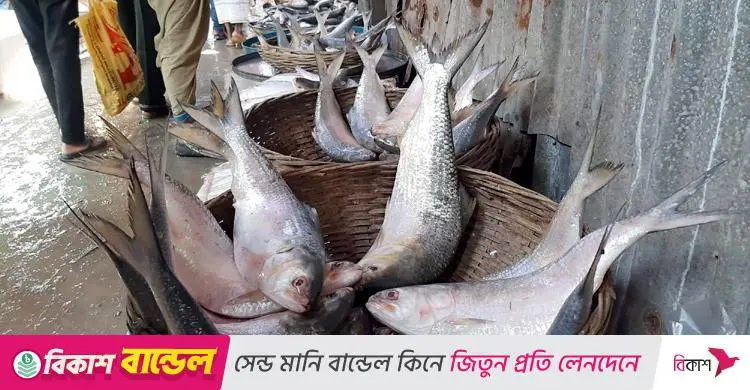
Even in the peak season, not enough hilsa is reaching Barishal's hilsa markets, and ordinary buyers cannot afford what does arrive. Where a thousand maunds used to come in at this time of year, the markets are now getting 150 to 200 maunds. Those involved say prices are somewhat high because supply is low, and will fall when supply rises.
Prices at Port Road
On the morning of Friday, 8 August, at the Port Road fish landing centre, Barishal's wholesale hilsa market, 1kg hilsa were selling for Tk 2,350, 1.5kg fish for Tk 2,800, 700-900g fish for Tk 2,100, 500g fish for Tk 1,200 to Tk 1,500, and small hilsa that run three to a kilogram for Tk 800. Other fish were also expensive.
The district's big landing centre has more than 160 aratdar (wholesaler) houses, but there is hardly any fish in them. Where trawlers laden with fish used to dock every dawn, hundreds of people, including aratdars, labourers and ice-cutters, now sit idle at the ghat.
Md Robin, manager of the hilsa aratdar Messrs Dulal Fish, said that for the past month trawlers have been bringing an average of 150 to 250 maunds of hilsa to Port Road, when thousands of maunds should be coming in at this time. Even a few years ago, the aratdars at Port Road traded 2,000 maunds of hilsa a day in peak season. Less hilsa is coming in for the season, while demand has risen several times over, he said, and that demand is why prices have gone up somewhat.
Buyers' frustration
Saiful, who had come to buy hilsa at Port Road, said his children had begged him to bring hilsa home that morning, but he could not find one he could afford. In the end he had no choice but to buy a 900g hilsa for Tk 1,800.
Saiful Islam is not alone; the same is true of every low and middle-income family. Buyers are frustrated by the high prices, and although hilsa comes from the country's own rivers, some people are on the verge of forgetting its taste.
Another buyer, Sohag, said he had come to the Port Road wholesale market instead of his local market hoping to pay a little less, but found hilsa selling at retail-level prices there too. He bought four small hilsa of 500g each for Tk 2,800. "Things are such that people will soon forget the taste of hilsa," he said.
A buyer named Rabbi said he came for hilsa but could not afford it and bought pangas instead. A 500g-size hilsa now costs Tk 1,500 a kg, up from Tk 500 to Tk 800 before, he said. Pangas has also risen: he paid Tk 280 a kg, against Tk 150 to Tk 180 before.
Another buyer, Murad Hossain, said traders had formed a syndicate and raised prices on the pretext of low supply. "This hilsa is not imported from abroad. It is fish from our own rivers and sea. I see no reason for such a price rise," he said.
Traders and officials
Aratdar Sajib Sikder said there are no fish in the rivers, and fishermen cannot go to sea because of the weather. The little fish that is landed cannot meet demand, which puts pressure on prices.
Md Kamal Sikder, member secretary of the Barishal Fish Owners' Association, said shoals have formed at various points on the Meghna, blocking the movement of hilsa, and rivers are silting up. If the rivers are not protected now, freshwater hilsa will no longer be found in Barishal in future, he said. He added that fish no longer come from Mohipur in Kuakata, because traders there sell hilsa directly to Dhaka and elsewhere; with the Padma and Payra bridges, they no longer need Barishal port. With no fish in the rivers around Barishal either, the business has collapsed, he said.
Barishal district fisheries officer Ripon Kanti Ghosh told Jago News that bad weather this year had somewhat disrupted hilsa catches in the rivers and the sea, which has affected the market. Prices will come down somewhat when supply returns to normal, he said.
Source: Jagonews24. First published in Bengali on The Agro News.
Comments
(0)