
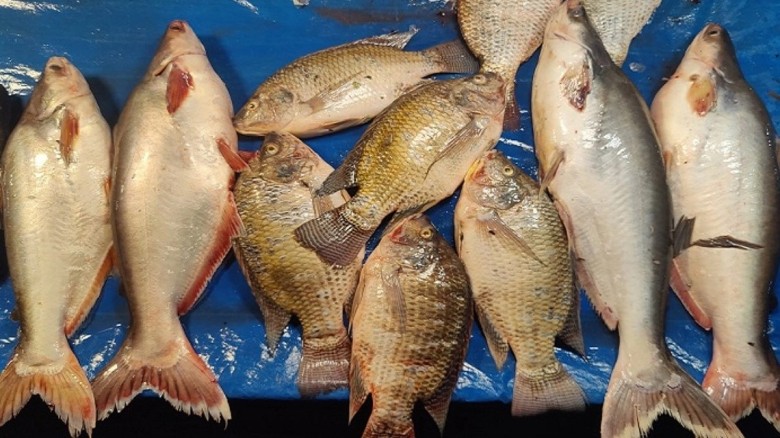
Port Road in Barishal city is the biggest hilsa market (mokam) in Barishal, and its familiar face has changed. At this time each winter the market used to be dominated by sea fish; now fresh hilsa has taken over the whole market. Workers are busy, buyers crowd in and the wholesalers are smiling. The holds of the trawlers anchored at the ghat are full of silvery hilsa.
In winter, Barishal's market is packed with hilsa. The bright, silvery fish are also large in weight and size, and the price is within buyers' reach. Such an abundance of hilsa in the rivers of the south over the past week has surprised traders, fishermen and buyers alike, because nothing like it has happened in this season before.
The country's hilsa experts do not see such abundance in the winter season as abnormal, but rather as a positive development.
M Niamul Naser, a professor in the zoology department of Dhaka University, told Prothom Alo that this is the second phase of the hilsa's breeding period, which happens towards the end of winter. Because conservation has been good, the quantity of hilsa has increased this time and the fish are bigger.
Traders report unbelievable arrivals
Port Road trader Zahir Uddin said: "I have never seen so many, and such big, hilsa arrive in winter. In previous years only a trickle came at this time, and they were small and not well fed. But this time the arrivals are huge, and the fish are big and plump. It seems our good days will return through hilsa."
Traders said 550 maunds of hilsa arrived at the market last Saturday, and the same on Sunday. On Monday it fell somewhat, but about 450 maunds arrived. For this time of year, they said, that is unbelievable.
Ashraf Ali, president of the Port Road fish wholesalers' association, told Prothom Alo: "We did not get many hilsa in the season this year, so fishermen and traders made no profit. But this unseasonal arrival in winter has washed away all our hardship. Prices are low too. Hilsa of 700 to 900 grams are selling at Tk 25,000 a maund, and fish over 1 kg at Tk 30,000 a maund. Hilsa of 450 to 700 grams are selling at between Tk 12,000 and Tk 20,000 a maund in the wholesale market."
Hilsa size and weight are increasing
The Department of Fisheries and the ECOFISH project of the international organisation WorldFish regularly survey the size, weight, breeding and price of hilsa. According to their latest data, the average size and weight of the country's hilsa have increased over the last three years. The average weight of hilsa caught in 2014 was 510 grams; in 2018 it rose to 880 grams. Over the same period the share of medium-sized hilsa (half a kilo to 1 kg) in the catch rose from 40 per cent to 77 per cent, while the share of jatka (young hilsa) fell from 60 per cent to 13 per cent. As a result the average price of hilsa has also fallen by 20 per cent over the past year. The catch of large hilsa out of season points to what the experts had expected.
Output rising, with Barishal the big contributor
Barishal division's wealth in hilsa is steadily growing. Over the past 10 years the hilsa catch in the division has more than doubled, and for several years more than 66 per cent of the country's hilsa has come from this division. Fisheries experts expect it to rise further this fiscal year. Statistics show that in 2018-19 the national hilsa catch rose 4.19 per cent over the previous year, and in Barishal it rose by about 8,000 tonnes. According to the fisheries department, the country's total hilsa catch in 2018-19 was 5,17,188 tonnes, of which 3,32,025 tonnes came from Barishal division. The previous fiscal year's national catch was 4,96,417 tonnes, of which 3,24,297 tonnes, about 66 per cent of the total, came from Barishal.
According to the Barishal divisional fisheries office, Bhola and Barguna supply the most hilsa in the division. Last fiscal year Bhola landed 1,61,832 tonnes and Barguna 70,237 tonnes.
Source: Prothom Alo. First published in Bengali on The Agro News.
Comments
(0)