
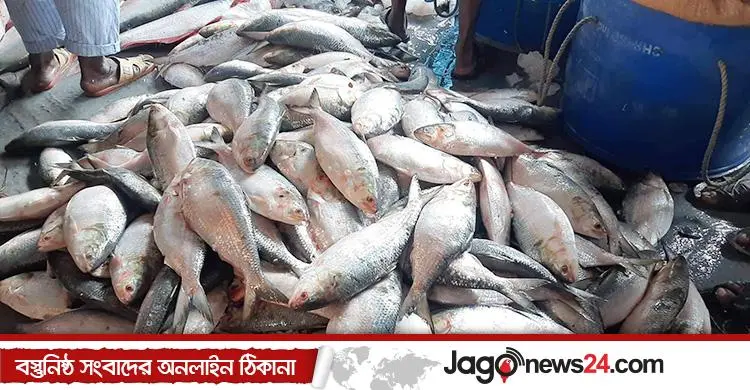
Two-thirds of the year's hilsa catch is landed in July, August and September, and these three months are regarded as the peak hilsa season. This year, in the rivers and sea of Barishal division, 23 percent less hilsa was caught in the peak season than last year, the lowest in four seasons.
From the start of the season there was an acute shortage of hilsa in the country. With low supply in the markets, prices were beyond the reach of ordinary people, and fishermen did not get the catch they hoped for in the rivers and sea. At the end of the peak season the scale of the shortage has become clear.
The figures
According to the Barishal divisional office of the Department of Fisheries, 79,310 tonnes of hilsa were landed in the division in the three peak months this year. In the same period last year the catch was 103,647 tonnes, so this year's catch was 24,337 tonnes (23 percent) lower.
Earlier, 103,797 tonnes were landed in July-September of 2003 (the year as the source gives it) and 105,515 tonnes in the same months of 2022. These figures show that although hilsa production had been falling for three years, the rate was very small: in 2023 the catch was 1,718 tonnes lower than the previous year, and in 2024 it was almost the same as the year before, just 150 tonnes lower. This year's 23 percent fall is a warning sign for the hilsa resource.
According to the Department of Fisheries, hilsa production has fallen alarmingly over the past year not only in Barishal division but across the whole country. Its figures show that the catch in July and August this year was 33.20 percent and 47.31 percent lower respectively than in 2024. In those two months 35,994 tonnes were landed, 22,941.78 tonnes or 38.93 percent less than in 2024.
Ban and jatka protection
Every year, catching is banned for 22 days around the full moon and new moon of the month of Ashwin, the breeding season of mother hilsa, as 80 percent of mother hilsa spawn during this time. Growth of the hilsa resource therefore depends on enforcing the 22-day ban and then the eight-month jatka (young hilsa) conservation programme. This year's ban, which began on 4 October, ended at midnight last Saturday. The eight-month ban on catching jatka will run from 1 November to 30 June.
People involved believe that with the rise of new political forces and a lax administration, the tendency to ignore the ban has grown considerably since last year. When officials tried to stop them, fishermen attacked them instead. The reckless catching of mother hilsa and killing of jatka has hurt this year's hilsa production, and output has fallen as a result.
Molla Emdadullah, director of the Hilsa Resource Development and Management Project, said production has fallen for several reasons, the two main ones being loss of navigability in inland rivers and estuaries, and overfishing. Unless these two are solved quickly, there will be no hilsa, he said.
He said hilsa breed in the rivers around October. Later, between the last week of April and the first week of May, the jatka move to the sea to grow. Most jatka are being killed in the estuaries. The Department of Fisheries has various programmes in the rivers to protect hilsa, but none at sea, so even if production rises in the rivers, the jatka that go to sea are not protected. The project director also acknowledged that attacks by fishermen have increased.
According to the divisional fisheries office, 3,531 drives were carried out in the division's six districts during the 22-day ban that has just ended. There were 1,363 cases, and 893 fishermen were jailed by mobile courts. Last year 3,394 drives were carried out in the 22 days, and 681 people were jailed in 1,057 cases. This means both cases and jail sentences were higher this year than last year.
Source: Jagonews24. First published in Bengali on The Agro News.

Comments
(0)