
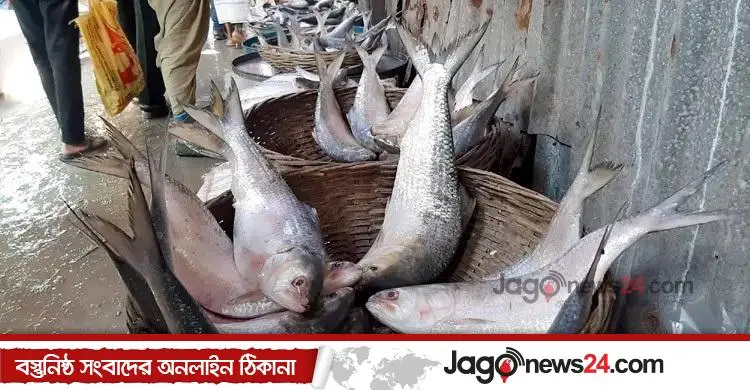
The 22-day drive to protect mother hilsa runs from 4 to 25 October, and more than two weeks have passed. Despite arrests, hilsa fishing has not stopped. Fishermen have fished in defiance of the ban and have launched reckless attacks when stopped. With lax monitoring by the administration, there are doubts about how successful the drive has been.
BBC Bangla has published a field report on the drive. It says that on three rivers in Barishal, fishing with illegal nets had not stopped. When fishermen sense the administration watching or nearby, some flee, while others band together and prepare reckless attacks. The BBC Bangla reporter also faced a hostile situation.
Countless boats were seen on the Kirtankhola and Kalabadar rivers in Barishal. Fishermen set nets secretly and hide nearby. During drives, some run away; elsewhere, attacks with bricks and stones are launched from the boats.
Reporters driven off
When the speedboat hired by BBC Bangla went onto the Kirtankhola, fishing boats tried to flee, thinking it carried officials. But on the Kalabadar river and at the mouth of the Meghna, the fishermen were quite aggressive, and organised groups were seen preparing to surround and attack.
When one fishing boat began throwing bricks, the BBC team tried to speak to them, identifying themselves as journalists, but were forced to withdraw to safety as stones were thrown continuously from the boat to drive the speedboat away.
Fisheries officials say that this year fishermen stopped from fishing have been more aggressive than at any time in the past and are attacking repeatedly.
Mehedi Hasan Bhuiyan, senior fisheries officer of Bhola Sadar upazila, said he had been chased by fishermen on at least five of the drive's 11 days. He said that in the Sreepur area, while the team was lifting nets after chasing off illegal fishermen, 30-40 boats gathered and came to attack them, and the administration's team was forced to withdraw for safety.
Describing a frightening experience on his first drive, he said: "If they catch you, they will kill you. In just 11 days of drives I have been chased on five days; I am just giving you one example. Their boats carry lots of brick pieces, bamboo and weapons. Often there are machetes, and fish spears. They use everything."
"When they throw stones, they all land in the boats. Three people on my boat were injured by stones, and the NDC (additional district magistrate) had his head split open."
"They want to catch us instead"
An official who served as executive magistrate said they were trying to hold the fishermen back as far as possible. "But without logistical support the drives cannot succeed. Without large speedboats, effective drives are not possible in Bhola, because going out in small boats means being attacked," he said.
There have been several attacks in the Hizla and Mehendiganj areas, and the administration says it is not letting up. There is a law allowing firing to save lives, but no such instruction has yet been given. "This is my second drive. I have never seen fishermen this aggressive. This time it has gone beyond limits. Where there was no trouble last time, this time we are coming back after being chased," said Bhola Assistant Commissioner (Land) S M Moshiur Rahman.
A message has reached the fishermen that if they stand together against the administration, the administration is forced to leave, he said, and once that message spreads it becomes hard to control.
Barishal District Fisheries Officer Ripon Kanti Ghosh said enforcement teams had come under attack from the very start this year. "They want to catch us instead; we have noticed this tendency from the beginning this time. There have been several attacks in Barishal, with a major attack in Hizla. Two magistrates and a deputy project director of the fisheries department were injured. In one attack in Barishal a speedboat sank and a weapon belonging to the Ansar was lost."
He said fishermen show some aggression every year, but this year it is greater. "Usually attacks start after 10 or 12 days. But this time we have seen attacks from the first day."
Rice aid and those left out
According to the Department of Fisheries, 7,43,000 fishermen in rivers across 38 districts of Bangladesh are involved in hilsa fishing. Of them, 6,20,000 received 25kg of rice each this year as government aid under VGF cards. By the department's count, 1,20,000 fishermen are outside government assistance.
Palash Howlader, a fisherman hiding after setting a net in the Kirtankhola, said they were fishing out of necessity, and claimed he had received no government aid. "We bought our nets in instalments, and we have to pay those instalments. How will we pay? Everything we have depends on this (fishing). A few days ago they gave 25kg of rice, but I didn't get it. And what they give isn't enough for fishermen anyway."
Asked what would make fishermen observe the ban, he said a system should be put in place so fishermen do not need to go on the river. "Let the government make an arrangement so fishermen can live and eat without casting nets. Then fishermen will never go into the river."
At Bhasanchar in Barishal, the families of fishermen were seen sitting on the bank in about 60 boats. These fishermen complained that most of the families living in the boats are not registered with the government, although they have lived by catching hilsa and other fish since birth. Most of them are outside government aid and registration.
One of them, Shahabuddin Sardar, said they used to get government aid but no longer do. "We haven't got it for the last 17 years. Everyone used to have a card. They say your cards have been cancelled. If we can't fish, we'll have to go without food. That's the truth."
Current nets and jatka
Ibrahim Khalil, a fisherman in Bhola, said he had received the government's 25kg of rice. In his view the ban is not being observed everywhere: there is not as much strictness on the Meghna in the Chandpur stretch as in Bhola. His experience is that hilsa output is falling because illegal fishing has not stopped, and the illegal net known as current net is widely used.
"Drives have to be carried out everywhere. Otherwise there's no chance for the fish to increase. And the current net factories must be shut. It's a dense net. Because the mesh is small, the fish get caught while they're still small. There's no other way," he added.
Two fishermen in Bhola said hilsa output will not benefit unless production of illegal current nets stops. They said catching jatka must also be stopped, because the hilsa are not getting a chance to grow.
"This drive won't help. It will only help if factories stop making current nets. Now officials burn nets and we take loans, join societies, and cast nets any way we can. We'll catch small fish for sure. They have no chance to grow."
Another fisherman, Abdur Rahim, also said stopping jatka catches would increase output. "Fish must be caught with cotton-thread nets. One kind of fish is caught in winter. This 22-day drive is for spawning. After that, around the months of Poush and Agrahayan, there is a fish of five or six inches. If that fish can be protected, output will rise. That fish is the main backbone of production."
Hilsa production was 5,71,000 tonnes in the 2022-23 fiscal year. It fell in 2023-24 to 5,29,000 tonnes. The Department of Fisheries says preliminary figures point to a further fall last year.
Bhola Fisheries Officer Mohammad Iqbal Hossain said any hilsa below 10 inches is jatka, and stopping jatka catches is being given the government's highest priority. The government has set up six hilsa sanctuaries, including the Tetulia river in Bhola, where catching, selling and transporting jatka is banned. Drives against jatka catches run from 1 November to June.
He said: "Fishermen tell us to take action where the factories are. We have informed senior officials that current nets are used most in the Munshiganj area. We keep appealing to the government that if these factories can be closed, the use of these nets will fall." Regular seizures of current net are not solving the problem, he said, because "so much is being produced that it never runs out. The net is very easy for fishermen to get, and cheap."
No joint ban with India
Although Bangladesh runs the 22-day drive to protect mother hilsa in its rivers and sea, it is not coordinated with India. While Bangladesh's coastal areas are under the ban, there is no ban for Indian fishermen.
Department of Fisheries officials say the 58-day sea ban in April is coordinated with India, but there is no coordination on protecting mother hilsa: India does not impose a fishing ban together with Bangladesh for that purpose.
Bangladeshi fishermen allege that many people come from India to fish. In the past there have been cases of Indian fishermen intruding and of fishermen and boats being seized. The Bangladesh Coast Guard, however, says no Indian fishing boat has intruded so far this year.
Lieutenant Md Muttakin Siddiqui, staff officer (operations) of the Coast Guard's southern zone, said they were working with the navy to stop any illegal intrusion. "For now we have no information that any foreign fishing trawler or boat is fishing in the country's waters. The Bangladesh Coast Guard and navy are trying to prevent it through joint drives and intelligence surveillance."
Bangladesh runs three drives a year to protect hilsa, yet hilsa production has been falling steadily for the past few years. Fishermen say jatka must be protected as well as mother hilsa in the breeding season. In their view, increasing hilsa in Bangladesh is impossible unless the ban is strictly enforced and the production and sale of banned current nets used to catch jatka is stopped.
In the first 10 days of the current drive, 4,254 drives and 976 mobile courts were run with various forces, and 53.5 tonnes of hilsa were seized. Mobile courts imposed fines of Tk 38.60 lakh in 1,076 cases and jailed 864 people for various terms. Boats, nets and other equipment used for illegal fishing were also auctioned, bringing Tk 24 lakh into the government treasury.
Source: Jagonews24. First published in Bengali on The Agro News.
Comments
(0)