
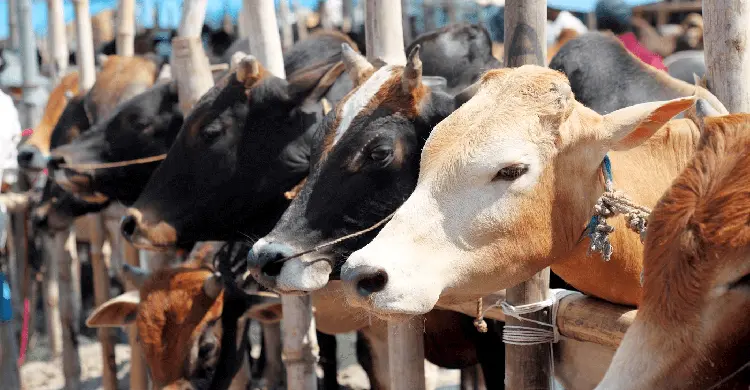
Bangladesh has estimated demand for 10,394,739 sacrificial animals for the coming Eid-ul-Azha, against 12,536,000 livestock fit for sacrifice, leaving a surplus of 2,141,594 animals this year.
Fisheries and Livestock Minister SM Rezaul Karim gave the figures at a briefing at the Secretariat on Wednesday morning (14 June).
The minister said the total number of animals fit for sacrifice this year is 12,536,333, which is 411,944 more than last year. They include 4,843,752 cattle and buffaloes, 7,690,000 goats and sheep, and 2,581 animals of other species.
Animals by division
By division, Dhaka has 895,454 animals fit for sacrifice, Chattogram 2,053,128, Rajshahi 4,511,614, Khulna 1,511,708, Barishal 493,206, Sylhet 410,225, Rangpur 1,962,951 and Mymensingh 698,047, he said.
Rezaul Karim said estimated demand this year is 10,394,739, so there is a surplus of 2,141,594 animals.
He said there is no shortage or crisis of sacrificial animals. As in the past four or five years, demand can be met with animals raised in the country, and there is no need to import any. Strict surveillance is being kept so that livestock cannot enter illegally across the border from the neighbouring country, and the Home Ministry has already been asked in writing to take action.
He added that last year 12,124,389 animals were fit for sacrifice and 9,921,941 were sacrificed.
Safe fattening and animal health
Rezaul Karim said that, as in previous years, the local administration, police and the Department of Livestock Services will work together to ensure cattle are fattened safely, without chemicals, steroids, hormones or antibiotics. The department has trained 72,563 farmers this year in scientific fattening. Regular surveillance will be carried out and mobile courts will be run where needed to stop adulterated feed and the use of banned antibiotics and hormones.
He said department officials had visited 87,095 farms across the country this year to stop the misuse of steroids and hormones. No diseased or sick animals will be allowed to be sold at the markets. As last year, veterinary medical teams will provide first aid for animals across the country, and a central monitoring team and an expert medical team will be formed to monitor their work.
He added that last year 1,623 veterinary medical teams worked at 3,195 sacrificial animal markets. Monitoring teams will be formed and control rooms opened to manage the markets. This year too, law enforcement agencies, district administrations and district livestock offices will work together to keep animals and sellers safe on road, rail and water routes and to prevent the hijacking of cattle trucks.
The minister said that, again this year, farmers who sell animals from their own homes will not have to pay hasil. Farmers who want to take their animals to distant markets cannot be forced to unload them on the way; law enforcement agencies and local government units, including municipalities, upazila and union parishads and city corporations, will ensure this. If someone sells an animal on the way to market, the lessee cannot forcibly collect a toll or hasil from them.
Cashless payments and online sales
He said that, at the initiative of Bangladesh Bank, digital transactions worth Tk 33 crore took place at six cattle markets last year. This year Bangladesh Bank has taken steps for cashless transactions at the cattle markets of Dhaka and Chattogram, through QR codes, smart apps, ATM booths, point-of-sale machines, mobile financial services (MFS) and agent banking. With the help of the Department of Livestock Services, digital transactions have also begun in 26 districts through 10 banks and three MFS providers.
He said 31,799 professional and non-professional butchers have been trained this year in skinning and preserving hides so that animals can be sacrificed hygienically. Steps will be taken to raise public awareness so that, during Eid-ul-Azha, animals are sacrificed at designated places wherever possible rather than anywhere on the roads.
The minister added that, following the past three years, online sales of livestock will continue this time. To prevent online fraud, the owner's name, address and mobile number and the animal's age, weight, price and photo must be included for every animal uploaded.
Source: Jagonews24. First published in Bengali on The Agro News.
Comments
(0)