
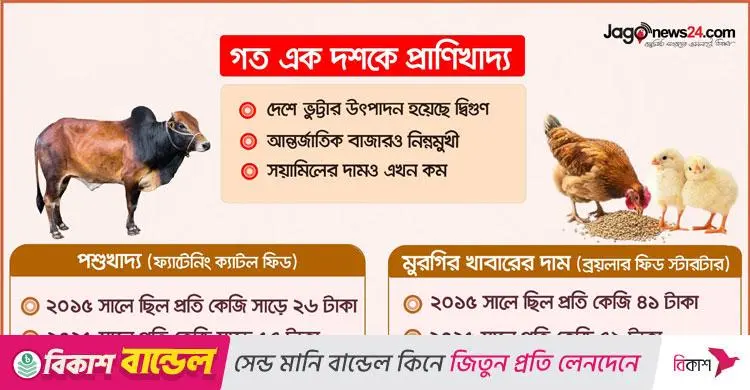
Maize is the main raw material for Bangladesh's animal feed factories. It has become cheaper, yet the price of feed is not falling. Maize cultivation keeps expanding, and domestic maize now meets about 70 per cent of demand.
The other two feed ingredients, soymeal and vitamins, are mainly imported. Their world prices have also been falling steadily since some time after the start of the Russia-Ukraine war. Even so, feed prices in the country are not coming down.
Farmers allege that some companies have formed a syndicate to hold the feed market at high prices. The market, worth about Tk 50,000 crore, is controlled by a handful of companies.
A Tk 50,000 crore market
People in the sector say the country has more than 45 crore livestock, including chickens, fish, cattle, buffalo, goats, sheep, ducks and birds. A significant number are raised commercially and depend on feed, so about 80 lakh tonnes of feed is needed a year.
About 300 registered factories produce some 75 lakh tonnes of feed a year, and more than a hundred unregistered factories produce about five lakh tonnes. About 60 per cent of the feed goes to poultry, 20 per cent to fish, 15 per cent to cattle and 5 per cent to domestic animals and birds.
As the feed market has grown, maize output has risen every year. Local maize meets 70 per cent of the feed industry's demand, and the remaining 30 per cent is imported. According to the agriculture department, the country produces about 65 to 70 lakh tonnes of maize a year, more than double what it produced a decade ago.
Maize production was 27 lakh 59 thousand tonnes in 2015-16 and rose to 68 lakh 84 thousand tonnes in 2023-24. Because of adverse weather, output so far in 2024-25 is about 66 lakh tonnes. About 80 per cent of it is used as feed, as people in the country eat little maize.
Feed mill owners say that when feed mills began expanding in 2008, about 90 per cent of raw materials were imported and the country grew less than 15 lakh tonnes of maize. Now about 70 per cent of needs are met by local maize. But this has had no effect on the feed market: feed prices keep rising, and farmers are making losses because of the extra cost.
Feed prices over ten years
An analysis of one company's market data shows its most widely used broiler starter feed now costs Tk 68.64 a kg. Exactly ten years ago, in 2015, the same feed cost Tk 41.30 a kg. Over the same period its cattle feed doubled in price: fattening cattle feed that sold for Tk 26.50 a kg in 2015 now costs Tk 57.48. The company is well known, but no one there agreed to comment.
Other companies are following the same path. Almost all now sell broiler feed at Tk 60 to 70 a kg, duck feed at Tk 50 to 65, cattle feed at Tk 45 to 60 and fish feed at Tk 55 to 70. Non-branded feed, made in small local factories, is somewhat cheaper.
Much of the profit from the work of lakhs of farmers ends up in feed margins. It costs marginal farmers Tk 150 to 160 to produce a kilogram of broiler; leaving aside the chick, about 80 per cent of the cost is feed, and medicine, vaccines and other costs make up the other 20 per cent.
Farmers allege a syndicate
Sumon Howlader, president of the Bangladesh Poultry Association (BPA), which represents marginal farmers, told Jago News: "After the Russia-Ukraine war in 2022, the companies used it as an excuse to raise feed prices abnormally. Even after the market later returned to normal, prices were not cut. Instead they keep rising."
He said: "Now they talk about the dollar and the cost of importing raw materials, but they do not import the amount they claim. There are enough raw materials in the country now, and prices are falling internationally too. Still, they make excess profits without cutting prices. The BPA believes they make about Tk 10 extra profit on every kilogram of feed."
Rubel Hossain, a farmer in Akkelpur upazila of Joypurhat, said: "When maize costs Tk 36, soymeal Tk 52 and protein Tk 92, how can feed that is 80 per cent maize with a little protein and soymeal cost Tk 70? These companies are running a complete syndicate and taking farmers' profits. That is why farms are closing every day."
World prices back to 2015 levels
The website of international price analyst Index Mundi shows world maize and soymeal prices are now similar to ten years ago, with the volatility of 2022-23 gone and prices falling steadily since. Maize cost $171 a tonne in 2015, rose to as much as $348 in 2022 and has since fallen to $196. Soymeal cost $350 a tonne in 2015, rose to $605 at the end of 2022 and has now fallen to $355.
Millers blame taxes and the dollar
Md Ahsanuzzaman, senior vice-president of the Feed Industries Association Bangladesh (FIAB), said the withdrawal of income tax benefits and advance income tax on raw material imports had put extra pressure on the sector. "We have to import part of our raw materials, and a new 5 per cent advance income tax has been imposed there. Besides, because of the dollar and higher bank interest rates, feed prices cannot be cut," he told Jago News.
There are about 400 registered and unregistered feed mills in the country, but a few companies control the market, setting prices and supply. A report on the feed industry published last March by financial institution IDLC shows Nourish Poultry has the largest share at 10.5 per cent, followed by ACI Godrej with 7.81 per cent and RRP Agro with 7.51 per cent. Paragon and Kazi Farms are fourth and fifth with 7.22 and 6.34 per cent. Next come CP Bangladesh and Quality Feeds, which together hold about 10 per cent.
The BPA's Sumon Howlader said: "These few companies control everything in feed. The domestic market may be large, but feed prices and supply are in their hands."
Shariful Haque, deputy director of the Department of Livestock Services (DLS), told Jago News: "We are working to bring feed prices to a tolerable level. Some feed prices have already come down on the department's instructions, and work is under way to set a fair price for feed."
Source: Jagonews24. First published in Bengali on The Agro News.

Comments
(0)