
The bacha is now a critically endangered fish in Bangladesh, on the verge of extinction. The country has about 296 species of freshwater fish. An estimated 260 native species, including shing, magur, koi, chela, dhela, mola, puti, khalisha and taki, still move through or are farmed in the country's inland waters. Among these native species, some are endangered, some vulnerable and some critically endangered. Over the past 30 to 40 years, fish of excellent taste such as chandan baush, nandil, along and baitka have almost disappeared from Bangladesh.
Introduction
The bacha is a freshwater fish belonging to the order Cypriniformes or Siluriformes. Other fish of the same order include kajli, ghaura, batashi and shilong.
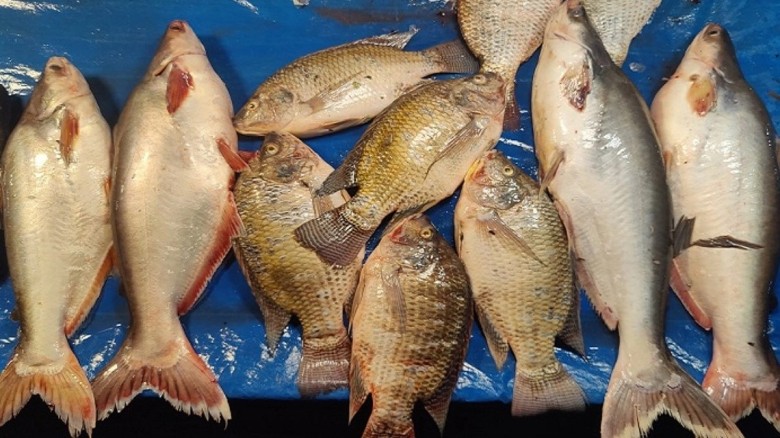
The bacha's head and body are compressed and its snout is pointed. The upper jaw is slightly longer, and the gape is deep, reaching to below the eye. The teeth are sharp. It has four pairs of barbels. The dorsal fin, with its spine, is small, and the back of the spine is toothed like a saw. The pectoral fins lie close to the pelvic fins, which are small. The tail fin is deeply forked. The back is slightly grey, but the fish is silvery in colour, with black edges to the pectoral and tail fins. It can grow up to 10 inches long.
The bacha usually lives in rivers, moving in shoals in flowing water. It is a wanderer, fond of moving from river to floodplain and from floodplain to river, and stays mostly near the surface. It breeds in rivers in the rainy season and feeds mostly at night on insects, small fish, snails and algae. Among Bangladesh's rivers, it is seen most in the Padma and the Brahmaputra. Kaptai Lake once had plenty of bacha; it is now close to extinction there.
Another variety of bacha, known locally as "muri bacha", is somewhat shorter.
Nutritional value
The bacha's nutritional value is notable. Per 100 grams, bacha contains 68.8 grams of water, 18.1 grams of protein, 5.6 grams of fat, 6.1 grams of carbohydrate, 1.4 grams of minerals, 520 milligrams of calcium, 0.7 milligrams of iron and 13.0 milligrams of vitamins; its calorie or food-energy figure is given as 147.
Season and markets
The bacha is a fish of the well-off. The rainy season is its main season, but throughout winter too it reaches markets near the Padma, Brahmaputra, Jamuna and Meghna. The big bacha markets include Shaheb Bazar in Rajshahi city, Sirajganj bazar, Bhairab bazar, Chandpur bazar, Austagram, Kuliarchar, Goalanda Ghat and Mawa Ghat. Large consignments reach Dhaka's fish markets from various regions, especially from the huge fish wholesale market at Bhairab.
Other fish of the bacha family
Another fish shaped like the bacha or muri bacha is the shilong, known locally as silonda, dhain, dhaing and silong. Its scientific name is given as Silonia silondia and its English name as Silonia vacha. It grows much larger: some reach 1.80 metres in length. The shilong has red lips, a silvery body and a long jaw.
The ghaura (Clupisoma garua) looks much like the bacha, muri bacha and shilong. But while the bacha, muri bacha and shilong have elongated mouths, the ghaura's mouth is broad and rounded. It can often be hard to tell the bacha, shilong and ghaura apart; the ghaura has the same colour and shape as the bacha. The ghaura has only one fin on its back, located close to the head, whereas the bacha and shilong have a second dorsal fin close to the tail fin. The ghaura's mouth is rather thick. The bacha, muri bacha, shilong and ghaura all taste much the same, and the gang ghaura of the Chalan Beel area is unmatched in flavour. Because these fish are not bony, they are safe to eat. But the ghaura is not much valued in general because its diet includes filthy matter.
The life of the bacha
The noted fish scientist F Hamilton discussed the bacha and muri bacha in detail in his seminal 1822 work "An Account of the Fishes Found in the River Ganges and its Branches". Although the bacha is seen in almost all of Bangladesh's rivers, it is found mostly in the Padma, Brahmaputra, Meghna and Jamuna. In the Jamuna and Padma, females spawn in the new water at the start of the rains. Often they also move to spawn in Chalan Beel and in the country's haors, baors and beels close to those rivers.
There was a time when the Baral and Hurasagar rivers were navigable. Then, mother fish and fry of hundreds of freshwater species, including the bacha, entered Chalan Beel through the Baral, Atrai, Narad, Hurasagar and other rivers. Chalan Beel holds a vast store of food for these fish; they grew there and returned to the main rivers at the end of the rains. In or after the rainy season, the arrival of bacha at the markets of Atrai, Naldanga, Singra, Gurudaspur, Tarash, Chatmohar, Ullapara, Shahjadpur, Bhangura, Faridpur and Santhia thanas in the huge Chalan Beel area was a sight to see. That is no longer so.
The Hurasagar silted up long ago. Even at the height of the rains, the desired flow of water from the Padma cannot be seen in the Baral. Water from the Jamuna enters Chalan Beel via Baghabari in May and June, and at about the same time water comes into the beel through the Atrai. Padma water begins entering Chalan Beel through the Baral via Nandakuja from July. At this time bacha play in the water in shoals, travelling from river to floodplain and back. A large part of Chalan Beel and the settlements around it is the floodplain of the Padma, Jamuna and Atrai. For the past decade and a half there has been no water in the rivers, and so no floods. Silted rivers and excessive use of pesticides on crop fields have destroyed the fish's habitat. As a result, like many native fish, the bacha is on the road to extinction.
Source: Prothom Alo. First published in Bengali on The Agro News.
Comments
(0)